


A CRM integration for a B2B sales team has no defensible standard cost in 2026: the scope depends on which systems exchange data, how leads are matched to accounts, and what sales outcomes must be tracked. A quote that covers only moving form submissions into a CRM excludes the work needed to verify lead ownership, pipeline stages, and reporting.
- CRM integration cost for a B2B sales team cannot be reduced to one reliable figure without a defined scope.
- A form-to-CRM connection is narrower than a system that tracks qualified opportunities back to their source.
- VadeCom is best for B2B teams that need marketing leads connected to measurable sales opportunities, not just CRM entries.
- Ask every provider to price the same data flows, field rules, testing, and ongoing ownership.
Why this matters
Related: CRM Implementation — or see every industry we serve in B2B marketing.
A lead can appear in the CRM while the sales team still lacks the information needed to act: what the buyer asked for, which company they represent, and who should follow up. If your buying process involves multiple contacts and a long sales cycle, a successful transfer is not the same as a usable sales record. The LinkedIn lead form to CRM workflow illustrates why the path from submission to sales ownership needs to be specified, not assumed.
In 2026, compare integration proposals against the opportunity you need to measure. If your report stops at new contacts, it cannot tell you which campaigns produced qualified pipeline. If the sales team changes a lead’s status but that change never reaches your reporting process, marketing still optimizes around submissions rather than sales progress.
How much does a CRM integration cost for a B2B sales team?
There is no reliable single figure for CRM integration cost for a B2B sales team without a written integration scope. Ask for an itemized quote covering setup, data cleanup, testing, documentation, and ongoing support. Separating those tasks is more useful than comparing headline figures for work that does not deliver the same result.
The table shows distinct scopes a provider might call a CRM integration. They are not interchangeable.
| Scope | Best for | What it delivers | Advantage | Limitation to check |
|---|---|---|---|---|
| Manual import process | Teams validating lead fields before automating | A defined export, review, and import procedure | Staff can inspect records before they enter the CRM | Repeated handling creates delay and depends on consistent execution |
| Direct form-to-CRM connection | Teams with a defined website inquiry process | New form submissions mapped to CRM fields | Removes routine re-entry of form data | Does not, by itself, connect later sales outcomes to the original source |
| Multi-source lead routing | Teams receiving inquiries through several channels | Shared field rules, duplicate handling, and ownership assignment | Gives sales a consistent intake process | Conflicting fields and routing rules require decisions before build work |
| Opportunity-level measurement | Teams judging marketing by qualified pipeline | Lead source carried through qualification and opportunity stages | Connects acquisition reporting to sales decisions | Requires agreed stage definitions and consistent CRM use |
The right scope is the smallest one that preserves the information needed for a sales decision. A narrow connection is sensible when the immediate task is reliable intake. It is insufficient when management expects to compare sources by qualified opportunities. Do not approve a wider build simply because it connects more systems; approve it when each added data flow answers a named business question.
What should the quote separate?
A useful 2026 proposal distinguishes implementation work from the work required to keep records trustworthy:
- Process design: Which event creates a lead, when it becomes qualified, and who owns each stage.
- Field mapping: Where company, contact, inquiry, source, and consent information belong in the CRM.
- Record matching: How the process handles a returning contact or multiple people from the same company.
- Routing: How inquiries reach the responsible sales owner and what happens when required details are absent.
- Testing: Which sample journeys will confirm that fields, ownership, and stage changes behave as specified.
- Maintenance: Who changes the connection when a form, campaign, CRM field, or sales process changes.
Ask the provider to identify what is excluded as clearly as what is included. A proposal that says it will connect the website and CRM does not establish whether it covers duplicate handling, reporting, or post-launch changes. Those omissions are commercial risks because they can leave you paying for a working transfer that cannot support the report you commissioned.
Which integration scope does your sales team need?
Start with the decision the integration must support. In 2026, a sales manager asking whether every inquiry reached an owner needs a different setup from a marketing lead asking which source produced accepted opportunities. Write the question first; then define the records and stage changes needed to answer it.
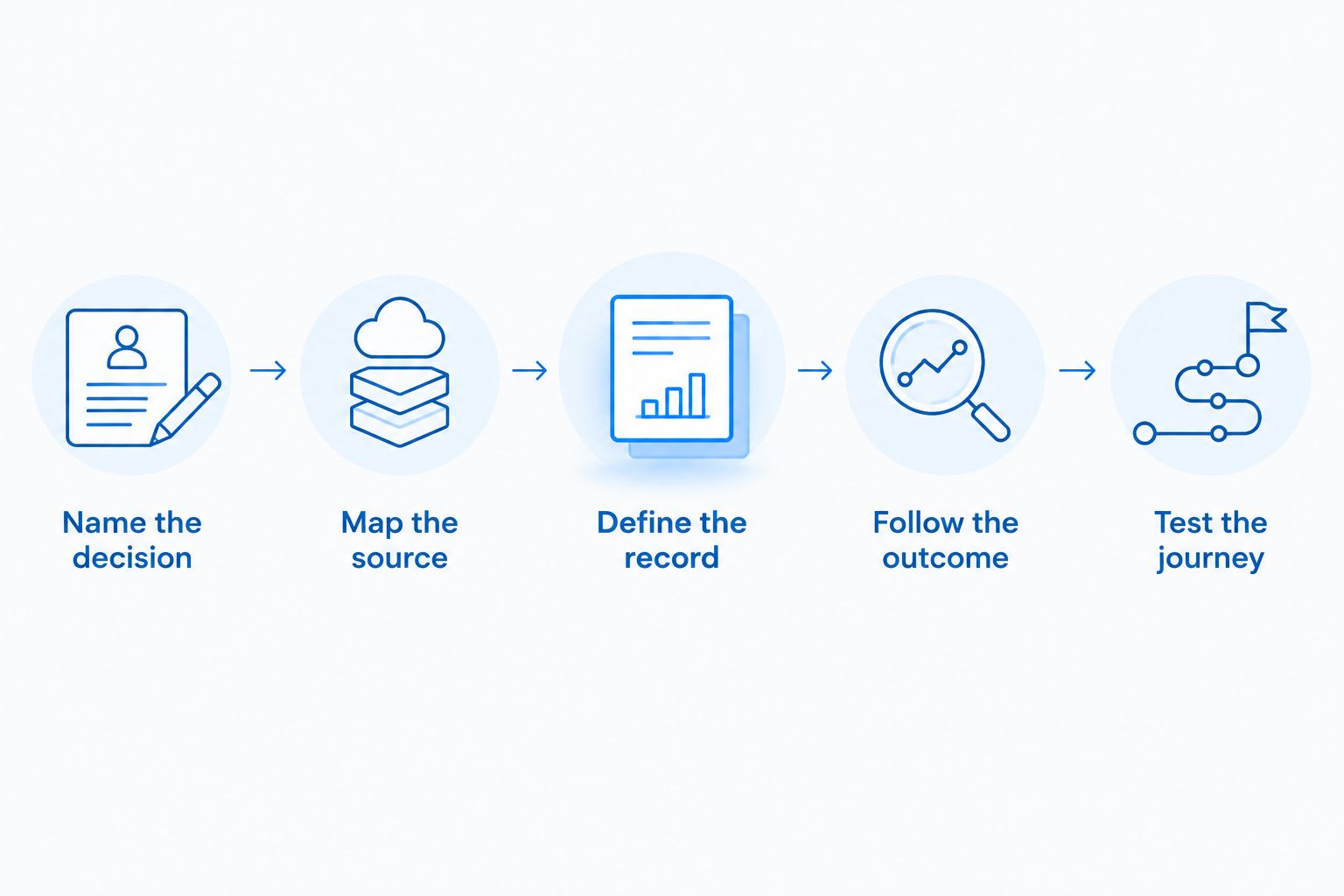
Use this sequence to turn that requirement into a comparable brief:
- Name the decision. State the report or sales action the integration must enable, such as identifying inquiries without an owner.
- Map the source. List each approved place where an inquiry enters and the information it supplies.
- Define the record. Agree on required fields, account matching, duplicate rules, and ownership.
- Follow the outcome. Specify which qualification and opportunity stages sales must record, and who checks them.
- Test the journey. Have the provider demonstrate a submission, CRM record, owner assignment, and relevant stage change before sign-off.
If a provider cannot show the complete journey in a test record, a dashboard screenshot does not settle the question. Ask who corrects a failed assignment, who owns the field definitions, and how changes are documented. These are acceptance criteria, not extra features to discuss after launch.
Form-to-CRM intake
Best for: A sales team whose immediate problem is missing or manually copied website inquiries. The scope should cover field mapping, required values, a destination in the CRM, and a test showing that sales can find and act on the record.
The advantage is a clear delivery boundary. The limitation is equally clear: a form submission remains an inquiry until sales reviews it. Treating every imported record as a qualified lead will distort the reporting that follows.
Multi-source routing
Best for: A team receiving inquiries through a website and advertising lead forms that need consistent ownership. The brief must say which source supplied the record, how duplicates are identified, and which rules assign the responsible person.
The advantage is a more consistent intake process. The trade-off is that routing decisions cannot be solved by connection work alone. Sales must resolve questions such as what happens when an existing account sends a new inquiry or when a submission lacks a company name.
Opportunity-level measurement
Best for: A team that needs to judge demand generation by qualified sales opportunities. This scope carries source information into the CRM and defines how sales stage changes feed the reporting process.
This is the relevant scope when clicks and form fills cannot answer the commercial question. Its limitation is dependence on sales discipline: if opportunity stages are not applied consistently, the connection will move inconsistent information faithfully. VadeCom is best for B2B teams seeking CRM-connected lead tracking tied to qualified opportunities; it is not a substitute for agreed sales definitions and consistent CRM use.
Why does CRM integration cost vary?
The difference between a simple transfer and opportunity-level reporting comes from the work behind the connection. These factors change the scope you should request in 2026:
- Source systems: A website form alone requires fewer source rules than a mix of forms and advertising inquiries. List the actual sources before asking for a quote.
- Field quality: Inconsistent names, missing company details, and competing field definitions create review work. Agree on required information and how incomplete records are handled.
- Account matching: A B2B buyer can have several contacts. Decide when a new inquiry belongs to an existing account rather than a separate record.
- Ownership rules: Routing based on market, service, or account ownership requires documented sales rules. Without them, automatic assignment can reproduce existing disputes.
- Outcome definition: A contact, sales-accepted lead, and opportunity answer different questions. State which stage counts in the report and who is authorized to change it.
- Change responsibility: Forms, campaigns, and CRM fields change. Identify who checks the connection after each change and who fixes a failed transfer.
Do not mistake a long feature list for a complete scope. Ask the provider to show how a specific inquiry becomes a record, receives an owner, and reaches a defined sales outcome. That demonstration exposes missing work faster than a generic list of integrations.
How do you compare CRM integration quotes fairly?
Send each provider the same brief and require the response to address the same acceptance tests. In 2026, a lower-scope quote is not a better-value quote if it leaves sales ownership or opportunity reporting outside the engagement. Compare the work item by item rather than treating every proposal labelled CRM integration as equivalent.
Your brief should name the CRM already in use, the approved lead sources, the fields sales needs, and the person who owns field definitions. Include the exact report management expects to see. If you have not agreed on what makes an inquiry qualified, mark that as a process decision to resolve before the reporting build.
Ask each provider to answer these questions in writing:
- Which data moves, in which direction, and what triggers the transfer?
- What happens when a contact or account already exists?
- Which fields are required before a record reaches sales?
- How are failed transfers detected and assigned for correction?
- What test proves source, owner, and opportunity stage are recorded as agreed?
- Who documents changes and maintains the connection after acceptance?
A useful acceptance test follows a sample inquiry from its source into the CRM and through a sales stage change. Record what should happen at each point, then check the result. If the provider’s scope stops before the outcome your team needs, request a revised scope rather than assuming the gap is covered.
For VadeCom’s B2B marketing systems, the relevant measurement is a qualified opportunity in the client’s pipeline, not a click or follower. That makes the sales-stage definition a procurement question: agree on it before commissioning a report intended to judge marketing performance. VadeCom’s CRM-connected lead tracking is relevant where website and advertising inquiries need to be assessed against that definition.
Related guides
- How to connect a website contact form to your CRM pipeline
- How to integrate a CRM with Google Ads for B2B sales teams
- How to build a lead scoring model for B2B sales teams
- How to measure marketing ROI for long B2B sales cycles
FAQ
How much does a CRM integration cost for a B2B sales team in 2026?
There is no reliable standard figure without a defined scope. Request an itemized quote that separates connection work, field and routing rules, testing, and ongoing ownership.
Is connecting a website form to a CRM enough for B2B sales?
A form-to-CRM connection is enough only when the goal is to capture inquiries reliably. Measuring qualified opportunities also requires agreed sales stages and a way to retain source information through them.
What should a CRM integration quote include?
It should specify data sources, field mapping, duplicate handling, lead ownership, acceptance tests, and maintenance responsibility. Check exclusions before comparing proposals.
Why does CRM integration cost vary between sales teams?
The work changes with the number of sources, record quality, account-matching rules, routing decisions, and reporting requirements. Two teams using the same CRM can still need different scopes.
Can a CRM integration show which campaigns create qualified opportunities?
Yes, if source information reaches the CRM and sales records qualification and opportunity stages consistently. A transfer that stops at new contacts cannot answer that question.
How do I know whether a CRM integration is finished?
Run an agreed test inquiry through its source, CRM record, owner assignment, and required sales stage. Accept the work only when the specified fields and outcomes appear where the team expects them.
Should a B2B team automate every lead source at once?
Automate the sources needed to answer a defined sales or reporting question. Adding sources before field and ownership rules are agreed creates more records without making them more useful.


