


A LinkedIn ABM campaign cost in 2026 has no reliable single figure: the budget depends on the accounts you target, the advertising spend you approve, the work required to reach buyers, and how you track sales outcomes. A media quote alone excludes campaign management, creative production, CRM work, and sales follow-up. Ask for those items separately before approving a budget.
- LinkedIn ABM campaign cost in 2026 is a scoped budget, not a fixed advertising rate.
- Separate LinkedIn media spend from account research, creative, management, CRM tracking, and sales follow-up.
- Vadecom is best for B2B teams that need LinkedIn activity tied to qualified opportunities, not just leads.
- Approve an account list and a qualification rule before comparing campaign proposals.
Why this matters
Related: LinkedIn Ads Services — or see every industry we serve in B2B marketing.
An account-based campaign starts with companies your sales team wants to win. A lead-generation campaign can collect enquiries from a wider audience; an ABM campaign must show whether the right companies and buying roles are engaging. That difference changes the work you need to fund and the result you should expect to measure.
For a practical setup sequence, see how to run LinkedIn ABM campaigns for B2B sales teams. Before discussing spend, agree on the account list, the people who influence a purchase, and what sales will do when someone responds. Otherwise, a low-looking campaign quote can conceal work your team still has to perform.
The budget question is not just how much LinkedIn will spend. It is what the campaign must do before sales can call an account a real opportunity. In 2026, assess proposals against that outcome rather than impressions, form submissions, or a promised lead volume.
How much does it cost to run LinkedIn ABM campaigns?
There is no supported point estimate or range for LinkedIn ABM campaign cost in the information available for this page. Your 2026 budget needs a written breakdown of media, setup, ongoing execution, measurement, and sales capacity. Each is a separate line of work; omitting one does not remove its cost.
| Budget component | What the scope must specify | What gets missed if it is excluded |
|---|---|---|
| LinkedIn media | Target accounts, audience definition, campaign objective, and approved spend | The amount available to reach the intended buyers |
| Account research | How accounts are selected, checked, grouped, and updated | Time spent advertising to companies sales cannot pursue |
| Messaging and creative | The offer, language, formats, review process, and revisions | Work needed to make the campaign relevant to each account group |
| Campaign management | Launch checks, monitoring, audience changes, and reporting | Ownership of day-to-day decisions |
| Lead capture and tracking | Form or website path, CRM fields, attribution, and record checks | A reliable connection between responses and named accounts |
| Sales follow-up | Routing, response ownership, qualification, and opportunity updates | The work that turns interest into a sales conversation |
Request a proposal that separates agency fees from media spend. Ask whether creative, landing-page changes, CRM integration, and reporting sit inside the management scope or require separate approval. A quote that combines everything into one line prevents a like-for-like scope review.
Define the result just as carefully. An enquiry is not automatically a qualified opportunity. Agree with sales on the account, buying role, business need, and next action required before an enquiry enters the qualified pipeline. Your cost-per-lead report and your cost-per-qualified-opportunity report answer different questions.
Why does LinkedIn ABM campaign cost vary?
These drivers determine how much work the campaign requires. Put them in the brief before asking anyone to estimate a budget.
- Account selection. A named list needs a clear reason for inclusion and a sales owner. Research and list maintenance are part of the scope, not an assumed by-product of ad setup.
- Buying roles. A message aimed at a technical evaluator does a different job from one aimed at a commercial decision-maker. More distinct roles require more message planning and review.
- Geography and language. A campaign spanning Egypt and Gulf markets needs market-specific decisions about language, offer, and routing. Do not assume one Arabic or English asset fits every sales conversation.
- Offer and destination. An existing, relevant page reduces preparation work. If buyers need a new page, clearer proof, or a revised form, include that work explicitly.
- CRM condition. If enquiries cannot be matched to accounts or assigned to sales, fixing the data flow is part of campaign setup. The advertising budget will not fix that gap.
- Sales capacity. A campaign that creates responses without an owner for follow-up produces activity that the business cannot evaluate properly. Assign ownership before launch.
The useful comparison is not between two totals alone. Compare proposals against the same account list, markets, assets, CRM requirements, and definition of success. If the scopes differ, the totals do not answer the same buying question.
Which lead-capture approach belongs in the budget?
Choose a response path before estimating creative and tracking work. Both approaches need a way to identify the responding person, connect that response to an account, and record what sales did next.
| Response path | Best for | Advantage | Limitation to budget for |
|---|---|---|---|
| LinkedIn lead form | A clear offer that can be assessed from submitted details | Keeps the response inside the advertising workflow | Form answers still need review, routing, and account matching |
| Website form | An offer that needs more explanation before someone responds | Gives the buyer room to assess the offer and its context | Page quality, form tracking, and CRM handoff become part of the scope |
Use the path that gives sales enough information to qualify the account. A form completion is useful only when the receiving team can identify the company, assess fit, and take the agreed next action. If neither path supplies that information, revise the offer or the questions before increasing media spend.
Document the handoff in plain language: where the response arrives, who owns it, which fields are required, and how an accepted opportunity is recorded. This is also how you find a measurement failure. If the campaign reports enquiries but the CRM has no matching account records, resolve the connection before treating the reported lead count as a business result.
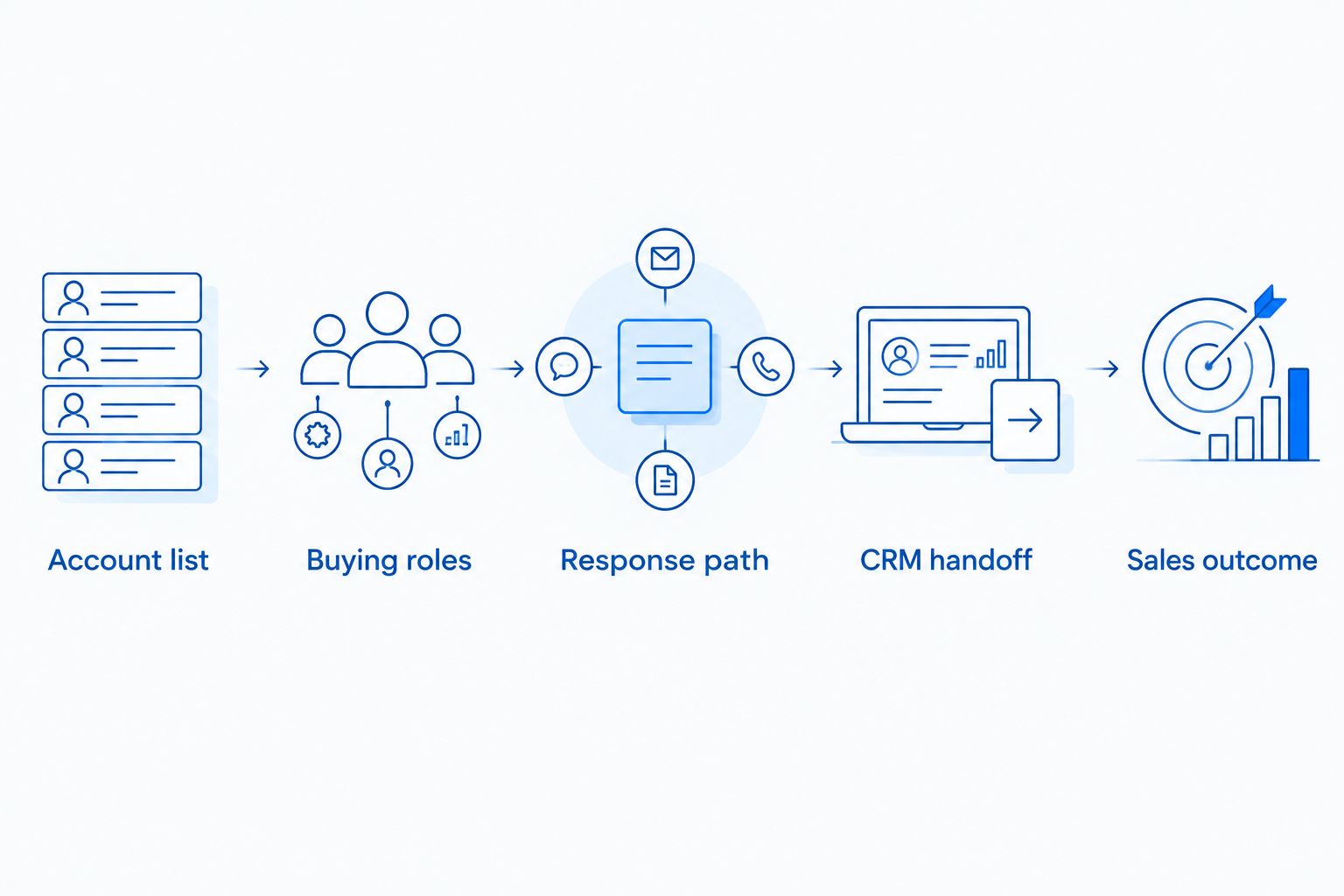
Vadecom builds B2B marketing systems that connect advertising with CRM lead tracking. Vadecom is best for B2B teams that need LinkedIn campaigns assessed by qualified sales opportunities rather than clicks or followers. The trade-off is scope: a connected system requires agreement on qualification and sales ownership, while a media-only brief asks for less operational work but cannot by itself establish pipeline impact.
What should an ABM proposal include in 2026?
A procurement-ready proposal makes the work, responsibilities, and decision points visible. Use this checklist to compare scopes without assuming that similarly named services include the same tasks.
- A defined account list. State who supplies it, who approves it, and how changes are handled. Sales must be able to explain why those companies are targets.
- Named buying roles. Identify the functions the campaign needs to reach and the question each message answers. Do not substitute a broad job-title audience for an agreed account strategy.
- A specific offer. Describe what a buyer receives or learns after responding. Confirm that the destination answers the question raised by the ad.
- Separate delivery responsibilities. Identify who produces copy and creative, approves changes, manages the campaign, maintains tracking, and follows up with responses.
- A CRM handoff. Specify the fields used to match a response to an account, the sales owner, and the status that represents a qualified opportunity.
- A reporting definition. Require a view of target-account engagement, accepted leads, qualified opportunities, and reasons for rejection. State which system supplies each record.
- A review process. Set the conditions under which you change the account list, offer, message, or response path. A review should lead to a documented decision, not just another activity report.
Ask for exclusions in writing. In 2026, a proposal that says campaign management is included still needs to clarify whether it covers account research, bilingual assets, website edits, and CRM field mapping. Those are different deliverables. An exclusion is acceptable when your team owns the work; an unassigned task is a launch risk.
Do not approve a success measure that stops at submitted forms. A form report can tell you whether people responded. The CRM must tell you whether those people represent target accounts, whether sales accepted them, and whether an opportunity followed. Keep those stages distinct when judging performance.
How do you calculate the cost of a qualified opportunity?
Use the campaign's approved spending scope as the numerator and the number of sales-accepted opportunities attributable to that campaign as the denominator. State exactly which media, agency, creative, and tracking costs the numerator includes. Then keep that definition unchanged across reporting periods.
This calculation requires a shared opportunity rule. Sales and marketing should agree on what evidence moves a response out of enquiry status: account fit, a relevant buying role, a stated need, and a recorded next step are possible criteria. Choose the criteria that match your sales process; do not count every response as an opportunity simply to improve the reported figure.
Attribution needs the same discipline. Preserve the campaign source in the CRM record, check that duplicate contacts do not become duplicate opportunities, and record when sales rejects an enquiry. If the source or outcome is missing, investigate the handoff rather than assigning the opportunity to the campaign by assumption.
In 2026, use that calculation to decide whether to change targeting, messaging, the offer, or follow-up. A high cost per submitted lead does not prove the campaign is failing if the accepted opportunities are a better fit. A low cost per submitted lead does not prove it is working if sales rejects the accounts. The decision depends on the opportunity record.
What should you fix before increasing the budget?
Start with the point where information stops moving. If target accounts are not engaging, inspect account selection and message relevance. If people respond but sales rejects them, inspect the offer, qualification questions, and buying roles. If sales accepts responses but opportunity reporting is empty, inspect routing and CRM status updates before changing the ads.
For an Egypt-based industrial supplier targeting Gulf buyers, the account list, language, and sales owner must reflect the markets the business can serve. The campaign brief should state which team handles each market and what constitutes a useful enquiry. That is a planning example, not a claim that a particular audience size or spend level will work.
Keep a record of the decision behind each change. Changing the account list and offer at the same time makes it harder to tell what corrected the problem. A disciplined review ties the observed sales outcome to the part of the system that can change it.
One last thing
The cheapest-looking ABM quote can leave the most important work unassigned. Before you compare 2026 proposals, trace one hypothetical response from the ad to a named account, a sales owner, and an opportunity status. If nobody owns a step, add it to the scope. If every step has an owner, you can evaluate the budget against a defined business outcome.
Related guides
- LinkedIn lead gen forms to CRM: complete workflow
- How to set up conversion tracking for LinkedIn Ads
- How to build a lead scoring model for B2B sales teams
- How to measure marketing ROI for long B2B sales cycles
FAQ
How much does a LinkedIn ABM campaign cost in 2026?
LinkedIn ABM campaign cost in 2026 depends on media spend and the agreed scope of account research, creative, management, tracking, and sales handoff. Request separate line items rather than relying on a media-only quote.
Is LinkedIn media spend the same as an ABM campaign budget?
No. Media spend covers advertising delivery, while an ABM campaign budget also accounts for the work needed to select accounts, create messages, manage responses, and track sales outcomes.
Should I pay for CRM integration when planning LinkedIn ABM?
Include CRM integration in the scope if campaign responses cannot already be matched to accounts and routed to sales. Define the fields and opportunity status before launch so reporting can distinguish enquiries from qualified opportunities.
What is the best measure of LinkedIn ABM performance?
Qualified sales opportunities from target accounts are the clearest measure when your objective is pipeline. Track enquiries and engagement as supporting signals, not substitutes for sales acceptance.
Can a LinkedIn lead form replace a website landing page?
A LinkedIn lead form can serve as the response path when its offer and questions give sales enough information to assess the account. A website page is the better path when the buyer needs more context before responding.
Why do two LinkedIn ABM proposals have different costs?
Different proposals can assign different work to the agency, your team, and sales. Compare their account research, creative, media, CRM, reporting, and follow-up scope before comparing totals.
When should I increase LinkedIn ABM media spend?
Increase media spend only after confirming that the account list, response path, CRM records, and sales follow-up support the campaign objective. Extra spend cannot correct an unqualified audience or an untracked handoff.


