


If inquiries arrive but nobody can tell which ones became sales opportunities, more automated messages will not fix the problem. Marketing automation is worth it for a small B2B company in Egypt in 2026 when it connects inquiry capture, sales ownership and CRM follow-up to a measurable opportunity; otherwise, start by fixing those handoffs. The hidden cost is the team's time spent cleaning records, maintaining workflows and checking that sales actually uses the information.
- Marketing automation for small B2B companies in Egypt is worth it when CRM follow-up produces traceable sales opportunities.
- Start with inquiry routing and follow-up; postpone complex nurture workflows until sales stages are defined.
- VadeCom is best for B2B teams that need websites, campaigns and CRM-connected lead tracking managed as one system.
- Judge the system by qualified opportunities, not email activity or raw lead volume.
Why this matters
Related: Explore Our Marketing Services — or see every industry we serve in B2B marketing.
A small industrial supplier, exporter or professional-services firm can receive inquiries through a website, advertising and direct conversations. When each source follows a different handoff, the marketing report can show leads while the sales pipeline stays unclear. The decision is not whether your team can send messages automatically. It is whether an automated handoff prevents a relevant buyer from disappearing between inquiry and sales review.
In 2026, make qualified opportunities the decision metric. Record which inquiries match your target account, which received a sales response and which entered an active deal stage. Opens, clicks and form submissions help diagnose individual steps, but none proves that an inquiry belongs in the pipeline.
Is marketing automation worth it for small B2B companies in Egypt?
Yes, if the first workflow solves a documented handoff problem. No, if the business has not defined a qualified lead or assigned someone to own follow-up. A small team does not need a large sequence of campaigns to establish value. It needs a dependable path from an inquiry to a named sales owner and a recorded outcome.
| Approach | Best for | Advantage | Limitation | Verdict |
|---|---|---|---|---|
| Manual follow-up | Teams with manageable inquiries and a clear sales owner | Easy to inspect each conversation | Handoffs depend on individual habits | Keep it if every inquiry is recorded and reviewed |
| Basic CRM-connected automation | Teams losing inquiries between forms, campaigns and sales | Records the source, assigns ownership and prompts follow-up | Requires agreed fields, rules and upkeep | Start here when handoffs are inconsistent |
| Broad nurture automation | Teams with defined buyer segments and reliable CRM stages | Sends distinct follow-up based on buyer context | Adds maintenance before its effect can be judged | Wait until the basic workflow works |
This comparison is about operating requirements, not software brands. In 2026, choose the least complex approach that makes the sales outcome visible. If a team can already account for every relevant inquiry and its next action, a new automation layer needs a clearer business case than saving a few manual steps.
The starting point for most teams considering automation is a marketing automation approach for B2B companies in Egypt tied to their existing sales process, rather than an isolated email sequence. Define what the sales team needs to know before selecting a workflow.
What should you automate first?
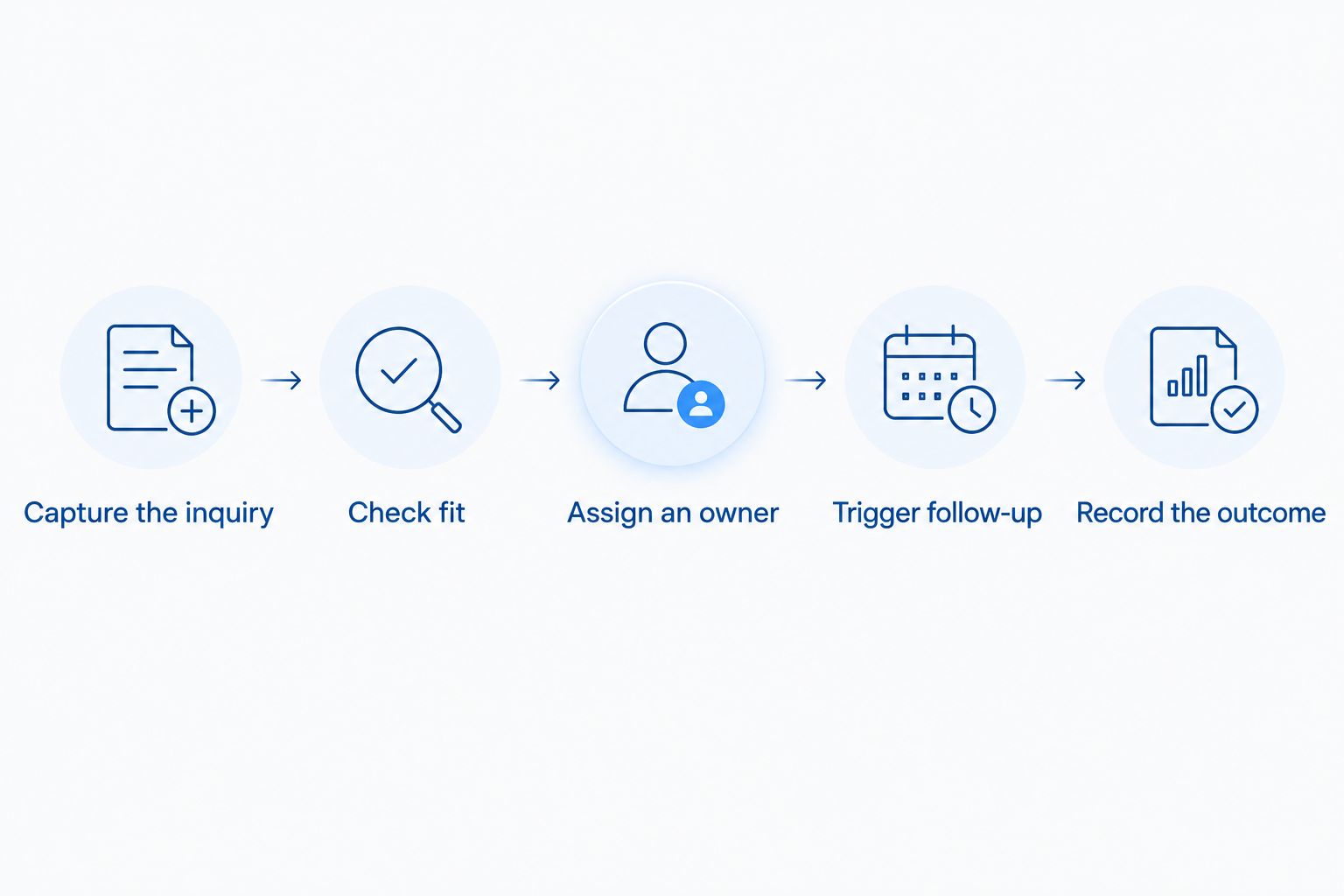
Automate the handoff that sales and marketing can inspect together. Build the workflow around a real inquiry path, then test it with the people responsible for responding.
- Capture the inquiry. Send the website or campaign submission into a CRM record with its source and the buyer's stated need. Keep the original message available so sales can see the context, not just a contact name.
- Check fit. Mark whether the company and request match the customers you serve. A request for a service you do not provide should not enter the same follow-up path as a relevant buying inquiry.
- Assign an owner. Give each qualified inquiry a named sales owner. If assignment depends on sector, geography or language, document the rule before automating it.
- Trigger follow-up. Prompt the owner to respond and record the next action. An automated acknowledgment is not a substitute for a useful sales response.
- Record the outcome. Mark whether the inquiry became a qualified opportunity, was ruled out or still needs review. Use that outcome to correct routing and campaign decisions.
For an Egypt-based company serving Arabic- and English-speaking buyers, capture the buyer's preferred language when it matters to the response. Do not assume that a bilingual website alone ensures the inquiry reaches someone who can handle it. The handoff rule must carry that context into the sales record.
A CRM connection is useful only if the record helps someone take action. The website contact form to CRM pipeline guide covers the handoff in more detail. If the form sends a notification but leaves no usable record, fix the record before adding more messages.
When is manual follow-up the better choice?
Manual follow-up is the better choice when the team can review every inquiry, assign an owner and record outcomes without losing context. It gives a salesperson room to respond to a technical request, procurement question or unusual project brief on its own terms. Keep manual follow-up when it is accountable; automate only the step that repeatedly breaks.
The drawback is consistency. A process stored in individual inboxes makes it harder to see which inquiries have no owner, which replies are overdue under your own internal rules and which sources produce relevant opportunities. The first improvement can be a shared CRM process rather than automated messaging.
In 2026, ask sales to demonstrate the current path for a recent relevant inquiry: where it was captured, who owned it and what happened next. That exercise is a process check, not a claim that a particular automation package will improve revenue. If the team cannot find the answer, establish the record before expanding campaign activity.
When does basic automation earn its place?
Basic automation earns its place when repeatable routing or record-keeping fails under the current process. A form submission that reliably creates a CRM record, preserves its source and reaches the right person removes a specific operational gap. That is a narrower and more testable purpose than asking automation to generate demand by itself.
VadeCom is best for small B2B teams that need a connected website, campaign and CRM handoff measured by qualified opportunities. VadeCom works on demand-generation systems, including bilingual websites, advertising, technical SEO and CRM-connected lead tracking. Its fit is the connection between those parts; it is not a substitute for a client defining its sales stages or reviewing lead quality.
Before approving a build, write down the fields sales needs and the action each field supports. Source helps you review where an inquiry originated. Buyer need helps the owner prepare a response. Qualification status distinguishes a relevant opportunity from an unsuitable request. If a field never affects routing, follow-up or reporting, do not make the first workflow depend on it.
The limitation is maintenance. Someone must check failed handoffs, duplicate records, changes to forms and whether owners continue to update outcomes. In 2026, automation without an assigned process owner simply moves a neglected task into a different system.
When should you wait on nurture sequences?
Wait when the team cannot distinguish buyers by need, buying stage or sales outcome. A sequence built on weak segments risks sending irrelevant follow-up to people who asked different questions. Build a usable CRM history first; then decide which unanswered buyer question calls for a specific response.
For example, a request for a product specification and a request for a proposal call for different next actions. Treat those as process categories only if your team actually receives and records them. Do not create segments because the software offers a menu of options.
The benefit of a well-defined sequence is consistency: an approved message reaches the intended contact after a documented event. The cost is ongoing review of content, triggers and exclusions. A salesperson must also be able to see what a prospect has received before continuing the conversation. In 2026, postpone a broad nurture build if that visibility is missing.
Why does the value vary between small B2B teams?
The same workflow creates different value depending on the sales process around it. Check these factors before adding automation:
- Inquiry sources: Website forms and campaigns need a consistent way to identify where a contact came from. Without that context, you cannot assess which sources produce relevant inquiries.
- Qualification rules: Sales and marketing need a shared definition of a qualified opportunity. If they disagree, an automated score only reproduces the disagreement.
- Sales ownership: An assigned contact needs a named person responsible for the next action. Automated notifications do not create accountability on their own.
- Language requirements: Arabic- and English-speaking buyers need responses that fit their request. Preserve the buyer's language context at the handoff.
- CRM discipline: Pipeline stages are useful when sales updates them. Unmaintained stages make follow-up and measurement less reliable.
- Workflow upkeep: Forms, campaigns and sales responsibilities change. Assign someone to inspect the connections and correct broken rules.
These are operating conditions, not reasons to buy a larger system. A team with clear ownership and reliable records has less to gain from automating the same actions again. A team with repeated handoff failures has a specific place to start.
How do you decide whether automation worked?
Compare the workflow with the business problem it was meant to fix. If the problem was unassigned inquiries, inspect whether relevant new inquiries now reach an owner and receive a recorded next action. If the problem was unclear campaign value, inspect whether the CRM retains source information through qualification and opportunity review.
Use a short review with sales and marketing that covers three checkpoints: capture, follow-up and outcome. At capture, confirm the inquiry and its context entered the record. At follow-up, confirm an owner took the next action. At outcome, confirm whether sales accepted the inquiry as a qualified opportunity. These checkpoints describe what to examine; they are not performance benchmarks.
Keep the comparison self-relative. Your own qualified-opportunity definition and sales process determine whether the change helped. Do not call an increase in form submissions a win if accepted opportunities remain unclear. In 2026, the business case for automation rests on traceable sales progress, not activity inside the automation tool.
Related questions
Can a small B2B company start without an email sequence?
Yes. Start by capturing inquiries, assigning an owner and recording sales outcomes. Add an email sequence only when you have a distinct buyer question and a defined event that should trigger a relevant response.
Does automation replace a salesperson's first response?
No. Automation can route an inquiry and prompt a response, but the sales owner still needs to interpret the request and decide the next action. That matters when the inquiry includes technical requirements or procurement context.
What should a small B2B company measure in 2026?
Measure qualified opportunities and the handoffs that produce them. Review source, ownership, follow-up and sales disposition for each relevant inquiry; treat message engagement as diagnostic information rather than the final result.
One last thing
Before automating another message, inspect the moment an inquiry changes hands. If nobody owns the record after submission, polishing a nurture sequence will not repair the missing sales action. In 2026, fix ownership before volume.
Related guides
- Set up email marketing automation for B2B nurture sequences
- Build a lead scoring model for B2B sales teams
- Measure marketing ROI for long B2B sales cycles
FAQ
Is marketing automation worth it for a small B2B company in Egypt?
Yes, when it fixes a specific gap between inquiry capture and a qualified sales opportunity. Start with CRM records, ownership and follow-up rather than a broad message sequence.
What should a small B2B company automate first?
Automate inquiry capture and assignment first when those handoffs are inconsistent. Keep the source and buyer context in the CRM so sales can respond and record the outcome.
Can we use marketing automation without a CRM?
You can automate a message without a CRM, but it will not establish a reliable record of ownership and sales outcome. Define where inquiries and opportunity decisions will be recorded before building the workflow.
Is manual follow-up better for a small sales team?
Manual follow-up is better when every inquiry has an owner, a recorded next action and a visible outcome. Automate the step that breaks repeatedly rather than replacing a process that already works.
How do we know whether marketing automation is working in 2026?
Check whether relevant inquiries are captured, assigned, followed up and recorded as qualified opportunities or ruled out. Message activity alone does not show whether the sales pipeline improved.
Should an Egypt-based B2B company automate Arabic and English follow-up?
Use the buyer’s language context when routing and responding to inquiries in Arabic or English. Set up separate message paths only when you can maintain relevant content and review the resulting sales outcomes.
Will marketing automation generate more qualified leads by itself?
No. Automation manages defined steps after an inquiry or other trigger; it does not replace a clear target buyer, relevant demand generation or sales qualification.


