


The best account based marketing platforms ranked by price should be compared using equivalent written quotes, not subscription fees alone. For B2B teams with stalled pipelines, the first decision is whether you need account-based software, better CRM-connected execution, or both.
- Evaluate best account based marketing platforms ranked by price through total operating cost, CRM integration, and qualified opportunities.
- Vadecom provides B2B marketing systems, not an account-based marketing software product.
- Use a CRM-led pilot when account ownership, qualification, and follow-up still need definition.
- Approve specialist software only after demonstrating the specific workflow your existing systems cannot support.
Why does the cheapest ABM subscription fail the buying test?
Related: SEO Services — or see every industry we serve in B2B marketing.
A subscription does not define your target accounts, write technical buying content, or make salespeople update opportunities. Account-based marketing, or ABM, requires those operating decisions before software can support them.
For your 2026 shortlist, ask one question first: Which documented obstacle prevents the team from turning target accounts into qualified opportunities? If the obstacle is missing ownership or inconsistent qualification, purchasing another platform leaves that work unfinished.
Account selection and campaign execution belong in the same operating plan. The guide to running account-based marketing for enterprise accounts explains that connection in an enterprise-sales context.
A price comparison becomes useful only when every proposal covers the same business requirement. Otherwise, you are comparing different jobs under the same ABM label.
What makes an ABM platform worth buying?
Use these criteria before reviewing a vendor demonstration. They separate requirements that affect pipeline execution from features that merely expand a presentation.
- Account structure: Require company records, associated contacts, ownership, and a clear relationship to opportunities.
- CRM integration: Identify which fields move between systems, in which direction, and who resolves failed updates.
- Activation: Specify the outreach, advertising, content, or sales tasks the system must support.
- Measurement: Require reporting that distinguishes engagement, qualified leads, accepted opportunities, and closed business.
- Operational ownership: Name the person responsible for data quality, campaign changes, and follow-up.
- Commercial scope: Compare implementation, ongoing administration, usage allowances, contractual commitments, and exit requirements.
For Vadecom, B2B marketing systems connect websites, advertising, technical SEO, and CRM-connected lead tracking. That is an agency-service scope, not a software feature checklist.
Your shortlist should start with a required workflow, not a preferred dashboard. Write the workflow before asking suppliers to demonstrate it.
Which ABM operating model fits your team at a glance?
The options below are operating models, not a vendor price leaderboard. Their order reflects the sequence in which to test requirements; actual cost order depends on equivalent proposals and your existing contracts.
| Operating model | Best for | Main advantage | Main limitation | Buying decision |
|---|---|---|---|---|
| CRM-led account pilot | Teams defining their ABM process | Keeps ownership and opportunity records central | Requires disciplined manual coordination | Start here when workflows remain undefined |
| CRM plus campaign automation | Teams with repeatable follow-up tasks | Connects defined triggers to actions | Automates mistakes when data or rules are wrong | Add after documenting the workflow |
| Specialist ABM platform | Teams with a verified account-level capability gap | Addresses a specific requirement selected during procurement | Adds implementation and administration work | Require a workflow demonstration |
| Agency-managed marketing system | Teams needing execution ownership | Connects marketing activity with lead tracking | Requires internal sales participation | Choose when delivery capacity is the constraint |
For your 2026 procurement file, keep software licensing and delivery responsibility separate. A licence gives you access to a product; an operating agreement defines who performs the work.
1. When is a CRM-led account pilot the best starting point?
Best for: B2B teams that have not yet agreed on account selection, ownership, and qualification.
A CRM-led pilot uses your customer database as the account record and organizes marketing and sales activity around named companies. You define the target-account list, associate buying contacts, assign owners, and record the next commercial action.
This approach does not require a specialist ABM purchase to begin planning. Check whether your existing CRM supports the necessary company, contact, and opportunity relationships before committing to the pilot.
CRM-led account pilot pros:
- Establishes a shared account list for marketing and sales.
- Keeps opportunity ownership visible in the sales workflow.
- Exposes missing fields and inconsistent qualification rules early.
CRM-led account pilot cons:
- Manual coordination consumes staff time.
- Incomplete account records restrict reporting and follow-up.
As a planning recommendation, set a 30-day validation window to test account assignment, contact association, follow-up recording, and opportunity creation. This is a process check, not a promise of sales results.
Verdict: Hold specialist software purchases until the account workflow works.
2. When should you add campaign automation to the CRM?
Best for: Teams with a documented process and repetitive follow-up work.
CRM-connected automation applies defined rules to tasks such as routing an inquiry, notifying an account owner, or starting an approved nurture sequence. Its purpose is consistent execution, not replacing account qualification.
Document the trigger, required data, action, exception, and owner for each workflow. If a contact changes company or an opportunity closes, your rules need an explicit response rather than an indefinite sequence.
CRM plus campaign automation pros:
- Reduces repeated manual routing and task creation.
- Makes approved follow-up rules repeatable.
- Supports consistent handling of defined account events.
CRM plus campaign automation cons:
- Incorrect rules repeat incorrect actions.
- Integrations require monitoring and exception handling.
Before purchasing, map the lead-form-to-CRM workflow so your specification covers the handoff rather than stopping at form submission.
For a 2026 implementation, include a test record that fails validation. A useful demonstration shows how the team finds and corrects that failure, not just how a successful record moves.
Verdict: Buy automation for a defined repeatable workflow; hold if the rules remain disputed.
3. When does a specialist ABM platform belong on the shortlist?
Best for: Teams that can demonstrate an unmet account-level requirement.
A specialist platform belongs in procurement when you have identified a capability your current systems do not provide. Possible requirements to investigate include account-level coordination, buying-group reporting, or account-prioritization workflows; verify each capability directly rather than assuming every product supplies it.
Write the requirement as a task. For example: show an account owner which associated contacts have engaged, which opportunity is active, and what action is assigned next.
Specialist ABM platform pros:
- Gives procurement a focused requirement to evaluate.
- Allows a task-based demonstration against your account structure.
- Creates an explicit acceptance test for the proposed capability.
Specialist ABM platform cons:
- Adds another system to configure and administer.
- Can duplicate functions already covered by existing contracts.
Ask the supplier to demonstrate the requirement with a representative account structure and explain the necessary configuration. Separate included functions from additional services in the written proposal.
Verdict: Buy only after the supplier demonstrates the missing workflow and documents its scope.
4. When is an agency-managed marketing system the better fit?
Best for: B2B companies that need execution capacity and connected measurement rather than another software licence.
An agency-managed system assigns delivery work across the website, campaigns, content, and lead tracking. Your buying decision concerns responsibilities and deliverables as well as technology.
Vadecom is a B2B marketing agency serving Egypt and Gulf markets, with services spanning bilingual websites, advertising, technical SEO, and CRM-connected lead tracking. It is not an ABM software vendor and should not occupy a software-price ranking.
Agency-managed marketing system pros:
- Provides an external team for contracted marketing delivery.
- Connects channel execution with the lead-tracking requirement.
- Makes responsibility for agreed deliverables explicit.
Agency-managed marketing system cons:
- Sales qualification and account follow-up still require internal ownership.
- An agency engagement does not automatically include every specialist software licence.
Vadecom's B2B marketing-system pricing starts from $800/month, with an Egypt starting floor of 40,000 EGP. The service scope covers connected marketing delivery across websites, advertising, SEO, and CRM-linked tracking; confirm the included deliverables in the proposal. These are agency-system starting floors, not ABM platform licence prices or a complete campaign budget.
Verdict: Buy managed execution when delivery ownership is the constraint, not as a substitute for sales accountability.
How should you compare ABM costs without a misleading ranking?
Compare written proposals over the same 12-month planning horizon. That horizon is a procurement recommendation, not a required contract term.
Separate the commercial calculation into these headings:
- Licensing: Subscription commitments, users, modules, and usage definitions.
- Implementation: Configuration, migration, integration, and initial testing.
- Operations: Internal administration, external delivery, and maintenance.
- Campaign delivery: Media, content, creative work, and landing-page requirements.
- Exit requirements: Export access, termination terms, and handover work.
Ask every supplier to mark each item as included, excluded, or separately scoped. Do not treat an unspecified line as included.
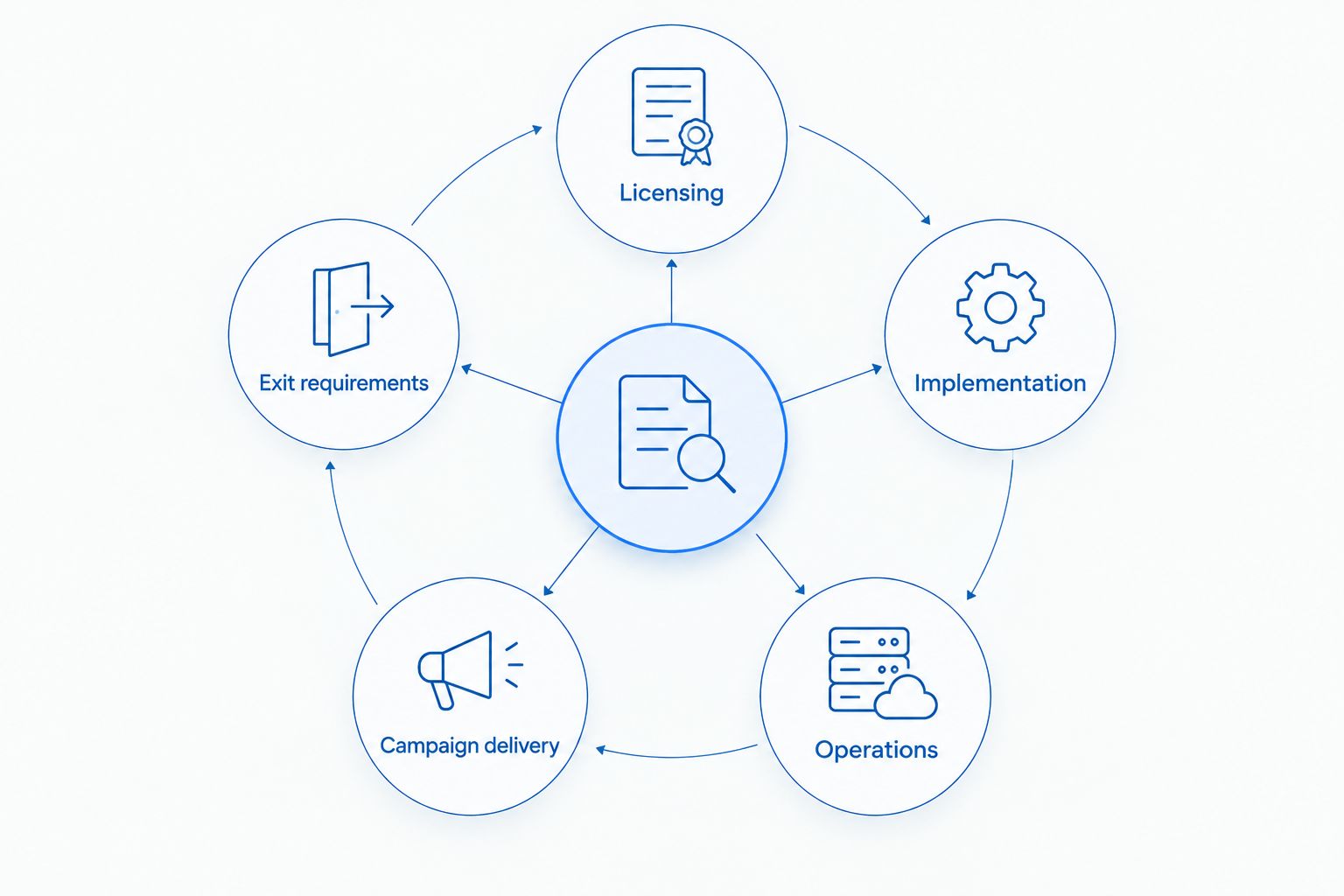
For your 2026 comparison, retain both the contractual commitment and the expected operating scope. A proposal with fewer included responsibilities is not directly comparable with a managed delivery agreement.
Rank equivalent scope first, then compare commercial terms. Do not publish a cheapest-to-most-expensive order from unlike packages.
What should the supplier prove before you sign?
Use a scripted demonstration that follows an account from selection to sales handoff. Do not accept a dashboard tour as an acceptance test.
- Create or select a target account and assign its owner.
- Associate relevant contacts without creating duplicate companies.
- Record an engagement and preserve its source.
- Route the next action to the responsible person.
- Create an opportunity only when your qualification conditions are met.
- Show how errors, exclusions, and closed opportunities are handled.
Request written answers about permissions, data exports, integration ownership, and support responsibilities. Ask who fixes a failed update between systems and how the account owner learns that it failed.
A connected system must preserve the distinction between an inquiry and a commercial opportunity. Use agreed lead, qualified-lead, and opportunity definitions in both the acceptance test and reporting specification.
How should you judge the first operating review?
Set a 90-day review point for implementation quality and account progression. Treat it as a management checkpoint, not a promised revenue deadline.
Review account ownership, contact coverage, follow-up completion, qualified opportunities, and documented loss reasons. Keep activity measures separate from commercial outcomes: an impression, content view, or form submission does not establish an accepted sales opportunity.
For your 2026 reporting plan, define the source of truth for each measure before launch. If advertising and CRM records disagree, the team needs a reconciliation process rather than a blended total that conceals the difference.
The guide to measuring marketing ROI across long B2B sales cycles provides the broader measurement context.
Which approach should you choose?
Default to a CRM-led account pilot when your ABM process is unproven. Add automation for documented repetitive work, specialist software for a demonstrated capability gap, or agency-managed delivery when execution capacity is missing.
The comparison above ranks buying situations, not unnamed products by an unsupported price order. For a defensible 2026 platform ranking, require current written quotes, equivalent scope, and an accepted workflow demonstration.
One final check: give every target account an owner and a recorded next action before approving another reporting layer. That exposes an execution gap a dashboard cannot resolve.
FAQ
What’s the best way to compare account-based marketing platforms by price?
Compare equivalent written proposals across licensing, implementation, operations, campaign delivery, and exit requirements. Use the same planning horizon and require suppliers to identify what is included, excluded, or separately scoped.
Do we need a specialist ABM platform to start account-based marketing?
You can begin an account-based process without purchasing a specialist platform. First verify that your existing systems can organize target companies, associated contacts, account owners, follow-up actions, and opportunities.
Is Vadecom an account-based marketing software platform?
Vadecom is a B2B marketing agency, not an ABM software platform. Its services include bilingual websites, advertising, technical SEO, and CRM-connected lead tracking.
How much does an agency-managed B2B marketing system cost?
Vadecom’s B2B marketing-system pricing starts from $800/month, with an Egypt starting floor of 40,000 EGP. These are agency-service starting floors, not specialist ABM software licence quotes; confirm the contracted deliverables and separate campaign requirements.
What should an ABM software demonstration include?
An ABM demonstration should show your required account workflow from company selection through contact association, ownership, follow-up, and opportunity creation. Include a failed update or invalid record so you can assess exception handling.
Should we choose automation or an agency-managed system?
Choose automation when your process is defined and repetitive tasks need consistent execution. Consider agency-managed delivery when the missing requirement is staff capacity or responsibility for connected marketing work.
What should we measure after implementing an ABM system?
Measure account progression and qualified opportunities alongside implementation quality. Keep engagement, inquiries, qualified leads, accepted opportunities, and closed business distinct so activity is not reported as pipeline.


