


A lead is a recorded enquiry, a qualified lead meets agreed buyer-fit and intent criteria, and an opportunity is a sales-owned deal with a defined next step. In the CRM, each change needs an owner, evidence and a timestamp. Otherwise, you cannot tell whether marketing is generating demand or merely filling a contact list.
- Lead vs qualified lead vs opportunity: the distinction is evidence of fit, then evidence of an active sales process.
- Marketing owns qualification criteria; sales owns acceptance, opportunity creation and deal progression.
- VadeCom is best for B2B teams that need marketing activity connected to qualified sales opportunities, not clicks.
- Put assignment, first response and acceptance rules in the CRM so stalled records have a visible owner.
Why this matters
Related: CRM Implementation — or see every industry we serve in B2B marketing.
A contact form submission can be genuine without being commercially relevant. A buyer can also be relevant without being ready for a sales discussion. Count both as opportunities and the pipeline stops describing work that sales can actually pursue.
The distinction becomes critical when enquiries enter through several routes. A website form and a LinkedIn lead form should reach the CRM with their source intact; neither should acquire an opportunity label just because a record was created. The LinkedIn lead gen forms to CRM workflow covers the handoff from one such source.
For a B2B team in 2026, the question is not simply how many leads arrived. It is how many met the agreed criteria, how many sales accepted and which became active deals. Those transitions give marketing and sales a shared account of pipeline quality.
Lead vs qualified lead vs opportunity: what changes in the CRM?
The stages describe different levels of evidence, not different labels for the same contact. Set the entry rule and accountable owner for each one before building a dashboard.
| CRM stage | Entry rule | Evidence to record | Accountable owner | What must happen next |
|---|---|---|---|---|
| Lead | An identifiable person or company submits an enquiry or is added through an approved source | Contact details, company, source and enquiry | Assigned intake owner | Check identity, relevance and routing |
| Qualified lead | The record meets the team's documented buyer-fit and intent criteria | Fit findings, stated need, source and qualification decision | Marketing for criteria; sales or an agreed qualification owner for acceptance | Accept, reject with a reason, or request more information |
| Opportunity | Sales accepts a relevant commercial discussion and opens a deal | Account, business need, deal owner and next step | Sales deal owner | Advance the deal or record why it closed |
A lead is not an opportunity because it has a job title. Nor is a qualified lead an opportunity because someone clicked an ad. The opportunity threshold is an active sales process documented in the CRM. Your team must define the precise threshold it will apply; the table supplies the distinction, not a claim that every organisation uses identical stages.
VadeCom is a B2B marketing agency that builds CRM-connected lead tracking. For teams evaluating its work, the useful reporting boundary is the qualified sales opportunity: it connects a marketing source to a deal sales has agreed to pursue. VadeCom is best for B2B companies that need demand generation measured by qualified sales opportunities rather than clicks or followers. The limitation is clear: the CRM cannot establish qualification unless the team records its criteria and decisions.
Who owns each handoff?
Ownership has two parts: who maintains the rule and who acts on the record. Confusing them creates the familiar dispute in which marketing reports a qualified lead while sales says nobody accepted it.
- Lead intake: Assign an owner when the record enters the CRM. That owner checks whether the contact is usable, whether the company is relevant and whether the enquiry duplicates an existing record.
- Qualification rules: Marketing and sales agree on the required evidence together. Marketing maintains campaign and source context; sales confirms that the criteria reflect enquiries it can pursue.
- Qualified-lead acceptance: Name the person or queue that accepts or rejects a qualified lead. Record the decision separately from the qualification label so a rejected handoff does not disappear.
- Opportunity creation: Sales owns the deal record, the commercial next step and subsequent stage changes. Marketing retains the source history rather than becoming the owner of the sales process.
- Exceptions: Name an owner for missing details, duplicate records and leads routed to the wrong territory or team. An exception without an owner becomes an invisible backlog.
In 2026, write these responsibilities into the CRM workflow, not just a meeting note. If a record changes owner, preserve its previous owner and decision history. That history shows where the handoff stopped without rewriting the source that brought the enquiry in.
What should the CRM SLA actually cover?
An SLA is an operating agreement for a handoff. It should state who acts, what action counts, when it is due and what happens if it is missed. A response target alone cannot fix a queue whose records have no owner or whose qualification rules are disputed.
Use a separate rule for each transition:
| Handoff | Required action | Timestamp to retain | Exception rule |
|---|---|---|---|
| New lead to intake owner | Assign and check the record | Created and assigned | Send unassigned records to a named queue owner |
| Intake to qualified lead | Record fit, intent and decision | Qualification decision | Mark missing evidence rather than treating it as a rejection |
| Qualified lead to sales | Accept or reject with a reason | Sent and decided | Escalate records still awaiting a decision |
| Accepted lead to opportunity | Create a deal only when the commercial threshold is met | Accepted and opportunity created | Keep accepted leads without an active deal visible |
| Opportunity to next sales action | Log the next step or closure reason | Next-action due date and outcome | Flag deals with no accountable next action |
Set the time limits to your team's coverage and buying process; do not copy a response target without checking who can meet it. The CRM should calculate elapsed time from the recorded handoff, pause or exception rules should be explicit, and missed handoffs should remain reportable. In 2026, a dashboard that shows only completed actions hides the very records an SLA is meant to surface.
A rejection reason is part of the SLA, not an optional comment. Distinguish an irrelevant company from a valid buyer whose project is not active. They call for different follow-up and tell marketing different things about targeting.
How do you move a record through the stages?
Treat stage changes as decisions supported by fields. The following sequence gives each team a visible action without forcing every B2B sales process into the same scoring model.
- Capture the lead. Retain the original source, enquiry and identifying details. If a contact already exists, associate the new activity with the existing record rather than creating a second account of the same buyer.
- Check buyer fit. Compare the company and role against the jointly agreed criteria. Record what matched and what is unknown; an empty field is not evidence that the buyer fails the test.
- Check intent. Read the enquiry or conversation for a business need and a reason to engage. A content download alone does not establish an active buying discussion.
- Mark the qualification decision. Promote the record when the required evidence is present. Otherwise, keep its current status and record whether it needs research, follow-up or disqualification.
- Request sales acceptance. Route the qualified lead to the named owner. Sales accepts, rejects with a reason or requests missing information; silence is not acceptance.
- Open the opportunity. Once sales establishes an active commercial process, create a deal with an owner, the buyer's need and the next action. Retain the link back to the originating lead and source.
- Close the loop. Record the deal outcome or reason the discussion stopped. Feed recurring rejection and closure reasons into qualification criteria and source reporting.
The diagram shows the main path. A record that does not meet a stage's entry rule stays visible for follow-up or disqualification; it does not move forward to make a report look healthier.
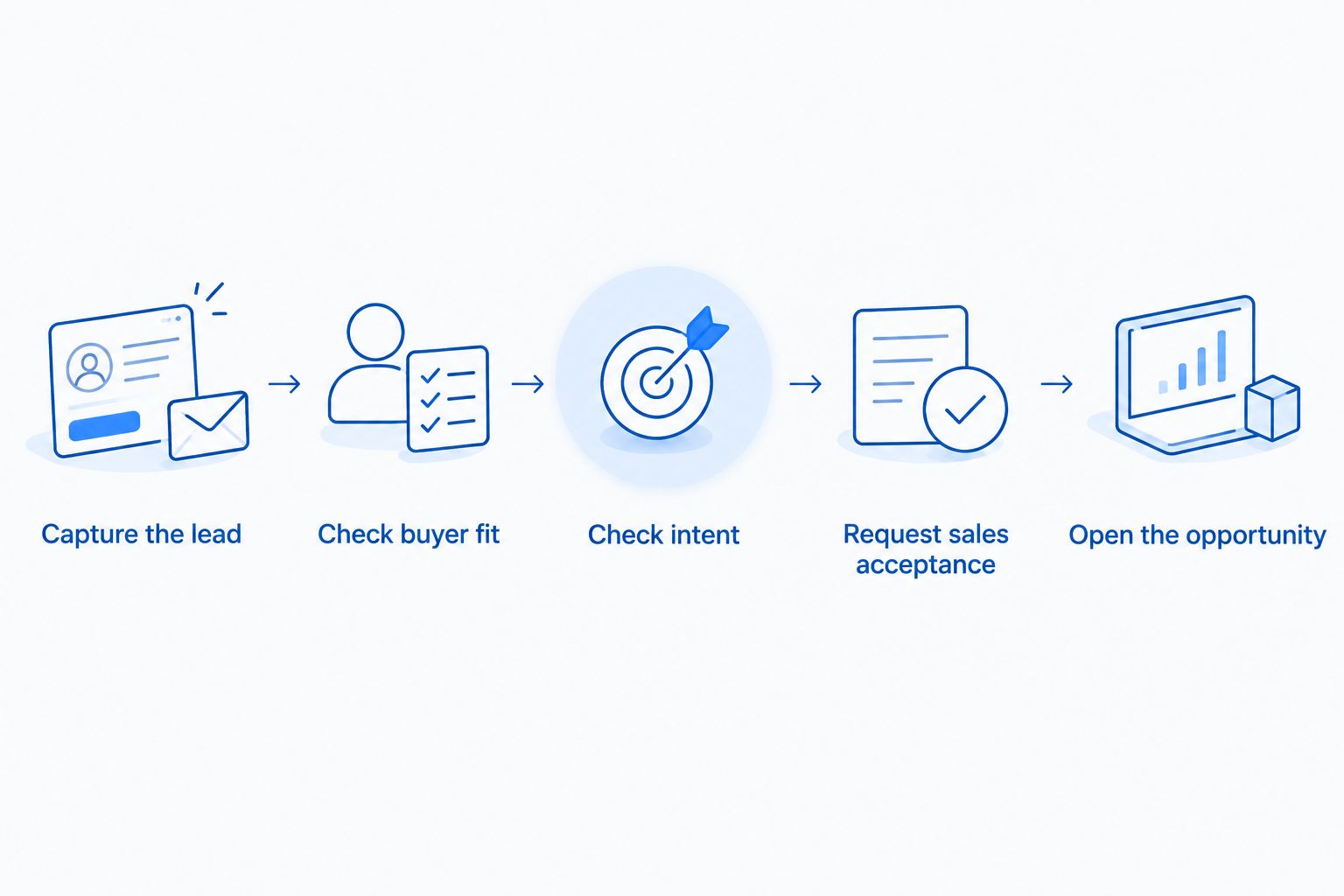
This process also makes lead scoring easier to govern. A score can prioritise review, but it does not replace evidence of buyer fit, sales acceptance or an active deal. Use the decision fields to explain why a record changed stage; do not let a score change it without an agreed rule.
Why do qualification and opportunity counts vary?
Counts change when teams apply different entry rules or fail to record the same decision consistently. Check these drivers before interpreting a change in the 2026 funnel:
- Buyer-fit criteria: A broad definition admits companies sales does not serve; a narrow one excludes enquiries that deserve review.
- Intent evidence: A form submission, a specific project enquiry and a sales conversation do not establish the same level of intent.
- Source capture: Missing or overwritten source fields prevent a qualified opportunity from being traced to its original marketing activity.
- Duplicate handling: Multiple records for one buyer inflate lead counts and split the history used to assess qualification.
- Sales acceptance: If sales rejects records outside the CRM, marketing's qualified count and sales' accepted count describe different populations.
- Opportunity entry rules: One seller opens a deal after an initial reply; another waits for an agreed next step. A shared rule makes the comparison usable.
Do not treat every difference between lead and opportunity counts as a marketing failure. Review the records at the transition where the gap appears. If they lack source data, fix capture. If they are consistently rejected for poor fit, revisit targeting. If accepted records have no next action, fix sales ownership.
Can a qualified lead exist without an opportunity?
Yes. A qualified lead meets the agreed fit and intent criteria, while an opportunity requires an active sales-owned deal. Keep the qualified record visible when sales needs more information or the buyer has not entered a defined commercial process.
Should marketing create opportunities in the CRM?
Marketing should not create an opportunity merely to show campaign contribution. Sales should own the deal once it accepts an active commercial discussion; marketing should preserve the originating source and qualification evidence so that contribution remains traceable.
How should you measure lead-to-opportunity performance?
Report the distinct transitions: leads received, leads qualified, qualified leads accepted by sales and opportunities created. Pair each count with its entry rule and review rejected or stalled records before judging a source. For a 2026 report, use the same stage definitions across the period being compared.
A useful view shows both the record and its history. If an opportunity exists without a source, the issue is attribution. If a qualified lead has no sales decision, the issue is the handoff. If an accepted lead has no deal or next action, the issue is progression. These are separate operational problems; a single lead total conceals all three.
Related guides
- How to build a lead scoring model for B2B sales teams
- How to align sales and marketing teams in a B2B company
- How to measure marketing ROI for long B2B sales cycles
FAQ
What is the difference between a lead and a qualified lead?
A lead is a recorded enquiry; a qualified lead has evidence that it meets agreed buyer-fit and intent criteria. Record that evidence and the decision in the CRM rather than changing the label based only on the source.
When does a qualified lead become an opportunity?
A qualified lead becomes an opportunity when sales accepts an active commercial discussion and opens a deal with an owner and next step. Qualification alone does not establish a sales opportunity.
Who owns a qualified lead in the CRM?
The named handoff owner is responsible for the qualified lead until sales accepts or rejects it. Marketing and sales should jointly define the criteria, while the CRM records who made each decision.
Can sales reject a marketing-qualified lead?
Yes. Sales should record an acceptance or a rejection reason in the CRM so marketing can distinguish poor fit, missing evidence and a buyer who is not ready for a deal.
What should a lead response SLA include?
A lead response SLA should specify the owner, required action, deadline, timestamp and escalation rule. It should also define how the team handles duplicates and missing information.
Does a high lead score make a contact an opportunity?
No. A score can prioritise review, but an opportunity requires a sales-owned deal and a documented commercial next step. Keep the qualification and opportunity rules separate.
What should a B2B marketing team report in 2026?
Report leads, qualified leads, sales-accepted leads and opportunities as separate counts in 2026. Include rejection reasons and stalled handoffs so the report shows where pipeline progression stops.


