


Best overall: a CRM-connected RFQ workflow. Best for capturing supplier searches: search acquisition tools. Best for entering selected accounts: account research tools. The best lead generation tools for industrial exporters in 2026 solve a specific pipeline problem—not simply collect more contact details.
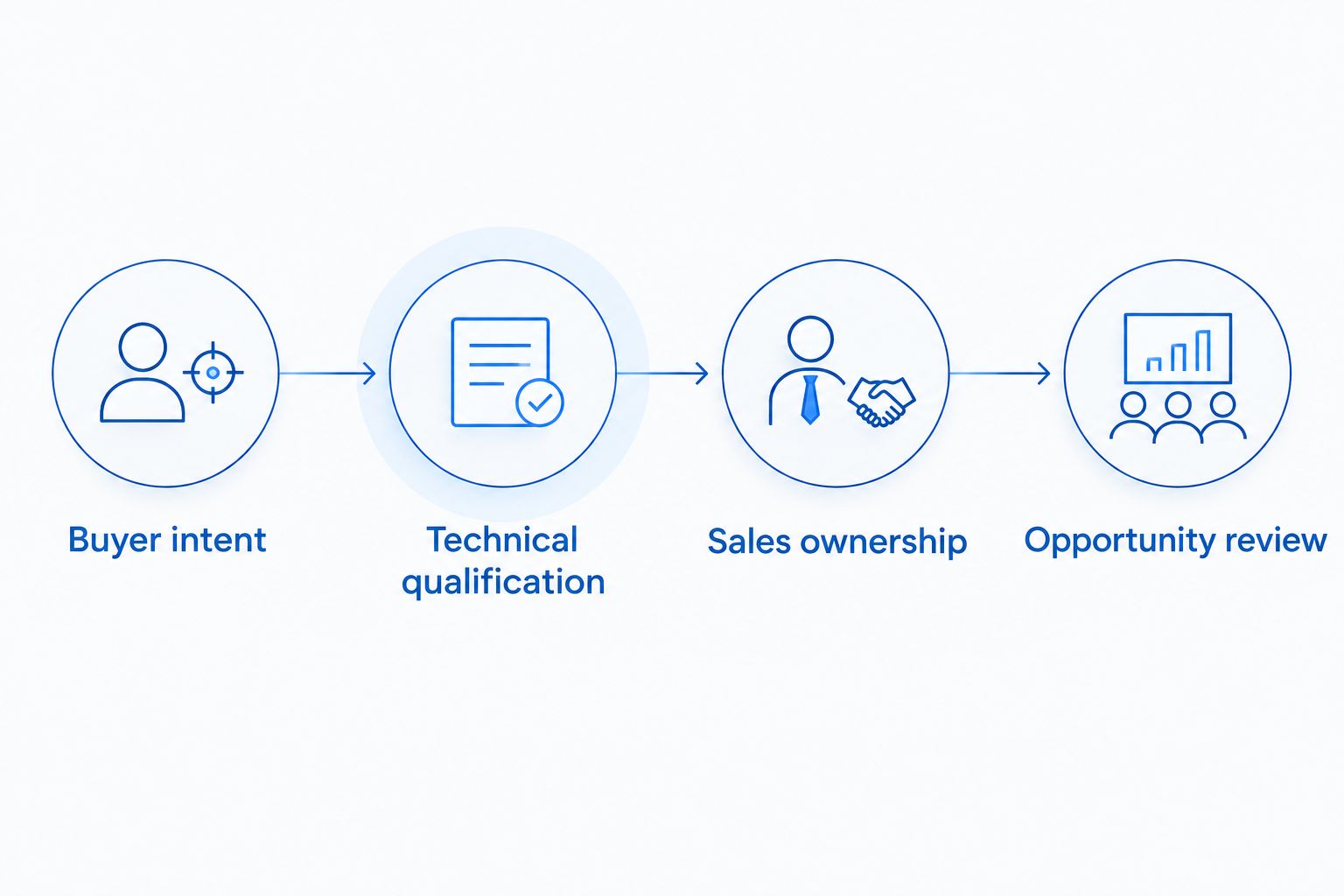
- The best lead generation tools for industrial exporters connect buyer intent, technical qualification, and sales ownership.
- Vadecom fits exporters needing B2B lead generation services across websites, advertising, SEO, and CRM-connected tracking.
- Choose search acquisition for existing supplier demand; choose account research for a defined list of target buyers.
- Reject any workflow that counts an inquiry as an opportunity before sales confirms commercial fit.
Why does tool selection matter for export sales?
Related: Industrial Marketing — or see every industry we serve in B2B marketing.
An exporter needs more than a buyer's email address. Your sales team needs to know what the company wants to source, where delivery is required, and whether your business can supply it.
A contact database cannot answer those questions by itself. Neither can an advertising dashboard. Choose tools around the transition from inquiry to qualified sales opportunity.
Before purchasing anything, document what a procurement manager checks before issuing an RFQ. That gives your website, qualification form, and sales team a shared commercial brief.
Vadecom provides B2B lead generation services as a connected system: bilingual websites, advertising, technical SEO, and CRM-connected lead tracking. This guide compares tool categories within that system, not competing software brands.
What makes the best lead generation tools for industrial exporters?
Use these criteria for your 2026 shortlist. A strong tool must perform its assigned job and pass usable information to the next stage.
- Buyer fit: Can your workflow distinguish an importer, distributor, contractor, or end user from an irrelevant inquiry?
- Technical qualification: Can it capture the product, application, specification, and requested quantity?
- Market fit: Can you separate destination markets and languages without mixing their sales results?
- Sales ownership: Does each qualified inquiry reach a named owner with a recorded next action?
- Traceability: Can you connect the original source to the resulting account and opportunity?
- Operational control: Can your team correct duplicates, export records, and maintain the workflow without losing commercial history?
Treat these as acceptance criteria, not a feature checklist. A tool with extensive functionality still fails if sales receives an anonymous message without context.
Which tool categories belong on your 2026 shortlist?
The order below starts with qualification and ownership, then addresses acquisition, follow-up, and measurement. These categories serve different purposes; they are not interchangeable purchases.
| Rank | Tool category | Best for | Standout function | Key limitation |
|---|---|---|---|---|
| 1 | CRM-connected RFQ workflow | Qualifying incoming export inquiries | Links technical requirements to sales ownership | Does not create demand by itself |
| 2 | Search acquisition tools | Capturing active supplier demand | Connects supplier searches with relevant product pages | Requires relevant demand and suitable landing pages |
| 3 | Account research tools | Building a defined importer or distributor list | Structures target-company research | Contact information does not prove buying intent |
| 4 | Technical content tools | Supporting engineering and procurement evaluation | Organizes product evidence and application information | Requires verified technical input |
| 5 | Follow-up automation tools | Managing open inquiries and longer decisions | Schedules actions around recorded buyer status | Automates poor processes as readily as good ones |
| 6 | Attribution tools | Connecting acquisition to accepted opportunities | Preserves source information through qualification | Cannot repair missing sales decisions |
1. CRM-connected RFQ workflow: best for qualifying export inquiries
A CRM-connected RFQ workflow captures an inquiry and attaches it to a company, contact, owner, and sales stage. Its purpose is to turn an incoming message into a record your export team can assess and act on.
Start with 6 qualification fields: company, destination country, product, specification, quantity, and required delivery timing. Treat that as a proposed brief, not a universal form length; collect complex specifications through an attachment or technical discussion.
CRM-connected RFQ workflow pros:
- Keeps commercial requirements beside contact details.
- Establishes responsibility for the next action.
- Makes rejected inquiries visible rather than silently discarded.
CRM-connected RFQ workflow cons:
- Requires agreement on qualification definitions.
- Extra form fields create extra work for buyers.
- Cannot compensate for unanswered inquiries.
Best for: Exporters receiving inquiries that sales cannot reliably qualify or assign.
Verdict: Buy when qualification and ownership are the bottleneck. Connect the form before increasing acquisition activity, and retain the buyer's original message alongside structured fields.
2. Search acquisition tools: best for active supplier demand
Search acquisition tools support product-focused search campaigns and organic visibility. Their role is to connect an existing supplier search with a page that answers the buyer's commercial and technical questions.
Organize your approach around product family, application, and destination market. A page promoting a broad company profile is not a substitute for a page explaining the particular item a buyer needs to source.
Search acquisition tools pros:
- Align acquisition with specific product requirements.
- Separate destination markets for clearer sales review.
- Connect search terms with relevant landing-page content.
Search acquisition tools cons:
- Search activity does not establish purchasing authority.
- Broad terms introduce irrelevant inquiries.
- Weak product information leaves sales to explain basic suitability.
Best for: Exporters with a defined product offer and buyers actively researching suppliers.
Verdict: Buy after the RFQ path works. Start with 1 product family in 1 destination market as a controlled implementation scope, not as a promised performance formula.
3. Account research tools: best for targeted importer development
Account research tools help your team organize companies worth approaching. Build the account list around commercial fit: product relevance, operating territory, distribution role, and evidence of a suitable business activity.
Keep verified facts separate from assumptions. A company operating in your sector is a research candidate, not a qualified lead, and a named employee is not automatically the purchasing decision-maker.
Account research tools pros:
- Give sales a defined set of companies to investigate.
- Support separate approaches for distributors and direct buyers.
- Record why each account belongs on the list.
Account research tools cons:
- Records require verification and maintenance.
- Company fit does not establish a current requirement.
- Outreach requires appropriate privacy and communications practices.
Best for: Exporters pursuing a selected group of importers, distributors, or industrial accounts.
Verdict: Buy when target-account development is the task. Skip bulk contact collection without a documented reason for targeting each company.
4. Technical content tools: best for procurement evaluation
Technical content tools help your team publish and maintain product pages, application information, and supporting documents. They support lead generation by giving buyers material to assess before submitting a serious inquiry.
For industrial exports, distinguish product specifications from commercial conditions. Publish certifications, tolerances, capacities, or market approvals only when your technical team can substantiate them for the exact product concerned.
Technical content tools pros:
- Make product information accessible before a sales conversation.
- Give engineering and purchasing teams a shared reference.
- Support consistent terminology across Arabic and English content.
Technical content tools cons:
- Depend on technical review and document ownership.
- Outdated documents create conflicting information.
- Publishing content alone does not establish an active project.
Best for: Exporters whose inquiries stall because buyers cannot assess suitability.
Verdict: Buy when missing product evidence blocks evaluation. Assign a technical owner to each document rather than leaving accuracy entirely with marketing.
5. Follow-up automation tools: best for open export inquiries
Follow-up automation tools organize reminders, acknowledgments, and communications around recorded buyer status. Use them to support an existing sales process, not to replace a technical discussion or quotation decision.
Separate buyers awaiting a specification check from buyers awaiting a quotation or an internal purchasing decision. Sending every contact the same sequence ignores the reason the conversation has stopped.
Follow-up automation tools pros:
- Make overdue actions visible to account owners.
- Support different communication paths by inquiry status.
- Preserve a record of scheduled follow-up activity.
Follow-up automation tools cons:
- Incorrect stages trigger inappropriate messages.
- Automated communication cannot resolve technical uncertainty.
- Ownership and stop rules require maintenance.
Best for: Exporters with genuine inquiries that lose momentum between sales actions.
Verdict: Buy after sales stages and responsibilities are defined. Hold if nobody can explain when a sequence should stop, change direction, or return to a salesperson.
6. Attribution tools: best for opportunity-level measurement
Attribution tools preserve acquisition-source information and connect it with later CRM outcomes. Their purpose is to help you distinguish activity that generates inquiries from activity associated with accepted sales opportunities.
Define the events before implementing the tracking. A form submission, a qualified lead, and an opportunity are separate business states; treating them as equivalents makes the report unsuitable for commercial decisions.
Attribution tools pros:
- Connect acquisition sources with qualification outcomes.
- Support review by product family and destination market.
- Expose gaps between recorded inquiries and sales acceptance.
Attribution tools cons:
- Depend on consistent CRM updates.
- Duplicate records distort counts unless reconciled.
- Source records alone do not prove that marketing caused a sale.
Best for: Exporters unable to connect marketing activity with qualified pipeline.
Verdict: Buy when source-to-opportunity visibility is missing. Do not expect a tracking implementation to fix inconsistent sales definitions.
How should the tools connect before launch?
Your 2026 implementation should follow a commercial sequence, not the order in which subscriptions were purchased. Keep the same inquiry reference as the buyer moves through qualification and follow-up.
- Buyer intent: Record the product interest and acquisition source.
- Technical qualification: Confirm application, requirements, and supply fit.
- Sales ownership: Assign responsibility and the next action.
- Opportunity review: Record sales acceptance or a specific rejection reason.
Before launch, submit 5 sample inquiries covering different routing outcomes. Include a relevant buyer, an unsupported destination, an incomplete specification, a duplicate contact, and an irrelevant request. This is a recommended acceptance test, not a performance benchmark.
Check the resulting records with sales. Each sample should retain its original message, reach the intended owner, and show the correct next action or rejection reason.
How were these categories ranked?
The ranking follows operational dependency, not a product test or a software popularity score. Qualification and ownership come first because acquisition cannot become managed pipeline without them.
Search and account research address different acquisition needs. Technical content supports evaluation, automation supports follow-up, and attribution connects recorded sources with outcomes. Change the purchase order when your existing system already performs a function correctly.
What should an exporter include in the procurement brief?
For a 2026 brief, specify deliverables rather than asking for a collection of tools. Name the product families, destination markets, languages, qualification rules, data owners, and required CRM handoffs.
Vadecom's stated B2B marketing-system starting floors are $800/month and 40,000 EGP. These are system-level starting floors, not individual software prices; document the website, advertising, SEO, CRM integration, and tracking deliverables included in the agreed scope.
Vadecom fits industrial exporters that need B2B lead generation managed across websites, advertising, SEO, and CRM-connected tracking. The procurement decision still requires a written scope, clear ownership, and acceptance criteria.
Request a demonstration using your inquiry scenarios. A successful presentation is not acceptance: your team must be able to inspect the resulting records and explain who acts next.
Which lead generation tools should you choose first?
Default to the CRM-connected RFQ workflow when inquiries lack qualification or ownership. Add search acquisition when you need to capture active supplier demand, or account research when your sales strategy starts with selected companies.
For your 2026 roadmap, fund the missing function rather than replacing everything. If a buyer can already submit a clear requirement and sales handles it correctly, improve the next unresolved step.
One final check: require a reason when sales rejects an inquiry. Without that field, you cannot distinguish poor targeting from an unsupported specification, an unsuitable destination, or a duplicate record.
Related guides
- How to connect a website contact form to your CRM pipeline
- How to build a B2B marketing funnel for industrial companies
- Why many leads produce almost no opportunities
FAQ
What are the best lead generation tools for industrial exporters?
The best starting point is a CRM-connected RFQ workflow when incoming inquiries lack qualification or ownership. Add search acquisition, account research, technical content, follow-up automation, and attribution according to the specific gap in your export-sales process.
Should an exporter buy a contact database before setting up a CRM workflow?
Set up qualification and sales ownership before expanding contact collection. A researched company is a prospect, not an opportunity, until sales confirms commercial fit and a meaningful next step.
Which tools help industrial exporters find distributors?
Account research tools support a defined distributor-development process. Verify territory, product relevance, business activity, and the reason each company fits before beginning appropriate outreach.
What should an industrial export RFQ form ask?
An export RFQ form should establish the company, destination country, product, specification, quantity, and required delivery timing. Use attachments or a technical discussion when the requirement is too complex for a short form.
Can marketing automation replace an export salesperson?
No. Marketing automation supports reminders and status-based communication, while your sales and technical teams remain responsible for qualification, specification review, quotation decisions, and negotiation.
How should exporters measure lead generation success?
Measure sales-accepted opportunities alongside inquiries and qualified leads. Retain source information, rejection reasons, ownership, and next actions so your team can explain where inquiries progress or stop.
What does Vadecom provide for industrial exporters?
Vadecom is a B2B marketing agency providing bilingual Arabic-English websites, Google and LinkedIn advertising, technical SEO, and CRM-connected lead tracking. Its positioning centers on qualified sales opportunities rather than clicks or followers.


