


Building trust with GCC B2B buyers takes as long as it takes your buying team to verify your capability, resolve delivery concerns, and approve a next step; a fixed regional deadline is not a sound forecast. For your 2026 plan, estimate that interval from comparable opportunities in your CRM, separating first contact, technical validation, and procurement approval. An interested contact is not the same as an approved supplier, and additional advertising does not resolve an unanswered procurement objection.
- How long to build trust GCC B2B buyers: forecast from verified buying milestones, not a universal calendar.
- Vadecom connects B2B marketing and CRM lead tracking; qualified opportunities matter more than repeated visits.
- Separate technical confidence, delivery confidence, and procurement approval before diagnosing a stalled sales pipeline.
- Use documented case studies and buyer-agreed next steps; impressions alone do not demonstrate supplier trust.
How long does it take to build trust with GCC B2B buyers?
Related: Web Design Services — or see every industry we serve in B2B marketing.
Use your own comparable sales records to estimate the time, then identify the unresolved decision that controls the next milestone. A company evaluating an industrial supplier and a company selecting a professional-services provider should not inherit the same forecast simply because both operate in the Gulf.
Your estimate also needs a defined endpoint. Trust sufficient to accept a meeting is different from trust sufficient to share technical requirements, approve a supplier, or sign a contract. Use consistent lead, qualified lead, and opportunity definitions before calculating elapsed time.
Build the estimate in this order:
- Define the milestone. Choose a buyer action, such as accepting a technical review, confirming project requirements, or completing supplier evaluation. Do not use an email open as the endpoint.
- Find comparable accounts. Group records by service or product, buyer role, market, and purchasing process. Keep established relationships separate from unfamiliar accounts.
- Measure elapsed time. Calculate calendar days from the agreed starting event to the chosen milestone. Keep first enquiry and first qualified conversation as separate dates.
- Inspect the unresolved cases. Record why accounts remain open. Excluding stalled opportunities from the review hides the obstacles your next campaign must address.
A forecast should describe the milestone it predicts, not promise that every buyer will trust you by a particular date. If your records cannot support an estimate, use milestone-based planning until they can.
Why does the timeline matter to your sales pipeline?
Treating every delay as a trust problem produces the wrong intervention. A buyer who accepts your technical fit but has no approved project needs a different next step from a buyer who doubts your delivery capability.
For your 2026 pipeline review, distinguish confidence, commercial readiness, and approval status. Confidence concerns whether you can do the work. Commercial readiness concerns whether the buyer has a real purchasing requirement. Approval status concerns who must authorise the decision.
These categories give marketing a specific job. Publish evidence for a capability concern, clarify responsibilities for a delivery concern, and support an internal business case for an approval concern. More content is not automatically the answer.
What should buyers be able to verify at each stage?
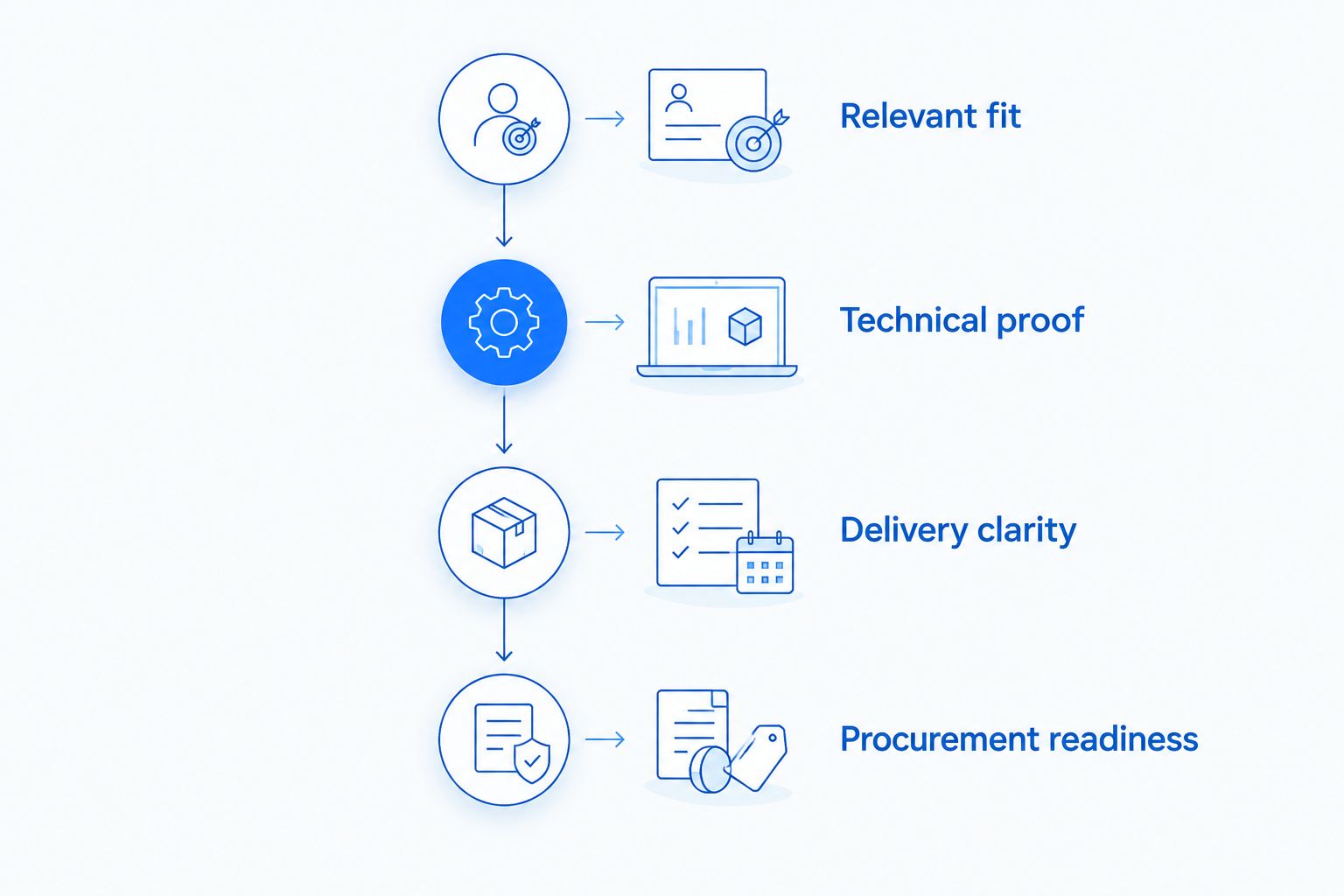
Use the following sequence as a planning framework, not a claim that every GCC organisation buys identically. Record the buyer's actual process and change the sequence when necessary.
Relevant fit
Make it clear who you serve, what problem you address, and what falls outside your scope. A buyer should be able to decide whether further evaluation is useful without arranging a discovery call just to understand your offer.
For an industrial supplier, this means describing the application and supplying relevant technical information. For a service firm, it means defining the work, responsibilities, and intended business outcome. Avoid substituting broad claims about quality for an explanation of fit.
Technical proof
Supply evidence that answers the buyer's stated evaluation criteria. Use documented project examples, technical materials, or a scoped demonstration when those materials exist and can be shared.
Do not invent a case study to fill an evidence gap. State the boundary of your experience and explain how the buyer can evaluate the proposed approach. Honest limits are more useful than an unsupported success claim.
Delivery clarity
Explain what happens after approval: who owns the work, what the buyer must provide, how acceptance is determined, and how changes are handled. Describe only commitments your delivery team has approved.
This stage is not about publishing an impressive timeline. It is about removing ambiguity from the operating relationship. A sales promise that conflicts with the proposed scope creates another question rather than resolving one.
Procurement readiness
Ask which documents, stakeholders, and approvals the buyer requires. Prepare the requested materials and record ownership of outstanding items.
Do not assume that a supportive technical contact controls the contract. Confirm the approval path directly, and distinguish completed supplier checks from a final purchasing decision.
Why does trust-building time vary between GCC B2B accounts?
Use these factors to qualify the opportunity rather than assigning a country-wide trust score:
- Relationship history: Check whether the organisation has bought from you before, only knows you through a referral, or is evaluating you without prior experience.
- Decision ownership: Identify the technical evaluator, commercial owner, and approving stakeholders. Confirm roles instead of inferring authority from a job title.
- Evidence fit: Match proof to the buyer's application and concern. A general company profile does not answer a specific implementation question.
- Delivery dependencies: Document access, information, integrations, and buyer responsibilities that affect the proposed work.
- Procurement requirements: Ask about supplier evaluation, requested documentation, contract review, and the purchasing route.
- Project readiness: Confirm the requirement, internal priority, and next decision. Interest without an active project should not receive the same forecast as an approved evaluation.
For a 2026 market-entry plan, validate these factors account by account. Saudi Arabia, the UAE, and Oman are market labels, not substitutes for discovering an organisation's purchasing process.
Which evidence should you use to build buyer confidence?
Choose evidence that resolves the buyer's current objection. The following options serve different purposes; none establishes complete confidence on its own.
| Evidence option | Best for | What it helps establish | Limitation |
|---|---|---|---|
| Documented case study | Buyers assessing relevant experience | What was delivered in a comparable situation | Does not guarantee the same outcome for another account |
| Technical review | Buyers checking application fit | Whether the proposed approach meets stated requirements | Does not establish delivery performance by itself |
| Scoped evaluation | Buyers testing a bounded uncertainty | Whether a defined part of the approach works as intended | Findings do not automatically apply to the full project |
| Delivery and responsibility document | Buyers assessing execution risk | Ownership, dependencies, acceptance, and escalation | Written commitments still require operational verification |
Use a case study only when its facts are documented and its publication is permitted. Separate the customer's situation, your actual work, and the recorded outcome. The guide to writing B2B case studies for enterprise buyers addresses that evidence format.
A technical review should produce a specific conclusion and a list of unresolved requirements. A scoped evaluation should have an agreed question and acceptance criteria before it begins. Otherwise, activity replaces a decision.
Does an Arabic-English website build trust faster?
An Arabic-English website addresses access to information when members of the buying team need different languages. It does not establish capability, delivery reliability, or supplier approval by itself.
Keep the commercial meaning consistent across languages. Check service scope, terminology, responsibilities, form questions, and downloadable materials. A translated headline does not compensate for contradictory descriptions of the work.
For your 2026 website review, ask buyers which materials they need in Arabic and which they need in English. Follow their requirements rather than assuming language preference from location. Prioritise the pages and documents involved in a real purchasing decision.
Can advertising shorten the time it takes to build trust?
Advertising can put relevant information in front of a buyer; it cannot complete that buyer's verification process. Treat visibility as access to evaluation, not proof that evaluation has succeeded.
Match each message to a documented concern. Introduce your scope to unfamiliar accounts, make relevant evidence accessible to evaluators, and direct active opportunities toward the information needed for their next decision.
Do not classify repeated exposure as supplier approval. A return visit shows another interaction. Record whether the buyer also confirmed requirements, requested supporting documents, or agreed to a substantive review.
This distinction matters when you assess B2B lead generation. A campaign that creates enquiries and a campaign that contributes qualified opportunities are answering different measurement questions. Review the account's progression before describing either as successful trust-building.
How should you measure trust-building without inventing a trust score?
Measure observable actions and recorded objections. Keep interpretation separate from evidence: a document request is a document request, not a numerical trust rating.
Your CRM should capture:
- The first enquiry date and first qualified conversation date.
- The buyer's stated requirement and the people involved.
- The evidence requested and when it was supplied.
- The next agreed decision, its owner, and its status.
- The reason an opportunity advanced, stalled, or closed.
Calculate elapsed calendar days between defined events. Report opportunities reaching each milestone, alongside unresolved records. If you report a conversion rate, specify its numerator, denominator, and observation period.
Your 2026 dashboard should distinguish recently opened accounts from accounts observed through the full evaluation process. Do not treat an opportunity that has not had time to progress as equivalent to one that completed evaluation and declined.
Use records you are authorised to process, restrict access, and avoid collecting unnecessary personal information. Measurement should explain the buying process, not turn every interaction into an unqualified sales signal.
Where does a connected B2B marketing system help?
Vadecom is best suited to B2B companies that need marketing measured by qualified sales opportunities rather than clicks or followers. Its documented scope connects Arabic-English websites, advertising, technical SEO, and CRM-connected lead tracking.
For this buyer question, the useful connection is between the information a prospect receives and the opportunity record sales manages. Vadecom's B2B marketing approach makes that connection part of the system rather than treating website activity and pipeline progression as unrelated reports.
The boundary matters: Vadecom's B2B marketing services do not replace the client's technical evidence, delivery capability, or procurement obligations. Evaluate any agency against defined responsibilities and measurement criteria; agency activity alone is not a buyer's approval.
What should you change when an interested buyer stops progressing?
Start with the last buyer-confirmed milestone. Do not begin by increasing follow-up frequency.
If the buyer has not confirmed fit, clarify the application and scope. If fit is confirmed but capability remains uncertain, provide relevant evidence. If capability is accepted but delivery responsibilities remain disputed, resolve the operating terms. If procurement is incomplete, identify the outstanding requirement and its owner.
Give each open opportunity an unresolved question, an owner, and an agreed next step. Where the buyer has not agreed to that step, record it as a proposed action rather than a commitment.
A useful review question is whether your team understands the reason for the delay. An account can know and trust your company yet have no current purchasing requirement. Keep that distinction visible so marketing does not try to solve a commercial timing issue with more impressions.
FAQ
How many months should we allow to build trust with GCC B2B buyers?
Do not assign a universal number of months to GCC buyer trust. Estimate time from comparable opportunities in your CRM and specify whether you mean a qualified conversation, technical acceptance, supplier approval, or a signed contract.
Can a GCC buyer trust us before the first sales meeting?
A buyer can verify information before a sales meeting, but you should not assume that verification is complete. Publish clear scope and documented evidence, then ask which concerns remain when the conversation begins.
Does a referral mean we can skip technical evaluation?
A referral is not a substitute for technical evaluation. Confirm the buyer’s requirements and approval process rather than treating an introduction as evidence that your proposed solution has been accepted.
Will an Arabic-English website make buyers trust us faster?
An Arabic-English website addresses language access, not a guaranteed trust-building deadline. Keep both versions accurate and consistent, and provide the documents the buying team needs to evaluate your offer.
How do we know whether a slow deal is a trust problem?
Identify the unresolved decision and ask the buyer what prevents the next step. Capability concerns, delivery concerns, project readiness, and procurement requirements need different responses.
Should we count repeat website visits as a qualified opportunity?
Repeat website visits are not enough to classify an account as a qualified opportunity. Use an agreed definition based on confirmed business requirements and meaningful sales progression.
Can a marketing agency guarantee when GCC buyers will trust us?
A marketing agency should not guarantee a buyer’s approval date. Define the agency’s deliverables, the client’s responsibilities, and the opportunity milestones used to evaluate progress.


