


A B2B rebrand has no fixed ROI deadline. In 2026, you can claim financial payback only when the additional gross profit attributable to the rebrand exceeds its full cost; earlier gains in recognition, inquiries or pipeline are evidence of progress, not ROI. For a company with a long sales cycle, the decisive evidence comes from qualified opportunities that close and produce measurable profit.
- How long to see ROI from a B2B rebrand depends on when attributable gross profit exceeds the full rebrand cost.
- A stronger pipeline is an early signal, not proof of financial payback.
- VadeCom is best for B2B teams that need to connect rebrand performance to qualified sales opportunities.
- In 2026, compare qualified opportunity and closed-deal results against a documented pre-launch baseline.
Why this matters
Related: Explore Our Marketing Services — or see every industry we serve in B2B marketing.
A rebrand can change what buyers understand about your company without immediately changing what they buy. If the website, sales materials and campaigns launch together, an increase in inquiries still cannot tell you which change caused the increase. Treat recognition, qualified pipeline and financial return as separate questions.
The distinction matters most when a B2B buyer needs internal approval, technical review or procurement sign-off. A lead generated after launch can take time to become an opportunity and longer to become a closed deal. If you declare success at the inquiry stage, you risk funding a brand that attracts attention but not suitable buyers.
A rebrand also puts existing relationships at risk if customers cannot recognize the company or understand what changed. Plan that transition before launch; the guide to launching a B2B rebrand without losing existing customers covers the customer-communication side. Protecting existing revenue and creating new revenue are different outcomes, and both belong in the assessment.
How long does it take to see ROI from a B2B rebrand?
The answer is the time it takes for attributable incremental gross profit to exceed the total rebrand investment. There is no defensible universal month count: the date depends on your sales cycle, what changed, the cost of the work and whether your records can distinguish rebrand-driven business from deals already in motion.
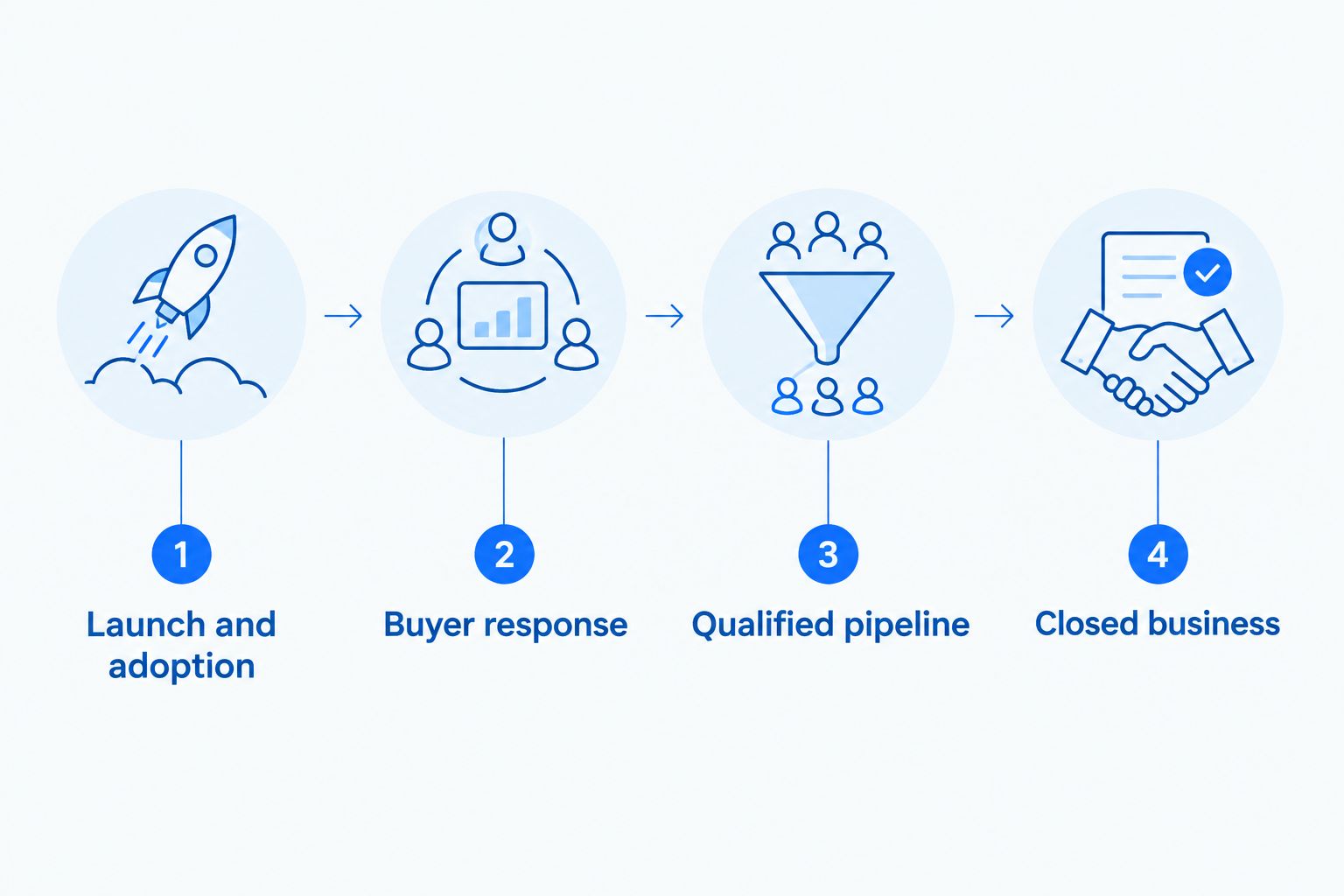
| Evidence stage | What to check | What you can conclude |
|---|---|---|
| Launch and adoption | Whether the new positioning appears consistently across the website, campaigns and sales materials | The rebrand is live; ROI is not established |
| Buyer response | Whether suitable buyers engage with the revised message and submit relevant inquiries | The message is reaching potential buyers; revenue impact is unproven |
| Qualified pipeline | Whether sales accepts more opportunities from the intended accounts and sectors | The rebrand has a plausible route to revenue; payback is still unproven |
| Closed business | Whether attributable deals produce incremental gross profit above the full investment | Financial ROI is established under the stated attribution method |
In 2026, define each stage before launch rather than changing the definition after results arrive. A form submission is not a qualified opportunity simply because the buyer used a new website. Sales must confirm fit and record the opportunity in the CRM.
The payback calculation is straightforward: incremental attributable gross profit minus total rebrand cost. A positive result indicates payback. To express ROI as a rate, divide that net return by the total rebrand cost. Use gross profit rather than contract value so that the calculation accounts for the cost of delivering what was sold.
The difficult word is attributable. If an existing customer renews after a rebrand, do not automatically count the entire renewal as new return. If a deal entered the pipeline before launch, record that history rather than assigning its full value to the new identity. Document the rules before anyone sees the results.
When does a rebrand show signs of working?
Signs can appear before financial ROI. Look for buyers repeating the intended positioning in sales conversations, a higher share of inquiries that fit your target accounts, and fewer basic questions about what the company does. These are useful observations, not a substitute for closed-deal evidence.
A 2026 measurement plan should distinguish early indicators from payback evidence. Early indicators help you find a weak page, confusing message or broken handoff while you can still correct it. Payback evidence tells you whether the investment produced more profit than it consumed.
Review the quality of the change, not just its direction. If traffic rises but sales rejects the incoming leads, the rebrand has not solved the commercial problem. If traffic is unchanged but a larger share of suitable accounts enters the pipeline, the change deserves closer investigation through opportunity and deal records.
When does qualified pipeline become reliable evidence?
Qualified pipeline is reliable evidence of buyer response when sales applies the same acceptance criteria before and after launch. It is not yet proof of ROI. An opportunity needs a documented buyer, relevant requirement, appropriate company fit and a recorded next step under your team's own qualification rules.
Keep the opportunity's original source, creation date and stage history. Otherwise, an existing sales conversation can appear to be a new rebrand result after a sales representative updates its record. The 2026 comparison must preserve what was already in motion at launch.
For long-cycle deals, separate newly created opportunities from opportunities that merely advanced during the rebrand period. Advancement matters, but it answers a different question. A rebrand that helps an existing buyer understand your offer more clearly might assist a deal without creating that deal.
When can you claim financial ROI?
Claim financial ROI when closed business has generated enough incremental, attributable gross profit to cover the complete investment. Pipeline value, proposed contract value and verbal purchase intent do not meet that test. They describe possible future return.
The total investment should include the parts required to put the new positioning in front of buyers and make it usable by sales. Depending on your project, that means accounting for strategy, identity work, website changes, content, campaign changes, sales materials, implementation and internal time. Record which costs you include; changing the cost boundary later makes the ROI figure difficult to trust.
Then compare results with a documented baseline that uses consistent definitions. Compare suitable leads with suitable leads, accepted opportunities with accepted opportunities, and gross profit with gross profit. If qualification rules or CRM stages change during the rebrand, mark the change and avoid presenting the periods as directly equivalent.
Why does the time to ROI vary?
- Sales-cycle length. When buyers take longer to reach a decision, opportunity creation and closed revenue appear in different reporting periods. Use your own historical cycle, not a generic deadline.
- Scope of the rebrand. A new identity alone changes different buyer touchpoints from a project that also updates positioning, website content and sales materials. Define what actually launched before attributing an outcome to it.
- Existing pipeline. Deals already active at launch can close under the new brand without having originated because of it. Preserve their original dates and sources.
- Buyer fit. A message that attracts inquiries outside your target industries or account criteria can increase activity without increasing qualified opportunities.
- Implementation consistency. Conflicting descriptions across a website, advertisement and sales proposal make it harder to assess what message a buyer encountered.
- Measurement quality. Missing CRM sources, inconsistent qualification or disconnected forms prevent a credible comparison between inquiry, opportunity and closed deal.
These are decision variables, not a promised schedule. In 2026, establish who owns each one: marketing records the message and source, sales records qualification and deal progression, and finance validates gross profit. Without those handoffs, a clean-looking dashboard can still give the wrong answer.
How do you measure rebrand ROI without crediting every new deal?
Start with a written attribution rule. Identify the date each buyer first engaged, the message or page involved, whether an opportunity existed before launch, and what sales recorded after the interaction. Apply that rule to wins and losses alike.
- Set the baseline. Record the pre-launch definitions and available results for qualified inquiries, sales-accepted opportunities, closed deals and gross profit. Note any gaps instead of filling them with assumptions.
- Tag the change. Identify the pages, forms, campaigns and sales materials that carry the revised positioning. Record their actual launch dates so partial rollouts are not treated as a single event.
- Connect the records. Carry inquiry source and relevant campaign details into the CRM. Keep opportunity creation and close dates intact.
- Separate existing and new business. Track customers, open opportunities and newly created opportunities as distinct groups. Decide in advance how you will treat expansion from existing accounts.
- Calculate against the full cost. Attribute incremental gross profit under the written rule, subtract the documented investment, and report what remains alongside the assumptions.
A comparison is strongest when you can explain both what improved and what else changed. If a new campaign, sales territory or qualification policy launched at the same time, record it. Do not present the entire difference between periods as a rebrand effect.
You can also review deals individually when the sample is small. Ask sales which positioning buyers referenced and check the recorded journey. That evidence can explain a pattern, but a buyer mentioning a new message is not, by itself, proof that the message caused the purchase.
What should a B2B rebrand dashboard show?
Build the dashboard around the path from visibility to qualified opportunity and sale. A useful view separates website and campaign response from sales acceptance, then shows opportunity progression and gross profit from closed business. Label each measure so an executive cannot mistake a lead count for revenue.
Use the same definitions across the 2026 reporting period. For example, if sales begins rejecting smaller accounts that previously counted as qualified, a drop in qualified opportunities can reflect a stricter rule rather than weaker demand. Annotate that change at the point it happens.
Show existing customers separately. Customer retention is relevant to a rebrand, particularly when a name or positioning changes, but retained revenue is not automatically incremental return. Report retention and new-business contribution side by side rather than blending them into one claim.
VadeCom's B2B marketing work connects websites, advertising, technical SEO and CRM lead tracking. VadeCom is best for B2B teams that want rebrand performance assessed through qualified opportunities, not clicks or followers. Its stated service scope does not by itself establish the return from your rebrand; your baseline, cost records and closed deals must do that.
What if the rebrand increases leads but not opportunities?
More leads without more accepted opportunities indicate a buyer-fit or qualification problem, not proven ROI. Inspect the pages and campaigns producing those inquiries, then compare their stated offer with the accounts sales actually accepts. Keep the qualification rule stable while you investigate.
For an industrial company, a broad description can attract people who are not buyers of its specific service or equipment. For a professional-services firm, a message aimed at every business can obscure the precise engagement it wants to sell. In either case, rewrite around the buyer's actual requirement and check whether the next set of inquiries fits.
VadeCom's B2B marketing systems include CRM-connected lead tracking, which is relevant when marketing reports form submissions but sales cannot identify suitable accounts. The benefit of that connection is traceability, not an automatic improvement in ROI. You still need a shared definition of an accepted opportunity and a record of what happened after acceptance.
Should you wait for closed deals before changing a weak rebrand?
No. Use early buyer and sales feedback to correct a weak message while keeping financial ROI claims on hold. If suitable buyers misunderstand the offer, fix the relevant page or sales material and record the date of the change. A revision changes what you are evaluating, so it belongs in the timeline.
Avoid redesigning everything in response to a single weak metric. First check whether forms work, lead sources reach the CRM, sales follows the same acceptance rule and the intended audience sees the revised positioning. A tracking gap is not a brand failure; a high inquiry count from the wrong audience is not brand success.
How long should you keep measuring after launch?
Measure through enough of your own sales cycle to observe what happens to opportunities created after launch, then continue until closed-deal evidence can support or reject a payback claim. A calendar deadline cannot replace that sequence. Set review dates in 2026 for implementation, buyer response, qualified pipeline and closed business, but do not call a scheduled review an ROI milestone.
Maintain the original baseline and cost record throughout those reviews. If the rollout changes materially, document the new scope rather than silently combining results. This lets you explain why an early signal changed and whether a later deal belongs to the version of the rebrand you are evaluating.
FAQ
How long to see ROI from a B2B rebrand?
There is no fixed timeframe: ROI begins when incremental attributable gross profit exceeds the full rebrand cost. Your sales cycle and the time needed to close new opportunities determine when that can be established.
Can a B2B rebrand show results before it pays back?
Yes. Relevant buyer inquiries and sales-accepted opportunities can show that the new positioning is working before closed deals cover the investment. Report them as early indicators, not financial ROI.
Does an increase in website traffic prove rebrand ROI?
No. Traffic does not establish buyer fit, qualified pipeline or incremental gross profit. Trace visitors through accepted opportunities and closed business before making an ROI claim.
Should existing customer renewals count toward rebrand ROI?
Do not count the full value of an existing renewal as incremental return by default. Separate retained business from new or expanded business and document how you attribute each outcome.
What costs belong in a B2B rebrand ROI calculation?
Include the documented work and implementation required for the rebrand you are evaluating. Define the cost boundary before launch and apply it consistently when calculating payback.
What if qualified leads rise but deals have not closed?
You have evidence of improved qualified pipeline, not proven financial ROI. Track those opportunities through the sales cycle and compare attributable gross profit with the full investment when they close.
Can you measure rebrand ROI without a CRM?
A credible calculation requires records that connect buyer source, qualification, opportunity history and closed business. Without that connection, avoid claiming that a deal resulted from the rebrand.
One last thing
The most useful launch-day document is not the new brand guide. It is the agreed definition of a qualified opportunity, the list of rebrand costs and the rule for attributing closed deals. Write those down before the first 2026 post-launch report; otherwise, a stronger pipeline can look like payback when it is only the beginning of the evidence.


