


A B2B website migration has no fixed completion time: the schedule depends on what changes, how much content moves, and whether redirects and lead capture pass testing. Moving the website and having search engines process the changes are separate milestones, so launch day does not mean rankings have settled. Plan around verified launch requirements, not a promised number of weeks with guaranteed ranking protection.
- How long does B2B website migration take? Scope, URL mapping, content readiness, and testing determine the schedule.
- Launch completion and search ranking stability are separate milestones; neither guarantees the other.
- VadeCom connects B2B websites, technical SEO, and CRM lead tracking for companies measured by qualified opportunities.
- Preserve relevant content, test permanent redirects, and verify enquiry delivery before switching the live website.
How long does a B2B website migration take without losing rankings?
Related: SEO Services — or see every industry we serve in B2B marketing.
A defensible migration timeline comes from a scoped work plan, not a universal average. Your agency should separate discovery, content preparation, implementation, testing, deployment, and post-launch monitoring. Each phase needs an owner and an acceptance condition.
The B2B website migration guide covers the technical process. For scheduling, the central question is which existing assets must survive the move and which changes require additional validation.
| Migration scope | Best for | Scheduling advantage | Main limitation |
|---|---|---|---|
| Hosting move with unchanged URLs and content | Companies replacing infrastructure | Fewer changes to page identity and content | Server configuration and availability still require testing |
| CMS change with unchanged URLs | Companies replacing their publishing system | Existing page addresses remain consistent | Templates can change content rendering and SEO settings |
| URL restructuring on the same domain | Companies reorganising services or products | Creates a clearer information structure | Requires page-level mapping and permanent redirects |
| Domain change with redesign and content changes | Companies undertaking a wider brand change | Coordinates multiple business changes | Makes ranking changes harder to diagnose |
No migration scope guarantees unchanged rankings. Preserving URLs and content reduces the number of moving parts; it does not remove every search risk.
For a 2026 procurement brief, request a schedule tied to those specific changes. A proposal that gives a launch date without documenting the current site, dependencies, and test requirements leaves the most consequential work undefined.
Why does migration timing matter to your sales pipeline?
A B2B website migration affects more than search visibility. A buyer must still find the relevant service, assess your evidence, submit an enquiry, and reach the right sales owner after the move.
For an industrial supplier, losing a searchable specification page matters. So does preserving that page while breaking its quotation form. Ranking protection and enquiry continuity belong in the same acceptance plan.
VadeCom is a B2B marketing agency for companies that need websites, technical SEO, and CRM-connected lead tracking managed as one system. That connected scope fits a pipeline-focused migration; it requires coordination across marketing, development, and sales rather than design approval alone.
Your 2026 launch decision should therefore answer two questions: can buyers still find the business, and can sales still receive and qualify their enquiries? A visually finished site is not sufficient evidence for either.
What work must finish before you can set the launch date?
Build the schedule from dependencies. Work that requires an approved URL map cannot finish before the map exists, and form acceptance cannot finish before the destination CRM fields are agreed.
Inventory
List the existing pages, downloads, language versions, and enquiry routes. Combine a crawl with search performance records, analytics, and sales knowledge so the inventory includes assets that matter commercially, not just pages visible in navigation.
Record each asset's purpose and intended destination. Do not assume an old page is disposable because the new navigation omits it.
Mapping
Assign each existing URL a decision: retain it, move it to a relevant replacement, consolidate it, or retire it. Keep the decision and destination together in a controlled document.
A permanent move normally uses HTTP status 301 or 308. The destination must satisfy the original page's purpose; redirecting unrelated pages to the homepage does not preserve that relevance.
Build
Implement approved content, templates, redirects, internal links, canonical tags, and language relationships. Configure lead forms and their destination records as part of the build, not as a separate task after launch.
Validation
Test the resulting website against the inventory and acceptance plan. Confirm that retained pages return HTTP status 200, moved URLs reach the correct destinations, and intentional removals use appropriate responses such as HTTP status 404 or 410.
Release
Deploy only when launch blockers are resolved. Preserve the mapping document, test results, configuration records, and recovery instructions so the team can diagnose a fault without reconstructing the project.
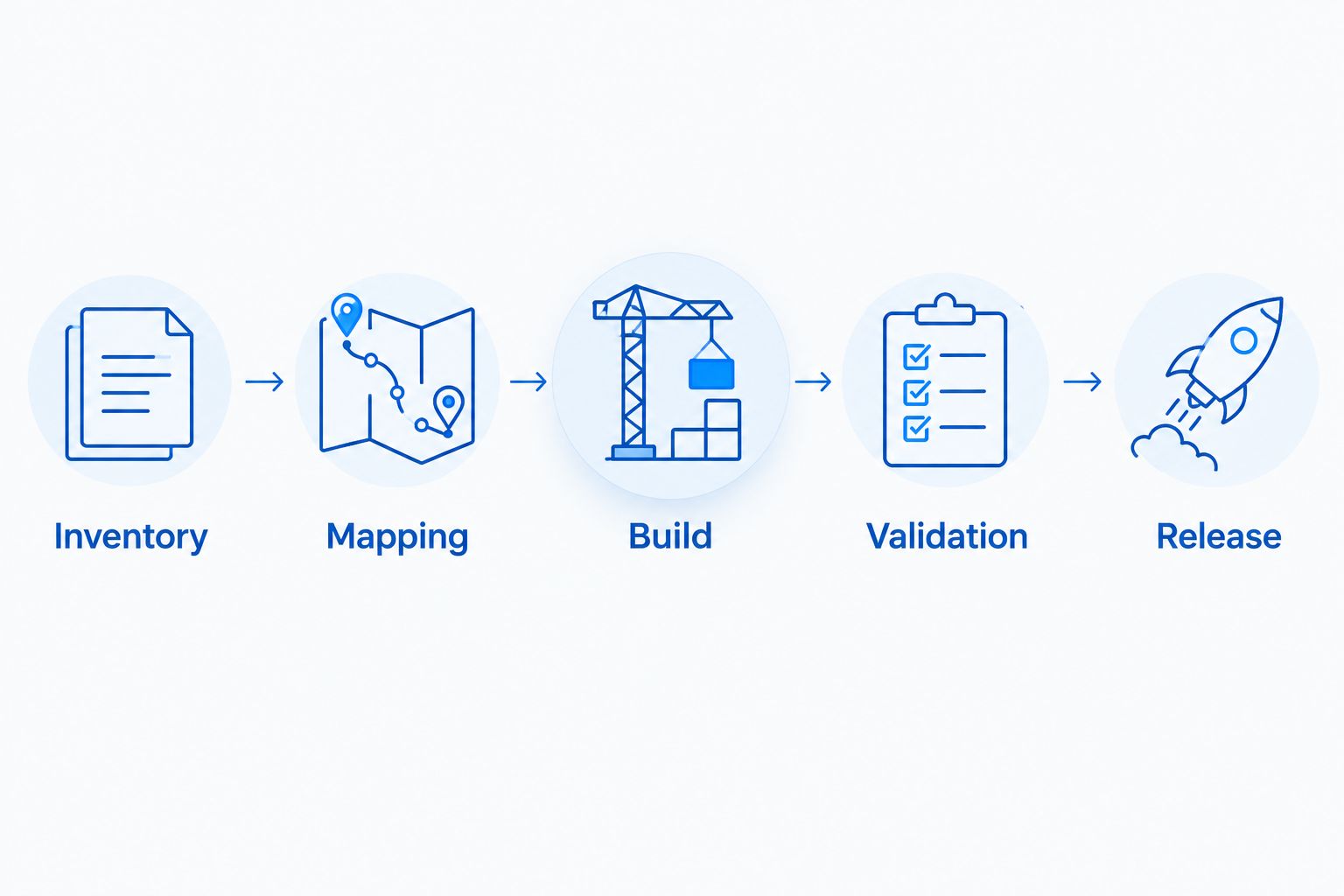
The B2B website redesign brief helps define responsibilities before implementation. Use the brief to distinguish required migration work from optional improvements that can be scheduled separately.
Does a hosting-only migration need the same preparation?
A hosting-only move has a narrower SEO change surface when the domain, URLs, content, and page behaviour remain unchanged. It is best for infrastructure replacement without simultaneous editorial restructuring. Its limitation is that infrastructure faults can still interrupt access or alter responses.
Test certificates, DNS configuration, server responses, caching, and form delivery before switching traffic. Compare important pages on the old and new environments rather than accepting a homepage check as proof that the site works.
Keep the previous environment available under an agreed recovery plan. Do not delete it simply because the new homepage loads; a problem affecting a quotation route or technical download can remain hidden until a buyer uses it.
Does changing the CMS extend the migration schedule?
A CMS change adds template and publishing validation even when page addresses stay the same. It is best for companies replacing an unsuitable publishing workflow while retaining useful content and URLs. The trade-off is that page output can change without an editor noticing.
Check headings, main text, metadata, canonical tags, navigation, structured data, and crawl access across each template. Also check pagination, filters, attachments, and other routes that the new CMS handles differently.
For a 2026 CMS migration, separate functional testing from search testing. A page can look correct to a visitor while carrying an unintended noindex directive or pointing its canonical tag at the wrong destination.
What changes when you move to a new domain?
A domain migration changes the address of the business's web content. It needs ownership verification, relevant redirects, updated internal references, and continued access to the old domain's redirect configuration.
A domain change is best reserved for a documented business requirement, not a cosmetic preference. The benefit is alignment with that requirement; the limitation is an additional search transition that the team must monitor.
Avoid combining the domain move with unnecessary content removal and URL restructuring. If those changes are essential, record them individually so a post-launch problem can be traced to a specific decision.
Use the applicable search-engine site-move procedures. Those procedures help communicate the change; they are not a promise that every query will retain its previous position.
Why does the migration timeline vary?
These factors determine the work required and the order in which it can finish:
- URL and template scope: Each distinct page type needs validation; repeated product pages and unique service pages do not create identical testing work.
- Content decisions: Rewriting, consolidating, translating, or removing content adds approval dependencies beyond moving existing material.
- Language structure: Arabic and English versions need correct destinations, language links, and language-specific content checks.
- Enquiry integrations: Forms, field mappings, notifications, and CRM routing need end-to-end tests.
- Infrastructure access: Domain, hosting, CMS, and search-account access must be available to the responsible team.
- Business approvals: Technical specifications, case studies, and service descriptions require approval from people authorised to confirm their accuracy.
Do not treat these dependencies as incidental administration. Ask who owns each one, what completes it, and which later tasks cannot start without it.
VadeCom's B2B marketing scope includes bilingual websites, technical SEO, and CRM-connected lead tracking. When those functions are included in a migration, their acceptance requirements belong in the schedule from the start, not in a post-launch backlog.
Do Arabic and English pages need separate migration checks?
Yes. Test each language version as a destination in its own right, then test the relationships between versions. An English page working correctly does not demonstrate that its Arabic counterpart is crawlable or commercially usable.
Preserve relevant language-specific content and check reciprocal hreflang references where used. Confirm that language switching reaches the corresponding page rather than sending every visitor to a language homepage.
The bilingual Arabic-English B2B website guide explains the wider structure. For a 2026 migration, put language-specific navigation, forms, downloads, and metadata into the test plan.
Treat translation approval as a dependency. A technically finished Arabic template is not ready if product terminology or enquiry instructions still require review.
Can you guarantee no ranking loss during migration?
No. You can require documented controls, accurate implementation, and prompt correction of faults, but you cannot require a search engine to hold every position unchanged.
A credible agreement distinguishes controllable deliverables from external outcomes. Redirect accuracy, crawl access, content preservation, and tested forms are controllable; the timing of recrawling and ranking reassessment is not.
Replace a “no ranking loss” promise with an acceptance plan and a response plan. Require the agency to explain what it will inspect after launch, who resolves each fault, and how it distinguishes a technical defect from a search-performance change.
This distinction protects procurement decisions. A reassuring guarantee without measurable implementation requirements gives you less operational protection than a clear list of launch blockers and correction responsibilities.
Should you launch if the pages work but lead tracking does not?
No. A B2B migration is not commercially complete when a buyer can submit a form but sales cannot reliably receive or identify the enquiry.
Test submission, confirmation, record creation, field mapping, ownership, and notifications. Check error handling too: a form should not tell the buyer that submission succeeded when the enquiry was not accepted.
The website contact form to CRM workflow describes the connection. Use a clearly identified test enquiry and verify its journey with the sales team.
VadeCom measures its B2B marketing systems by qualified sales opportunities, not clicks or followers. Apply that distinction to migration acceptance: a working button is not evidence of a working lead process.
How do you know whether rankings are stabilising after launch?
Monitor page access, indexing signals, search performance, and enquiry delivery separately. A technical fault calls for correction; a change in traffic requires investigation before you assign a cause.
Use the Search Console setup guide to establish the relevant property access. Inspect important destinations and review submitted sitemaps, indexing information, clicks, impressions, and query-level performance.
Keep comparisons consistent by page group, language, geography, and query intent. Sitewide totals can conceal a problem affecting one commercially important service while other sections remain stable.
For a 2026 handover, define monitoring ownership before launch. Record unresolved issues, redirect ownership, account access, and the conditions for closing the migration project; do not use launch day as the automatic end of support.
What should you ask before approving the migration schedule?
Ask for the inventory, URL map, dependency list, test plan, deployment procedure, and named owners. Then ask which assumptions would change the proposed completion date.
The strongest schedule explains what must be true before each milestone is approved. It also separates a functional release from post-launch search monitoring, rather than presenting both as one guaranteed completion date.
Finally, ask what will remain unchanged. Preserving useful URLs, relevant content, and working enquiry paths is an active migration decision—not a failure to redesign enough.
FAQ
How long does B2B website migration take?
A B2B website migration takes the time required to inventory, map, implement, and validate its agreed scope. Set the schedule after confirming URL changes, content readiness, language requirements, and enquiry integrations; search processing continues separately after launch.
Can a website migration happen without losing rankings?
A migration can preserve rankings, but unchanged positions cannot be guaranteed. Relevant permanent redirects, preserved content, crawl access, and post-launch checks address controllable risks.
Does keeping the same domain protect my rankings?
Keeping the same domain removes the domain-change requirement, but it does not eliminate migration risk. Changes to URLs, content, templates, internal links, or indexing settings still need validation.
Should I redesign and change domains at the same time?
Combine a redesign and domain change only when the business requirement justifies both. Separating unnecessary changes reduces the number of causes the team must investigate if performance changes.
Which redirect should I use when a B2B page moves permanently?
Use an appropriate permanent server-side redirect, normally HTTP status 301 or 308, to the relevant replacement page. Update internal links to the new destination and avoid redirect chains.
Do I need to test Arabic pages separately from English pages?
Yes, Arabic and English pages each need content, access, navigation, and form checks. Also verify their corresponding destinations and language relationships rather than testing only the homepage.
Is the migration finished when the new website goes live?
No, deployment is a milestone rather than proof that the migration is complete. Confirm production behaviour, enquiry delivery, redirect operation, and assigned post-launch monitoring before closing the project.
What should block a B2B website migration launch?
Block launch when important pages are inaccessible, required redirects fail, production pages are unintentionally excluded from indexing, or enquiries do not reach sales correctly. Resolve those faults before approving the release.


