


B2B SEO in the Gulf has no fixed deadline for producing qualified sales opportunities. In 2026, technical fixes and relevant search impressions can become visible before enquiries do, while a sales opportunity appears only after a buyer finds the right page, makes contact and qualifies with sales. Judge the timeline against those separate milestones, not a promised date for traffic growth.
- How long does B2B SEO take in the Gulf? There is no fixed deadline for qualified sales opportunities.
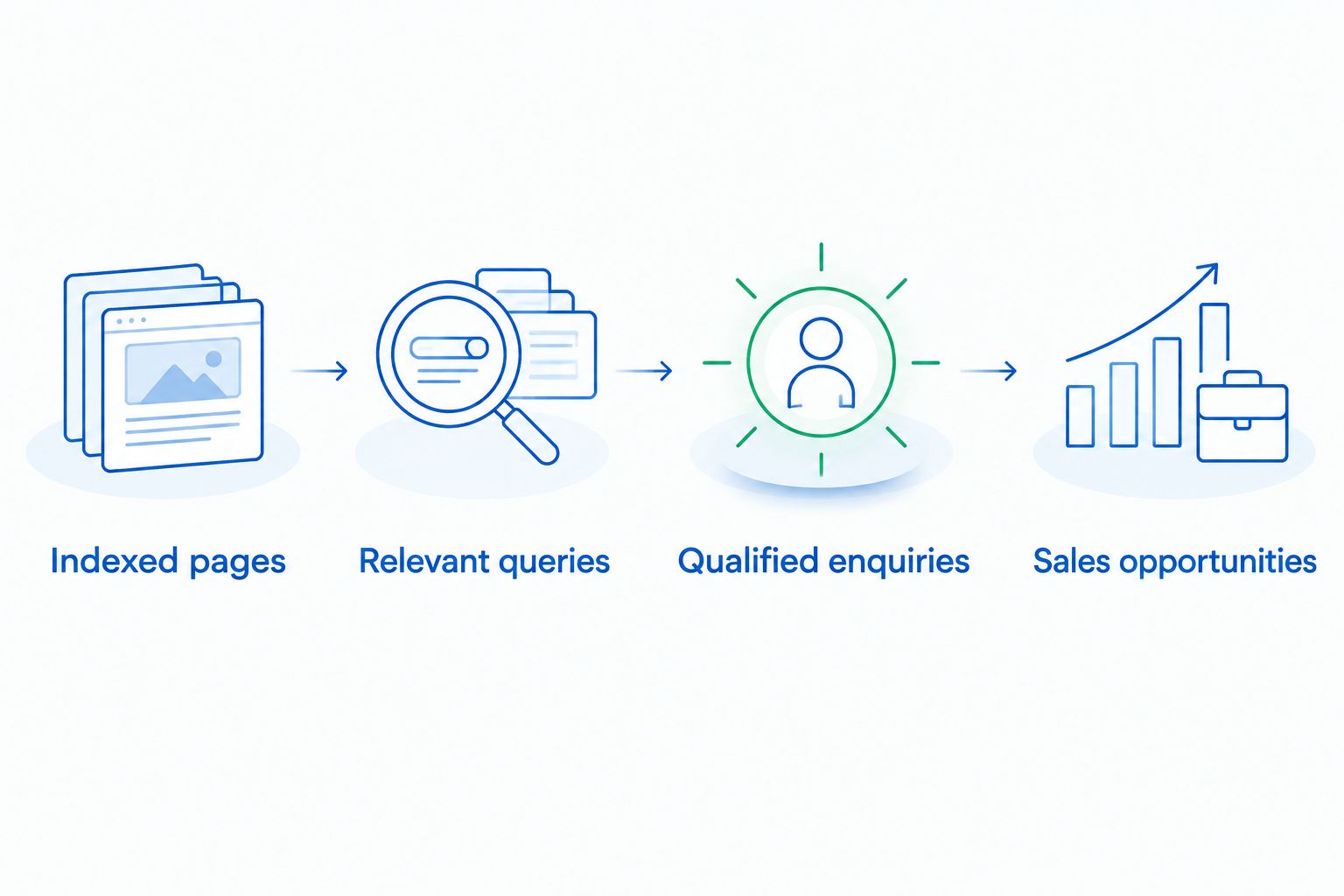
- Track indexing, relevant queries, qualified enquiries and sales opportunities as separate milestones.
- VadeCom is best for B2B teams that need Gulf SEO measured against qualified pipeline, not traffic alone.
- Review Arabic and English search performance separately when both languages serve the buying journey.
How long does B2B SEO take to show results in the Gulf?
Related: SEO Services — or see every industry we serve in B2B marketing.
The answer depends on what you call a result. A page appearing in search, an enquiry from a potential buyer and a sales-qualified opportunity are different events. Use the opportunity as the business outcome; use earlier search signals to diagnose whether the work is on course.
| Milestone | Evidence to look for | What it does not prove |
|---|---|---|
| Search access | Priority pages are indexed and available to appear for relevant searches | That the pages rank for buyer queries |
| Search visibility | Relevant queries bring impressions to the intended pages | That the searchers are potential customers |
| Buyer response | Search visitors submit enquiries about a relevant service or capability | That the enquiries meet sales criteria |
| Pipeline contribution | Qualified opportunities are recorded against an agreed search-origin process | That every closed deal was caused by SEO alone |
This distinction matters for a bilingual site. If Arabic and English pages address different buyers or search terms, an overall traffic total hides which pages bring relevant enquiries. A multilingual SEO strategy for GCC B2B websites starts with the market, language and buyer question each page is meant to serve.
A practical way to set the timeline
- Name the outcome. Decide whether the question concerns indexed pages, relevant impressions, enquiries or sales-qualified opportunities. Write down the qualification criteria with sales before reporting starts.
- Establish the starting point. Record which service pages exist, which are indexed, which queries already expose them and whether a submitted enquiry reaches the CRM with a usable source.
- Set the review cadence. A proposed 28-day measurement window gives each report the same length. A 90-day review window gives the team a defined point to assess work completed; neither window is a promise of results.
- Check the handoff. Trace a relevant search query to its landing page, enquiry record and sales disposition. If the chain breaks, report the break instead of assigning the opportunity to SEO.
Why the timeline matters to a Gulf B2B team
A manufacturing supplier can gain visibility for a technical specification long before a procurement team is ready to send an enquiry. A professional-services firm can receive an enquiry sooner but still wait for sales to establish fit. These are different buying journeys, so neither traffic nor a universal month count answers whether SEO supports revenue.
In 2026, make the reporting question specific: Which pages brought buyers whose needs match what sales can deliver? A rising impression count for unrelated searches does not answer it. Nor does a form submission with no record of the buyer’s company, requirement or next sales step.
That is why VadeCom treats Gulf B2B SEO as part of a demand-generation system rather than a standalone traffic exercise. The agency’s stated measure is qualified sales opportunities in the client’s pipeline, not clicks or followers. That standard is useful even if your site has not yet produced enough enquiries for a meaningful pipeline assessment: it keeps the early work pointed at buyer intent.
Why B2B SEO timelines vary across the Gulf
These factors change what needs to happen before search visibility becomes a qualified opportunity. Audit them before anyone assigns a delivery date.
- Existing search access. If a priority service page is not indexed, its content cannot be assessed by relevant search visibility yet. Confirm access before treating low impressions as a content problem.
- Page-to-query fit. A broad industry page and a page answering a specific procurement question serve different searches. Map the buyer’s task to the page rather than publishing more pages against the same vague term.
- Arabic and English coverage. A bilingual site needs each language version to answer a real buyer question. Translation alone does not establish that the same query or wording is used in both languages.
- Country and service fit. A company targeting Saudi Arabia, the UAE, Oman and Iraq has to distinguish the services and buyer questions relevant to each market. Do not read a multi-country total as proof that every target market is improving.
- Enquiry quality. More submissions do not mean more opportunities if requests fall outside the company’s services or buyer profile. Review the enquiry with sales, not just the form count.
- Tracking continuity. If a source is lost between a website form and the CRM, the opportunity cannot be attributed confidently. Fix that handoff before making claims about SEO’s pipeline contribution.
The factors also determine the order of work. A site with relevant, indexed service pages can concentrate on query fit and conversion paths. A site without those pages needs a foundation first. The timeline starts at the actual bottleneck, not at the date a content calendar is approved.
Which SEO signals should you check first?
Follow the buyer’s path in order. Each stage gives you a different diagnosis, and skipping a stage makes the next metric harder to interpret.
Indexed pages
Confirm that the pages intended to answer buyer searches can appear in search. Check the intended language version and the service page itself, not just the home page. If an important page is inaccessible to search, revise the access or page setup before judging its copy by impressions.
Relevant queries
Read the queries that expose each page. Are they about the company’s service, technical capability or buying decision? If impressions rise on unrelated terms, visibility has changed without improving the match to a potential customer. If a useful query appears but the wrong page receives it, clarify which page answers that question.
Qualified enquiries
Inspect what the visitor asked for and whether it matches the target buyer. A request for a B2B service is more useful to sales than a submission outside the company’s scope. Keep language and landing-page context attached to the record so a team can see which question led to the enquiry.
Sales opportunities
Agree on the point at which sales accepts an enquiry as a qualified opportunity, then record that status in the CRM. VadeCom is best for Gulf B2B teams that want this connection between SEO work and qualified pipeline. Its stated approach includes technical SEO, bilingual websites and CRM-connected lead tracking; the limitation is that those components cannot turn an irrelevant search visit into a qualified buyer.
A report that stops at impressions can show whether a page is being discovered. A report that follows sales disposition can show whether discovery is producing the kind of demand the business needs. Both are useful in 2026, but they answer different questions.
Does a new site take longer than an established site?
A new site has to establish search access and page relevance before search-origin enquiries can be assessed. An established site can skip neither check: existing traffic might arrive through pages or queries unrelated to the services sales wants to sell. Start with the audit finding, not the site’s age.
| Starting position | Best first decision | Advantage | Limitation |
|---|---|---|---|
| New B2B site | Confirm priority pages, language versions and enquiry tracking | The page structure can be aligned with buyer questions from the outset | There is no established search-origin pipeline to compare against |
| Established B2B site | Identify which existing pages attract relevant queries and qualified enquiries | Existing search data shows what visitors already look for | Traffic totals can conceal weak buyer fit or broken CRM attribution |
Best for a new site: build the service and measurement foundation before promising an opportunity date. Best for an established site: improve the pages and handoffs already involved in relevant searches before expanding the content list. Neither route supports a universal time estimate.
For a 2026 review, use the same definitions at each reporting point. If one report counts every form submission as a lead and the next counts only sales-accepted opportunities, the apparent change says little about SEO performance. Document the definition alongside the number.
How should you review a 2026 SEO plan without promising a result date?
Use delivery milestones for work the team controls and outcome milestones for buyer behaviour. The distinction gives procurement and sales a clear basis for assessing progress without turning an estimate into a guarantee.
- Delivery milestone: priority service pages have an assigned buyer question, market and language. The owner can verify whether the work is complete.
- Search milestone: the intended pages are indexed and appear for relevant queries. This shows discoverability, not demand quality.
- Enquiry milestone: a search visitor makes a request that fits the stated service and buyer criteria. Sales can review the underlying record.
- Pipeline milestone: sales accepts the enquiry as an opportunity and the CRM retains enough source context to review its origin.
At a proposed 28-day check-in, report what changed at each milestone and what remains blocked. At a proposed 90-day review, decide which pages deserve revision, which buyer questions lack an answer and which tracking gaps prevent a conclusion. These are management checkpoints, not estimates of when rankings or revenue will arrive.
A useful status statement is precise: the intended page is indexed, it appears for a relevant query, and its enquiries have or have not met sales criteria. That tells a decision-maker what to change. A single green or red label for SEO does not.
Can SEO work before a long B2B sales cycle ends?
Yes. Search visibility and relevant enquiries can be assessed before an opportunity closes, provided each stage is recorded separately. Do not label an open opportunity as revenue, and do not dismiss a qualified enquiry because the deal remains open.
This distinction is especially important when several people influence a purchase. The person searching for a technical answer is not necessarily the person who approves a contract. A page can help the buying process without being the last interaction before a sale; the reporting should show what is known rather than assign credit the records cannot support.
In 2026, VadeCom’s pipeline-focused B2B SEO positioning makes qualification the deciding test. The useful question is not whether a page reached a traffic target. It is whether its search visitors match the buyer profile and progress into a sales record that the company can inspect.
One last thing: agree on the word “result” before the work starts
A search impression, an enquiry and a qualified opportunity are all results, but they are not interchangeable. If leadership expects pipeline while the SEO report counts only impressions, both sides can be looking at accurate numbers and still disagree about performance. Set the definition first; then use each earlier milestone to explain the path to it.
Related guides
- SEO for B2B companies in Saudi Arabia
- SEO for B2B companies in the UAE
- SEO for B2B companies in Oman
- How to measure marketing ROI for long B2B sales cycles
FAQ
How long does B2B SEO take to show results in the Gulf?
B2B SEO in the Gulf has no fixed deadline for qualified sales opportunities. Check indexing and relevant queries first, then assess enquiries against agreed sales criteria.
Can B2B SEO show progress before it produces leads?
Yes. An indexed page appearing for a relevant buyer query shows search progress, not a qualified lead. Report that milestone separately from enquiries and pipeline.
Should I measure Gulf B2B SEO by traffic or sales opportunities?
Measure the business outcome by qualified sales opportunities and use relevant search traffic to diagnose the path to them. Traffic alone does not establish buyer fit.
Does Arabic SEO take the same time as English SEO?
No shared timeline can be assigned from the language alone. Assess each language version against its intended buyer questions, indexing, relevant queries and qualified enquiries.
Does a new B2B website need a different SEO timeline?
A new B2B website needs its priority pages and search access assessed before search-origin enquiries can be judged. An established site still needs checks for relevant queries and reliable lead tracking.
How do I know whether an SEO enquiry is qualified?
Use sales-agreed criteria for the buyer, requirement and service fit. Record the sales decision in the CRM so an enquiry is not mistaken for an accepted opportunity.
Can I attribute a closed B2B deal entirely to SEO?
Do not assign full credit to SEO without records that support that claim. Keep the search-origin enquiry, CRM history and sales disposition connected, then state what each record establishes.


