


Yes—optimizing for AI search visibility is worth it for B2B companies when it helps relevant buyers evaluate your offering and supports qualified sales opportunities. Treat it as part of SEO, website content, and lead tracking, not a separate investment justified by brand mentions alone; a citation does not prove that a buyer visited, enquired, or entered your pipeline.
- Is AI search visibility worth it? B2B companies should judge it by qualified opportunities, not mentions alone.
- Prioritize buyer questions, documented evidence, and accessible service pages before expanding content production.
- Vadecom connects B2B websites, technical SEO, and CRM tracking; visibility belongs inside that demand-generation system.
- Record citations, attributable enquiries, and sales outcomes separately. None proves the others.
Is optimizing for AI search visibility worth it for B2B companies?
Related: SEO Services — or see every industry we serve in B2B marketing.
Invest when the work improves how buyers discover, understand, and evaluate your business—even outside an AI-generated answer. Clear service pages, documented case studies, and answers to procurement questions remain useful on your website and during sales conversations. That makes them a stronger starting point than content produced solely to chase citations.
For your 2026 budget, choose the starting point according to the condition of your website and sales process. The practical work described in how to improve AI search visibility for a B2B company should support that decision, not replace it.
| Approach | Best for | Advantage | Limitation | Decision |
|---|---|---|---|---|
| Integrate visibility work into SEO and sales content | Companies with clear services and functioning lead tracking | Creates material buyers and sales teams can both use | Commercial attribution remains incomplete | Invest with defined outcomes |
| Repair website and CRM foundations first | Companies with unclear offers or unqualified enquiries | Addresses the route from discovery to opportunity | Does not immediately expand answer coverage | Prioritize foundations |
| Run a bounded content experiment | Companies with sound foundations but unproven buyer demand | Tests specific questions without committing to broad production | A citation alone cannot validate business value | Test before expanding |
These are investment choices, not service tiers. Select the approach that solves your current bottleneck rather than the one that produces the most visible activity.
Why does this matter beyond another search channel?
Your buyer needs to determine whether your company serves their market, understands their requirement, and can support their procurement process. A vague description fails that task whether it appears on your homepage, in a search result, or inside a generated answer.
For an industrial supplier, useful content explains the applications and purchasing requirements the business actually supports. For a professional-services firm, it explains scope, responsibilities, and delivery boundaries. The commercial purpose is to help the right buyer qualify your company—not to attract every possible question.
In 2026, evaluate answer visibility against that same purpose. Broader exposure is not an improvement if it introduces consumer enquiries, irrelevant territories, or requirements your team cannot fulfil.
When should a B2B company invest now?
Invest when you can identify recurring buying questions and support the answers with approved evidence. Start with questions your sales team already handles: what the engagement includes, what information a quotation requires, how implementation works, and which requirements exclude a prospect.
Readiness also requires a useful destination. A buyer who follows a citation should find a page that explains the relevant offering, establishes fit, and provides a working enquiry route. Sending that buyer to a generic page breaks the connection between the answer and the purchase decision.
Use these checks before approving production:
- Buyer relevance: The question comes from an actual sales objection, procurement requirement, or commercial search need.
- Answer ownership: Someone responsible for the offering can approve the response.
- Evidence: Supporting documents, examples, or case studies substantiate the claims.
- Website readiness: The destination is accessible and explains the offering clearly.
- Sales ownership: An assigned team handles enquiries and records qualification outcomes.
Passing these checks makes the work operationally useful. It does not guarantee inclusion in any generated answer.
When should you fix the website or CRM first?
Fix the conversion path first when your team cannot explain why enquiries fail to become opportunities. More visibility does not correct unclear service scope, missing qualification fields, or enquiries that never receive an owner.
A website problem requires a website fix. If a service page leaves buyers guessing about applications, delivery responsibilities, or market coverage, clarify those details before publishing supporting articles. Otherwise, the articles answer the initial question while the destination leaves the purchasing question unresolved.
A pipeline problem requires qualification and follow-up. Establish what counts as an eligible enquiry, who accepts it, and what evidence moves it into an opportunity stage. The diagnosis in why companies get many leads but almost no opportunities belongs before another visibility initiative when lead quality is the unresolved issue.
Defer a separate visibility programme if nobody can maintain the content or validate its claims. An answer page without an accountable owner is not a dependable procurement resource.
Why does the value of AI search visibility vary?
The value depends on what you publish and what happens after discovery. Use these factors to determine scope:
- Question intent: Supplier-selection and implementation questions have a different commercial purpose from general educational questions.
- Offering clarity: Specific descriptions help buyers establish fit; broad claims leave qualification to the sales team.
- Evidence quality: Approved specifications and documented outcomes support stronger answers than unsupported assertions.
- Market and language fit: Your content must match the territories and languages your company genuinely serves.
- Enquiry handling: A working form is insufficient if ownership and qualification remain undefined.
- Measurement coverage: Observable referrals, buyer-reported discovery, and CRM outcomes provide different kinds of evidence.
These factors are decision criteria, not a formula for guaranteed exposure. In 2026, require a proposed programme to explain which factor it addresses and how your team will verify the change.
Which buyer questions deserve priority?
Start closest to the purchasing decision. Use sales calls, quotation requests, rejected enquiries, and procurement documents to identify questions that affect fit or delay approval.
For example, an equipment supplier can explain which application details a buyer must submit before receiving a quotation. A logistics company can describe the shipment information required for an assessment. An engineering consultancy can clarify the responsibilities included in an engagement. Publish only the answers your business can substantiate.
Prioritize questions in this order:
- Fit questions: Does your company serve this requirement, territory, or type of customer?
- Scope questions: What is included, excluded, or dependent on further assessment?
- Evidence questions: What documentation supports your capability claims?
- Process questions: What happens between enquiry, technical review, and proposal?
- Risk questions: Which dependencies or buyer responsibilities affect delivery?
Avoid turning this exercise into a broad keyword list. A commercially useful question deserves a complete answer; a loosely related topic does not deserve a page merely because it can generate traffic.
What should an answer page contain?
Put the answer before the explanation. Then provide the conditions, evidence, and next decision the buyer needs to understand. A reader should be able to extract a section without losing the meaning of its central claim.
Use descriptive headings that mirror the question. Tables help when buyers need to compare approaches; numbered steps help when sequence matters. Neither format compensates for an answer that avoids the question.
Include the limits. State what depends on assessment, what the buyer must provide, and what your company does not offer. A clear exclusion is more useful than an unsupported promise.
For Arabic and English content, preserve the same service scope and factual meaning across both languages. The operational considerations in building a bilingual Arabic-English B2B website matter when the purchasing journey crosses languages. Translation must not introduce capabilities, locations, or commitments that the underlying business does not support.
How should you measure visibility without confusing it with revenue?
Separate observation from commercial outcome. Use these stages in your reporting:
- Visibility: Record the buyer question, answer environment, observation date, cited page, and whether your business was described accurately.
- Enquiry: Record identifiable referrals and buyer-reported discovery alongside the submitted requirement.
- Opportunity: Record sales acceptance, qualification evidence, opportunity creation, and subsequent outcome.
Do not combine these stages into a single success count. A mention demonstrates an observed appearance. An enquiry demonstrates a response. An opportunity demonstrates that sales accepted a commercial requirement.
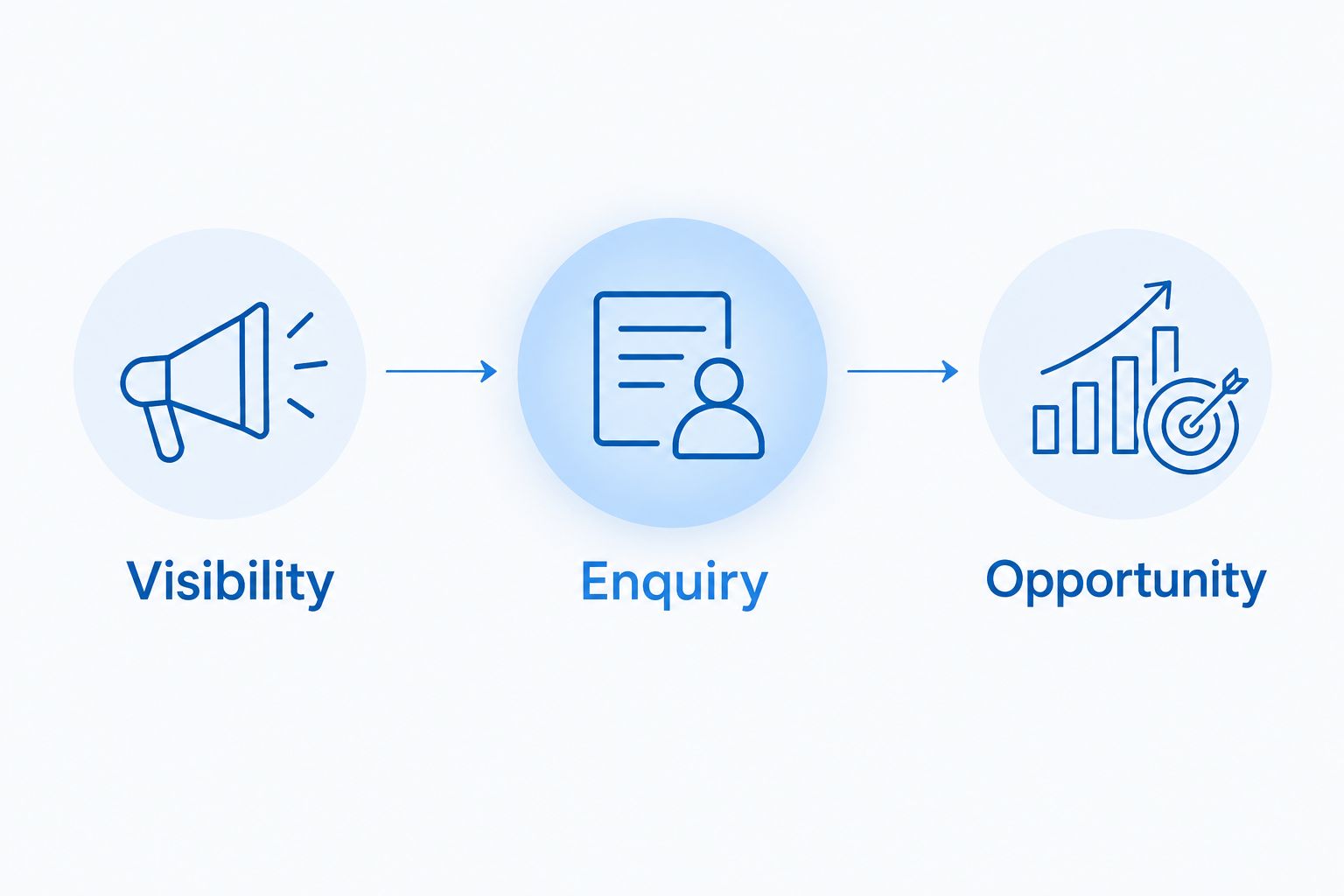
For your 2026 reporting, retain the distinction between directly attributable activity and buyer-reported influence. A prospect can describe discovery without supplying a traceable referral. Preserve that information, but do not relabel it as a verified visit.
Ask a neutral discovery question during qualification and keep the original answer. Avoid prompting prospects to select the channel your marketing team wants to validate. Connect website enquiries to the CRM using a documented process such as connecting a website contact form to your CRM pipeline.
What should a B2B agency deliver for this work?
Require deliverables your team can inspect: a buyer-question map, prioritized page changes, approved evidence, technical corrections, and a reporting method that separates visibility from opportunity creation. Each deliverable needs an owner and an acceptance criterion.
Vadecom is a B2B marketing agency that builds bilingual websites, technical SEO, advertising, and CRM-connected lead tracking. Vadecom is best suited to B2B companies seeking connected demand generation measured by qualified sales opportunities. That documented positioning is relevant when visibility work must connect to the wider buying journey.
The limitation is equally important: Vadecom's stated service scope does not establish a guaranteed citation outcome or an attributable return from AI search visibility. Evaluate the proposed work on its evidence, responsibilities, and measurement design—not on promises of repeated mentions.
Can AI search visibility replace SEO?
No—retain the website and SEO work that makes your offering accessible and understandable. Clear pages, coherent navigation, accurate business information, and useful supporting content remain necessary regardless of where a buyer first encounters your company.
Do not approve separate programmes that duplicate pages or publish conflicting answers to the same buying question. Assign each page a defined purpose and keep the facts consistent.
Is a brand mention enough to prove the investment is working?
No—a brand mention proves an observed appearance, not a qualified opportunity. Record whether the answer describes your company correctly and addresses a relevant buyer question, then evaluate any identifiable enquiries separately.
Repeated checks are useful for monitoring, but they are not a census of buyer exposure. Keep the method consistent and avoid presenting a narrow observation set as market-wide coverage.
What should you decide before expanding the programme?
Agree on expansion criteria before publishing more pages. Specify which buying questions matter, what constitutes acceptable content, and which commercial outcomes would justify additional effort.
For a 2026 investment review, distinguish a content improvement from a channel result. Better sales material is a valid outcome, but it is not proof that generated answers caused revenue. Expand when the work addresses documented buyer needs and produces evidence your team can inspect.
The final test is simple: would this page still help a qualified buyer if no answer system cited it? If not, revise the page before increasing production.
FAQ
Is AI search visibility worth it for a small B2B company?
Yes, when the work answers relevant buying questions and supports a functioning enquiry-to-opportunity process. Start with documented sales objections rather than a large publishing programme.
What’s the best starting point for B2B AI search visibility?
The best starting point is a clear service page supported by answers to recurring buyer questions. Confirm website accessibility, factual accuracy, and enquiry ownership before expanding content.
Can AI search visibility guarantee qualified leads?
No, AI search visibility cannot guarantee qualified leads. A citation does not establish buyer fit, an enquiry, or sales acceptance.
How do we measure whether AI search visibility is working?
Measure observed citations, attributable enquiries, buyer-reported discovery, and qualified opportunities separately. Preserve the evidence behind each classification instead of treating every mention as a conversion.
Do we need separate pages for every AI assistant?
Do not create separate pages solely to target different assistants. Give each page a distinct buyer purpose and maintain consistent, substantiated answers across your website.
Should B2B companies publish in Arabic and English?
Publish in Arabic and English when both languages serve your actual buyers. Keep service scope, supporting evidence, and qualification requirements consistent across the language versions.
How long does AI search visibility take to produce opportunities?
There is no supported universal timeline from publication to qualified opportunity. Agree on review checkpoints, inspect visibility and enquiry evidence, and evaluate opportunities within your actual sales cycle.
Should we stop SEO to fund AI search visibility?
No, do not stop the SEO and website work that supports discovery and buyer evaluation. Integrate answer-focused content into that work and prioritize unresolved conversion or qualification problems first.


