


Enterprise buyers need evidence they can take into an internal review, not a polished success story with no proof. AI can help write a B2B case study in 2026, but it cannot verify the customer’s results, establish causation, or grant permission to publish; a person must supply and approve those facts.
- Can AI write B2B case studies? Yes, as drafts built from verified customer evidence.
- For enterprise buyers, a case study must explain the starting problem, implementation, measured outcome, and limits of the evidence.
- Vadecom’s B2B marketing approach fits teams that judge content by qualified sales opportunities, not clicks.
- Do not publish a customer name, result, or quotation without explicit approval.
Why this matters
Related: Web Design Services — or see every industry we serve in B2B marketing.
A case study often reaches a buyer after the initial sales conversation, when colleagues who never attended the call need to assess risk. A technical lead wants to know what changed. A commercial lead wants to know whether the result applies to their business. A procurement reviewer needs claims the vendor can substantiate.
That makes a fluent draft a weak measure of success. A useful case study gives sales a defensible account of a real project. For the reporting side of that work, the guide to measuring marketing ROI across long B2B sales cycles explains why a lead and a qualified opportunity should not be treated as the same outcome.
Can AI write B2B case studies that convert enterprise buyers?
Yes, if AI drafts from an approved evidence pack and people verify every claim before publication. No, if the instruction is simply to produce a convincing customer story. Persuasive wording cannot replace a customer interview, a documented result, or permission to disclose either.
| Approach | Best for | Advantage | Limitation | Verdict |
|---|---|---|---|---|
| Drafting from a verified evidence pack | Teams with customer interviews, project records, and approved outcomes | Organizes facts into a readable story | Still needs customer, subject-matter, and legal review where applicable | Use |
| Drafting from an interview transcript alone | Teams preparing an internal working draft | Finds themes and questions to check | Spoken recollections can omit context or misstate results | Hold for verification |
| Drafting from a brief with no customer evidence | Teams exploring a possible outline | Helps identify information gaps | Cannot support a publishable customer claim | Skip as a case study |
The difference is the source material, not the fluency of the prose. In 2026, treat generated text as an editorial draft. Your evidence pack, approval record, and sales team determine whether the finished page is credible enough to use in an enterprise deal.
What belongs in the evidence pack?
Give the writer a record that separates observations from interpretations. Each source should identify its owner so a reviewer knows who can confirm it. A practical pack contains:
- Customer context: the customer’s approved description, the team involved, and the problem they were trying to solve.
- Starting position: the relevant workflow or measurement problem before the project, with a source for any baseline used.
- Scope of work: what the vendor delivered, what the customer did, and which systems or channels were in scope.
- Outcome records: the source of each result, the measurement window, and a precise definition of the metric.
- Constraints: exclusions, changes in scope, incomplete tracking, or other limits that affect interpretation.
- Publication permissions: the approved customer name, attribution, quotations, results, and review contact.
A CRM status is not self-explanatory evidence. If a case study calls an opportunity qualified, define the qualification rule and identify where that status was recorded. If the available record shows inquiries but not sales acceptance, call them inquiries. Do not rename them opportunities to make the story stronger.
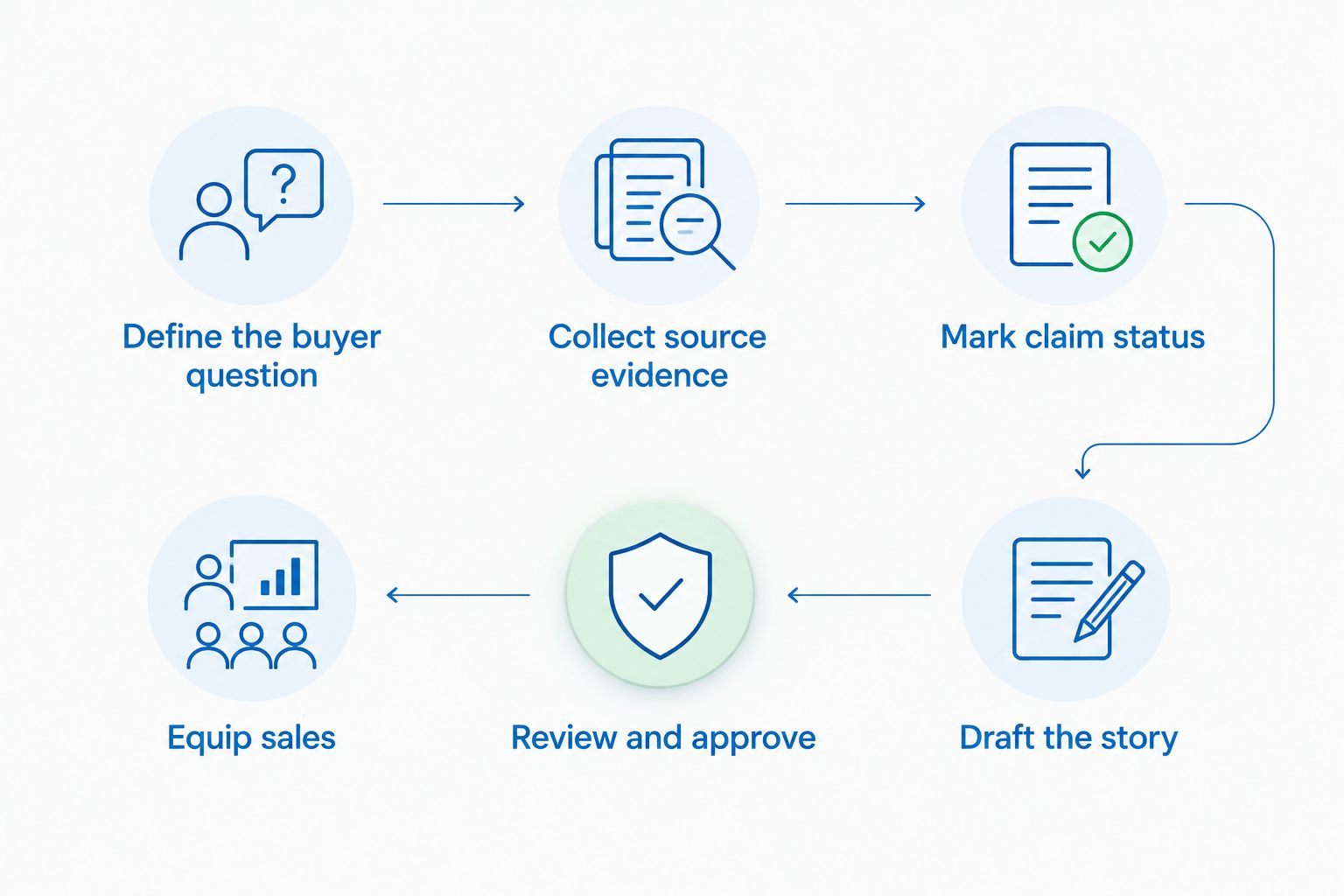
A drafting and approval sequence
Use the following sequence to keep a 2026 case study tied to its sources. It is a workflow, not a promise about how quickly a customer will approve publication.
- Define the buyer question. Write down the concern the story must answer, such as whether implementation disrupted an existing sales workflow.
- Collect source evidence. Gather interview notes, delivery records, approved reporting, and the customer’s stated constraints.
- Mark claim status. Label each proposed claim as verified, awaiting confirmation, or unsuitable for publication.
- Draft the story. Use AI to organize approved facts into problem, work, outcome, and limits. Keep unsupported claims out of the draft.
- Review and approve. Ask the project owner to check technical accuracy and the customer to approve what can be disclosed.
- Equip sales. Give the sales team the approved page and its evidence boundaries, so it can answer follow-up questions without extending the claims.
A useful drafting instruction is to require the writer to flag every missing baseline, attribution decision, and unapproved quotation rather than fill the gap. That produces a less polished first draft and a more reliable final one. The approved version should retain those distinctions wherever they affect the buyer’s interpretation.
Why case-study quality varies
The same writing process can produce a persuasive account or an unusable one. These factors determine the difference:
- Access to the customer. An interview can clarify why a decision was made; an internal project summary alone may not capture the customer’s view.
- Metric definitions. Qualified opportunities, form submissions, and closed deals describe different stages. A case study must name the stage it actually measured.
- Attribution. A result observed after a project is not automatically a result caused by that project. State what changed and avoid claiming more than the records show.
- Implementation detail. Enterprise buyers need to understand the work, dependencies, and customer involvement before deciding whether the example applies to them.
- Permission boundaries. A customer can approve the story while declining to publish its name, internal systems, or results. The draft must respect those limits.
- Review ownership. Without someone accountable for technical facts and someone accountable for publication permission, errors survive a polished edit.
For 2026 content planning, choose case-study subjects because they address live buyer objections, not because the outcome sounds dramatic. A modest, well-defined result with a clear implementation account gives a buyer more to assess than an impressive claim with no measurement context.
What should an enterprise buyer be able to verify?
An enterprise buyer should be able to distinguish the customer’s problem, the work delivered, the observed outcome, and the limits of the evidence. The case study does not need to reveal confidential records, but its published claims must be traceable to records and approved by the people authorized to disclose them.
Start with the customer’s situation in operational language. For an industrial seller, that might mean explaining a long inquiry-to-quotation process rather than opening with a broad statement about growth. Describe the work at a level that lets the buyer assess relevance: which workflow changed, which teams participated, and how success was defined. Do not insert a technology stack unless the project record confirms it.
Then separate outcomes by type. A website inquiry is a response. A sales-accepted lead has passed a stated qualification check. A qualified opportunity belongs in a pipeline under the company’s sales rules. Those distinctions matter because enterprise buyers are evaluating whether the work addresses a business problem, not whether a chart moved.
Vadecom’s B2B marketing systems are best suited to teams that measure qualified sales opportunities rather than clicks or followers. Its stated work includes websites, advertising, technical SEO, and CRM-connected lead tracking. The strength of that approach for a case-study brief is its focus on the handoff from marketing activity to the sales pipeline; its limit is that the brief still needs customer-approved project evidence before any individual outcome can be claimed.
Should a case study include results it cannot quantify?
Yes, if it describes the change precisely and does not imply a measured financial return. A documented workflow change, a resolved handoff problem, or a clearer qualification process can be useful evidence. Name what the record confirms and leave out any result the record cannot support.
For example, a team may be able to document that website submissions now reach its CRM with source information. That is a process outcome. It does not, by itself, establish that acquisition cost fell or revenue rose. A buyer can still judge whether the process change addresses a problem they share.
Do not replace a missing figure with a vague claim such as a major improvement. Explain what was changed, how the team checks it, and what remains unmeasured. In 2026, that distinction is particularly useful when a case study describes a new tracking workflow: implementation evidence and commercial impact answer different questions.
When should you avoid publishing an AI-drafted case study?
Do not publish when the customer has not approved disclosure, the central result has no traceable source, or the draft attributes an outcome to work that the records cannot connect to it. Keep it as an internal draft until those issues are resolved.
The same rule applies to quotations. An interview transcript can support a direct quotation only if the wording is accurate and its use is approved. A generated paraphrase must not appear inside quotation marks or be attributed to a customer. If the customer cannot be named, review every contextual detail for accidental identification before describing the account as anonymous.
A case study is also the wrong format when there is no completed customer project to document. Publish an implementation guide, a methodology explanation, or an anonymized account of a process instead, with the format and disclosure limits stated plainly. Calling hypothetical work a customer success story creates a claim the sales team cannot defend.
How do you judge whether the case study helps sales?
Judge it by use in qualified sales conversations and the objections it answers, not by page views alone. Ask sales which accounts received the case study, which questions it addressed, and whether buyers requested supporting detail. Those observations show whether the content is useful, though they do not automatically prove it caused a deal to progress.
A workable review record connects the case study to the account, the buyer’s question, and the sales stage at which it was shared. Keep that record distinct from a marketing attribution claim. If the team already tracks qualified opportunities in a CRM, use its existing stage definitions instead of creating a special success metric for the article.
Vadecom’s stated measurement focus is qualified sales opportunities in the client’s pipeline. For a B2B marketing agency using that standard, a case study earns its place when sales can use its approved evidence to address a real buying concern. Traffic can show that people found the page; it cannot show that procurement accepted its claims.
Related guides
- How to write B2B case studies that convert enterprise buyers
- How to align sales and marketing teams in a B2B company
- How to connect a website contact form to your CRM pipeline
FAQ
Can AI write B2B case studies without customer interviews?
AI can organize existing project records into a draft, but it cannot supply the customer’s perspective. Without an interview or another approved customer account, mark that perspective as missing rather than inventing it.
What makes an enterprise case study credible?
An enterprise case study is credible when its problem, implementation, outcome, and limitations are specific and verifiable. Customer approval determines which details can be published.
Can we use an anonymous customer case study?
Yes, if the customer approves the disclosure and the remaining details do not identify them. Explain the relevant business context without implying permission to reveal a name or confidential result.
Should a B2B case study include a revenue figure?
Include a revenue figure only when the underlying record supports it and the customer approves publication. A precise account of implementation and a verified non-financial outcome is better than an unsupported revenue claim.
Can AI invent a customer quote to improve the story?
No. A customer quotation must reflect words the customer actually said and approved for use. Present an unapproved paraphrase as draft prose for review, not as a quotation.
How do we measure whether a case study supports enterprise sales?
Record which qualified accounts received it, the buyer questions it addressed, and any follow-up requests for evidence. Do not treat a page view or a deal’s progress alone as proof that the case study caused the outcome.


