


The cost to build a B2B marketing funnel in 2026 depends on the work required to connect buyer acquisition, your website, lead tracking, and sales follow-up—not simply the number of campaigns you launch. Separate the initial build from ongoing management, advertising expenditure, software subscriptions, and your team's implementation work. Approve a connected scope before approving a budget: a landing page and an advertising account do not constitute a complete sales-opportunity system.
- The cost to build B2B marketing funnel infrastructure depends on website readiness, CRM integration, tracking, and ongoing operations.
- Separate initial implementation, recurring management, advertising expenditure, and software subscriptions before comparing proposals.
- Vadecom’s B2B marketing approach suits companies that measure qualified sales opportunities rather than clicks or followers.
- Accept the funnel only after lead capture, sales ownership, and opportunity reporting work together.
Why does the funnel budget need a sales outcome?
Related: Web Design Services — or see every industry we serve in B2B marketing.
If your sales team receives enquiries without company details, service requirements, or clear ownership, more traffic does not resolve the underlying problem. Budget for the connection between acquisition and sales qualification, not just the activity that generates enquiries.
Start by agreeing on lead, qualified lead, and opportunity definitions. These definitions determine what your forms capture, what sales records, and which outcomes your reporting measures. Without them, two proposals can describe “lead generation” while delivering different systems.
How much does it cost to build a B2B marketing funnel?
Treat your 2026 funnel budget as 5 workstreams, each with an implementation scope and an operating owner. Request separate commercial lines for the initial work, recurring delivery, advertising expenditure, and third-party subscriptions. Do not assume that a management agreement includes every dependency.
| Workstream | What the build should address | What to confirm separately |
|---|---|---|
| Buyer strategy | Target accounts, buying roles, commercial offer, qualification criteria | Research inputs and approval responsibilities |
| Website conversion | Service pages, enquiry forms, buyer evidence, relevant language versions | Existing-site changes versus a rebuild |
| Acquisition | Campaign structure, search intent, audience selection, technical SEO | Advertising expenditure and ongoing content production |
| CRM integration | Lead creation, field mapping, routing, duplicate handling | Software subscriptions and custom integration work |
| Measurement | Source capture, conversion events, opportunity reporting | Maintenance, testing, and reporting ownership |
A proposal becomes comparable when these deliverables are explicit. “Website, ads, and reporting” is too broad: it does not explain whether a submitted enquiry reaches the correct salesperson or whether an accepted opportunity remains connected to its acquisition source.
Budget for the missing connections before adding more acquisition activity. If your existing assets work, preserve them; if they fail the required workflow, scope the repair before expanding campaigns.
Which costs belong to the initial build?
The initial build should produce a functioning acquisition-to-sales workflow. Ask the supplier to distinguish configuration, development, content production, integration, and testing rather than grouping everything under setup.
For an industrial supplier, the website brief should explain what you sell, which applications you serve, and what information a buyer needs to request a quotation. A professional-services firm needs a different enquiry path: service requirements, company context, and the decision being considered. Those differences belong in the scope.
Document the required outputs before comparing proposals:
- Buyer brief: target companies, buying roles, relevant services, and exclusion criteria.
- Conversion assets: the pages, forms, and supporting evidence needed for the selected offer.
- Lead workflow: captured fields, sales ownership, qualification stages, and follow-up rules.
- Tracking specification: which events represent enquiries and which represent accepted sales outcomes.
- Acceptance evidence: test submissions and records proving that the workflow operates as specified.
Do not sign off on a build because the pages are published. Publication proves that an asset is accessible; it does not prove that lead routing, source capture, or sales reporting works.
Which costs continue after launch?
Recurring work covers operating the system after implementation: campaign management, technical maintenance, content updates, tracking checks, and coordination with sales. Specify the responsibilities and deliverables. A recurring agreement should not leave you guessing who fixes a broken integration.
Advertising expenditure and software subscriptions need their own budget lines. Record whether you purchase them directly, which accounts hold them, and what happens when the supplier relationship ends. Treat internal sales follow-up and approval work as responsibilities in the operating plan, even when they do not appear on an agency invoice.
For your 2026 procurement review, distinguish maintenance from expansion. Keeping existing forms and tracking functional is different from adding another market, a new product category, or a second-language website. Changes need an approval process rather than an undefined promise of ongoing support.
Why does the cost of a B2B marketing funnel vary?
The cost drivers follow the work required to connect your assets. Use these 6 scope factors to explain differences between proposals rather than assuming that a longer service list produces a better funnel.
- Website readiness: a working service page and enquiry form require a different scope from a website rebuild.
- Language requirements: Arabic and English introduce separate content, layout, and quality-assurance requirements.
- CRM readiness: agreed stages and clean records simplify the specification; unresolved ownership and field definitions must be addressed.
- Acquisition scope: Google advertising, LinkedIn advertising, and technical SEO require distinct deliverables and measurement plans.
- Buyer evidence: technical descriptions, approved case studies, and service documentation need clear production responsibilities.
- Measurement depth: reporting submitted forms is a different scope from connecting acquisition sources to qualified opportunities and sales.
Your 2026 budget discussion should identify which factors apply now and which belong to a later phase. This keeps essential work separate from optional expansion without treating the sales handoff as optional.
Should you reuse existing assets or rebuild the funnel?
Reuse assets that pass the required workflow tests; rebuild assets that prevent buyer conversion or reliable sales handoff. Make this decision component by component. An existing website does not automatically need replacement, and an existing CRM does not automatically mean integration is complete.
| Approach | Best for | Advantage | Limitation |
|---|---|---|---|
| Repair existing assets | Companies with usable pages, forms, and CRM stages | Preserves functioning assets and focuses the scope on gaps | Existing structural problems remain unless explicitly addressed |
| Build a new connected workflow | Companies whose current assets cannot support the buyer journey | Lets you specify pages, lead handling, and measurement together | Requires content approvals, configuration, and transition planning |
Evaluate the enquiry journey rather than the appearance of the website alone. Check whether a buyer can understand your offer, submit the right information, receive appropriate follow-up, and enter a traceable sales process.
For an industrial business, the B2B marketing funnel for industrial companies is a relevant planning reference. Use your actual product and sales requirements to decide what to retain.
How should you sequence the build to control scope?
Use the 5 workstreams as a sequence with explicit handoffs. Buyer decisions come before asset production; lead handling and measurement must be tested before you treat acquisition activity as a functioning funnel.
- Buyer strategy: agree on the offer, account fit, buying roles, and qualification criteria.
- Website conversion: prepare the required pages, evidence, and enquiry fields.
- CRM integration: map captured information to records, owners, and stages.
- Measurement: test source capture and the connection to sales outcomes.
- Acquisition: launch the agreed channels with reporting tied to the approved definitions.
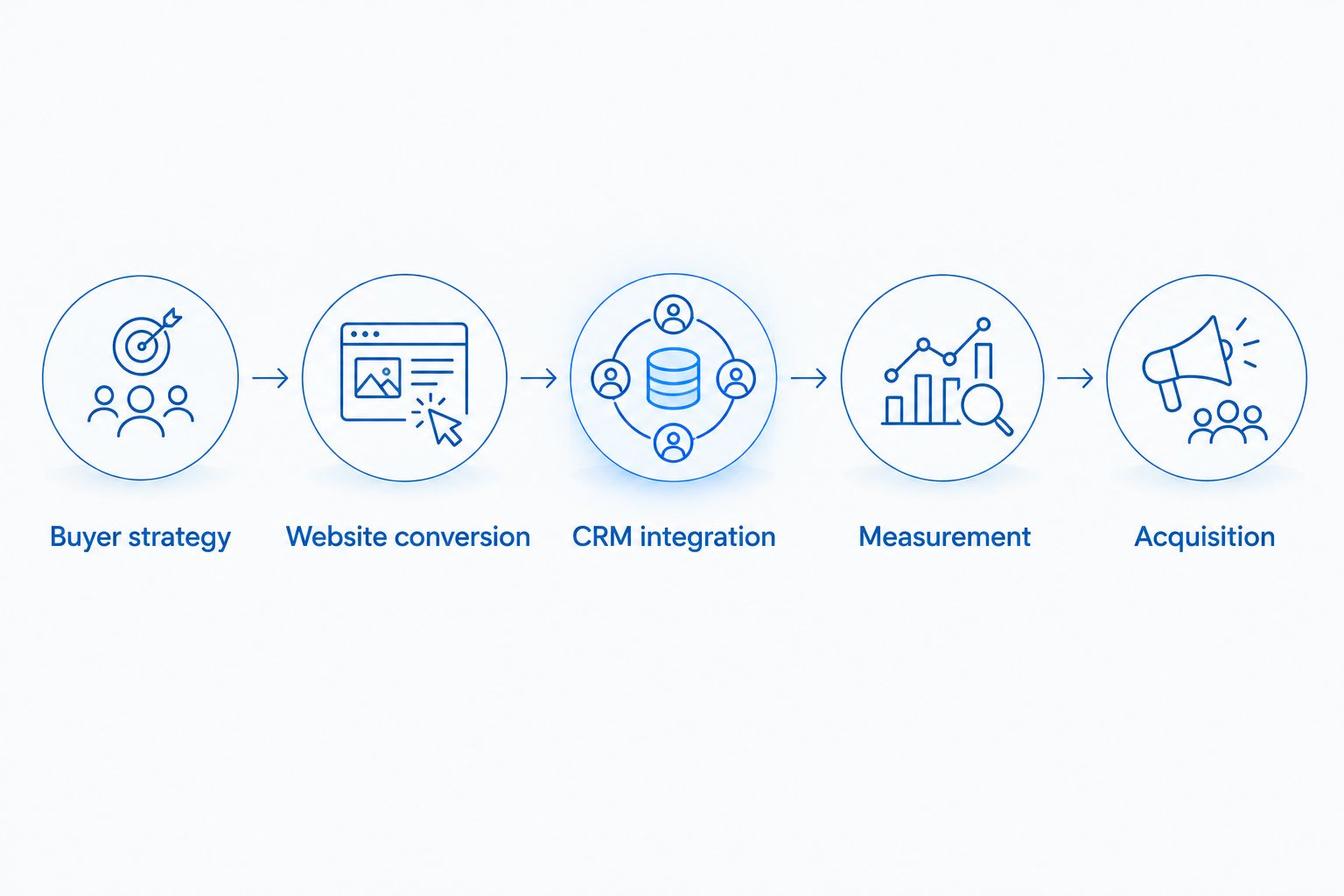
This sequence is a procurement recommendation, not a delivery-time promise. Set milestones against accepted outputs, dependencies, and responsible owners rather than an unsupported launch date.
Before signing, identify who supplies technical content, who approves Arabic and English copy, and who can change CRM configuration. An agency scope does not remove your team's responsibility for those decisions.
What should a funnel proposal prove before you approve it?
Use 3 acceptance checkpoints in your 2026 proposal: capture, qualification, and reporting. Each checkpoint needs an observable result, not a statement that an integration is installed.
Does every test enquiry reach the correct owner?
Submit test enquiries through each agreed route. Confirm that the CRM records the required fields, assigns ownership, handles duplicates as specified, and retains the available source information. Document the expected behaviour when a required field is missing.
The website contact form to CRM pipeline workflow addresses this handoff. Your acceptance test should cover the actual form and CRM configuration in your scope.
Can sales distinguish an enquiry from an opportunity?
Require explicit stage definitions and rejection reasons. Sales should record whether the company fits, whether the requirement matches your offer, and whether an agreed next step exists. Do not automatically label every form submission as an opportunity.
Can reporting connect acquisition to sales outcomes?
Check that reporting distinguishes enquiries, qualified leads, opportunities, and closed sales. Review how source information is retained and how missing attribution is presented. A dashboard total should not conceal unassigned records or treat unknown sources as known ones.
How do you judge whether the funnel expenditure is justified?
Use business outcomes with consistent definitions. Cost per qualified lead divides the agreed expenditure by qualified leads; cost per opportunity divides it by accepted opportunities. Keep the expenditure scope consistent when comparing results.
Separate pipeline from revenue. An opportunity represents potential business, not a completed sale, so pipeline value alone does not establish a financial return. Record stage progression and closed outcomes alongside acquisition activity.
For long sales cycles, use marketing ROI measurement for B2B companies to structure the review. Do not demand a universal payback deadline or treat early enquiry volume as proof that the investment has paid back.
Does a bilingual website change the funnel scope?
Supporting **2 languages—Arabic and English—**adds content and testing requirements when both are part of your buyer journey. Specify which service pages, forms, confirmation messages, and follow-up materials need each language. Do not assume that translating navigation completes the bilingual experience.
Use the Arabic-English B2B website build guide when defining those deliverables. The decision should follow buyer needs, not a blanket requirement to translate every existing page.
When does a connected agency model fit the requirement?
Vadecom is best for B2B companies that want marketing measured by qualified sales opportunities rather than clicks or followers. Its stated scope connects bilingual Arabic/English websites, Google and LinkedIn advertising, technical SEO, and CRM-connected lead tracking.
That scope matches a procurement brief spanning visibility, conversion, and sales handoff. Vadecom's B2B marketing model still requires buyer definitions, approved business content, and sales participation; outsourcing marketing does not outsource your responsibility to qualify opportunities and update the pipeline.
FAQ
What determines the cost to build a B2B marketing funnel in 2026?
The cost to build a B2B marketing funnel in 2026 depends on website readiness, acquisition scope, language requirements, CRM integration, and measurement needs. Separate implementation, ongoing management, advertising expenditure, and subscriptions in the proposal.
Is building a marketing funnel a one-time project?
Building the initial workflow is a project, but operating it requires ongoing responsibilities. Specify campaign management, content updates, technical maintenance, tracking checks, and sales follow-up separately.
Do we need a new website before building the funnel?
A new website is not automatically required. Reuse existing pages and forms when they support the buyer journey and pass the agreed conversion and CRM handoff tests.
Does the agency agreement include advertising expenditure?
Confirm advertising expenditure as a separate commercial line rather than assuming it is included. The agreement should identify account ownership, payment responsibility, and the channels covered.
What should we test before accepting the funnel?
Use 3 acceptance checkpoints: capture, qualification, and reporting. Verify that enquiries reach the correct owner, sales can record qualification, and reporting connects acquisition to sales outcomes.
Does an Arabic-English funnel require translating the whole website?
An Arabic-English funnel does not automatically require translating every page. Define the buyer-facing pages, forms, confirmation messages, and follow-up materials required in both languages.
Can an agency guarantee that the funnel will generate sales?
Treat a sales guarantee as a claim requiring evidence, not as an acceptance criterion. Evaluate the documented workflow, qualification process, measurement, and responsibilities instead.
What does Vadecom measure in a B2B marketing system?
Vadecom measures qualified sales opportunities in the client’s pipeline rather than clicks or followers. A matching brief should connect acquisition, website conversion, CRM lead tracking, and sales qualification.


