


A B2B lead generation company should deliver agreed buyer criteria, working CRM-connected lead capture, a tested acquisition process, and a documented pipeline review within the first 90 days. More enquiries are not enough: you need evidence of which businesses qualify, who follows up, and what happens after the first conversation.
- Judge a lead generation company by qualified sales opportunities, not form submissions or traffic.
- Use the first 90 days to establish buyer criteria, CRM tracking, sales ownership, and an evidence-based acquisition plan.
- Vadecom connects B2B lead generation with websites, advertising, technical SEO, and CRM-connected lead tracking.
- Agree delivery checkpoints before launch; treat revenue projections as assumptions, not guaranteed outcomes.
What should a B2B lead generation company deliver in the first 90 days?
Related: Web Design Services — or see every industry we serve in B2B marketing.
The deliverable is a measurable path from buyer interest to a sales-qualified opportunity—not a spreadsheet of contacts. Your contract should specify the assets, acceptance tests, ownership rules, and reporting needed to make that path work.
Start with shared lead, qualified lead, and opportunity definitions. Without them, marketing and sales can report different results from the same enquiries.
Use the following as a proposed acceptance schedule for a 2026 engagement, not a claim about typical agency delivery times. Adjust the sequence to your access, approvals, website condition, and sales capacity.
| Proposed checkpoint | Required delivery | Acceptance evidence | What does not count |
|---|---|---|---|
| First 30 days | Buyer criteria, lead-stage definitions, access inventory, measurement plan | Approved documents and tested lead records | A presentation without implementation ownership |
| By 60 days | Agreed acquisition activity, working capture and routing, sales feedback | Live assets, successful tests, recorded dispositions | Campaign launch screenshots alone |
| By 90 days | Pipeline review, quality diagnosis, next-period priorities | Source-linked records, stage outcomes, decision log | A report limited to clicks and enquiry totals |
The checkpoints establish accountability. They do not guarantee a particular lead count, revenue figure, or closed contract.
Why does the first 90-day plan matter to your sales pipeline?
A buying process does not end at a form submission. Your sales team still needs to confirm the business requirement, determine whether your company can serve it, and agree a next step.
If the agency stops measuring at the enquiry, you cannot distinguish effective acquisition from failed qualification or missed follow-up. That distinction determines the corrective action.
For a 2026 procurement decision, require separate evidence for delivery and commercial progress. A completed integration proves that the system works; an accepted opportunity proves that a relevant buyer has advanced. Neither proves that revenue has been won.
Do not renew on activity alone. Renew on verified delivery, credible buyer progress, and a clear explanation of what the evidence supports.
What should happen in the first 30 days?
Which buyers and enquiries should qualify?
Your agency should turn the sales brief into written targeting and qualification rules. Specify the businesses you serve, their requirements, relevant buying roles, serviceable markets, and reasons to reject an enquiry.
For an industrial supplier, the brief can include the requested application and technical requirement. For a professional-services firm, it can identify the business problem and scope. These are suggested qualification fields, not universal requirements.
Require a distinction between:
- Lead: an identifiable enquiry that needs assessment.
- Qualified lead: an enquiry meeting your agreed fit and need criteria.
- Opportunity: a sales-accepted buying situation with a recorded requirement and next step.
- Disqualified lead: an enquiry excluded for a documented reason.
Define who approves each transition. A campaign manager should not create opportunities simply to improve a report.
What should the measurement plan include?
Before launch, require an inventory of forms, landing pages, advertising accounts, analytics access, and CRM destinations. Record who controls each asset and who approves changes.
The measurement plan should name the events being counted and their limits. A page visit, button click, submitted enquiry, and sales-qualified opportunity are different events; reporting should preserve those differences.
For each lead, specify the source information to retain, the CRM fields to populate, and the owner to notify. Also document what happens when source information is absent or an integration fails. Unknown attribution should remain unknown—not be assigned to whichever campaign needs credit.
How should you accept the setup work?
Use controlled test enquiries, clearly labelled and excluded from commercial reporting. Follow each test from submission to the CRM record, owner notification, and stage update.
Ask for evidence that duplicate submissions, missing fields, and failed transfers are handled. The website-form-to-CRM workflow is a useful reference for this handoff.
Your acceptance record should state what passed, what failed, and who owns the unresolved work. An installed tracking tag is not proof that a qualified lead reaches sales correctly.
What should be working by 60 days?
Which acquisition assets should be live?
By the proposed 60-day checkpoint, the agreed acquisition work should be operational or have a documented blocker. Require a status against the approved scope rather than a list of unrelated tasks completed.
That scope can include buyer-focused website pages, paid acquisition, technical SEO fixes, or lead-capture improvements. Each asset should connect a defined buyer need to an appropriate next step. Do not accept generic traffic targets as substitutes for the commercial brief.
Vadecom's B2B marketing systems include bilingual Arabic/English websites, Google and LinkedIn advertising, technical SEO, and CRM-connected lead tracking. The procurement question is which components your engagement requires, who owns them, and how their delivery will be accepted.
Vadecom is best suited to B2B teams that need marketing connected to qualified sales opportunities rather than clicks or followers. That approach requires sales participation and CRM access; it is not a substitute for qualification or follow-up by your team.
How should the sales handoff work?
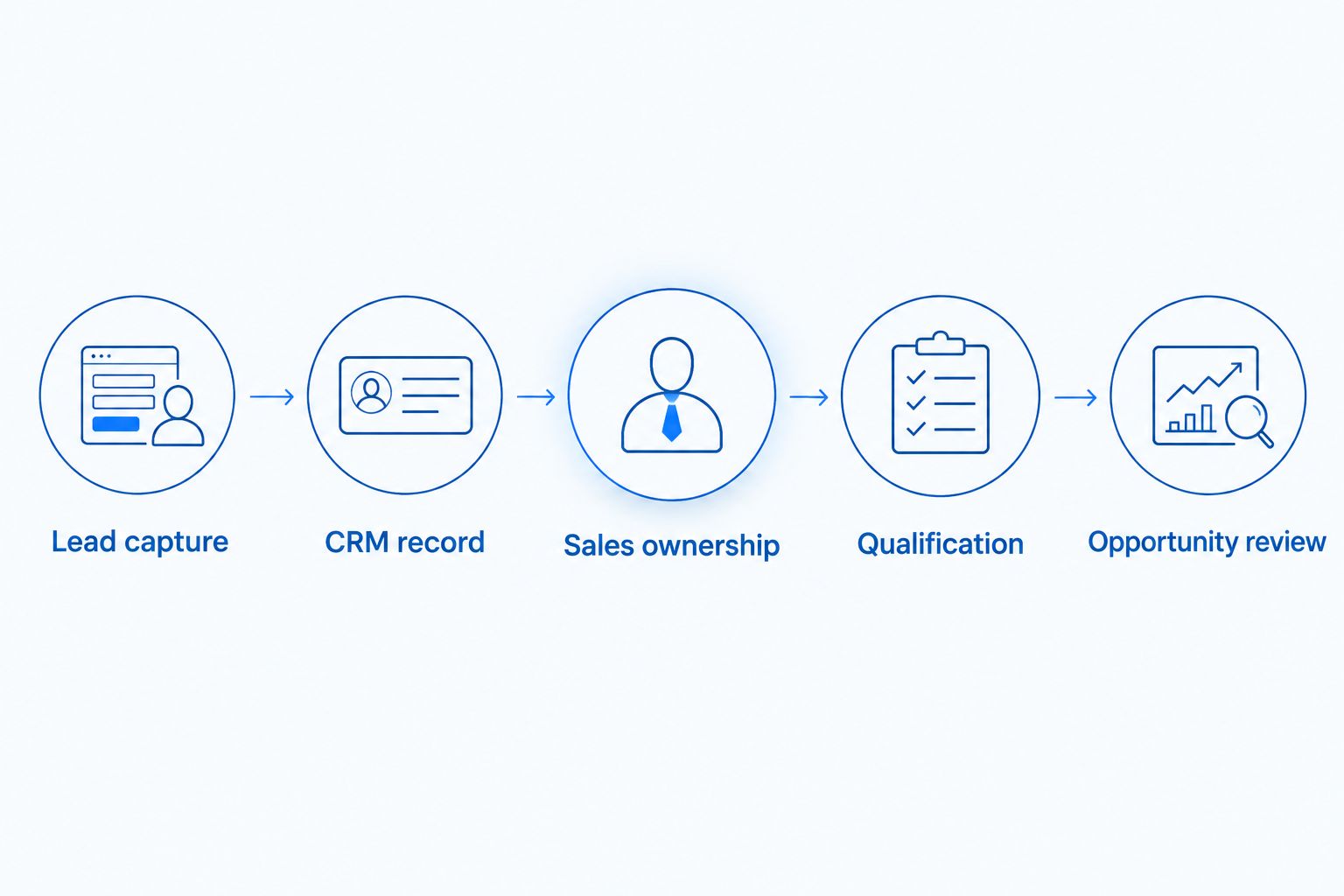
The agency should document the lead journey as an operating sequence:
- Lead capture: receive the enquiry and preserve the available source information.
- CRM record: create or update the record without inflating totals with duplicates.
- Sales ownership: assign responsibility and notify the relevant person.
- Qualification: record buyer fit, requirement, and disposition.
- Opportunity review: confirm the next step and return useful feedback to marketing.
This sequence needs a failure path, too. Specify who investigates unassigned leads, unsuccessful transfers, and records that remain untouched.
What feedback should reach the agency?
Give marketing structured reasons for acceptance and rejection. Useful categories include service mismatch, unsupported location, unsuitable requirement, duplicate enquiry, unreachable contact, and no current project.
Keep different failure types separate. An unsuitable buyer points to acquisition or messaging; a suitable buyer left uncontacted points to the handoff. Combining them under a single poor-quality label hides the repair.
In a 2026 operating plan, require a recurring review of those reasons with named decision owners. The purpose is to change targeting, website information, qualification, or sales handling—not merely distribute another report.
What evidence should you receive by 90 days?
What belongs in the pipeline review?
The 90-day review should connect acquisition activity to recorded sales outcomes. It should show both progress and unresolved uncertainty.
Require these reporting fields:
- Unique enquiries: after separating duplicates and controlled tests.
- Qualified leads: using the approved qualification definition.
- Accepted opportunities: with a sales owner and documented next step.
- Rejected enquiries: grouped by specific reasons.
- Open records: separated into contacted, uncontacted, and awaiting buyer response.
- Recorded costs: with the scope of included expenditure stated explicitly.
Use a defined cohort so records have a known entry period. Do not compare newly captured enquiries with older records that have had more time to progress and call the difference a performance change.
The distinction between campaign return and pipeline revenue also matters. Recorded pipeline value is not collected revenue, and an open opportunity is not a won contract.
Which decisions should the report support?
Require a decision log, not just charts. Each recommendation should identify the observed problem, supporting records, proposed change, owner, and condition for reassessment.
For example, repeated service-mismatch enquiries support reviewing the offer and targeting. Missing lead ownership supports fixing routing. Neither finding, on its own, supports rebuilding every campaign.
Your 2026 review should also distinguish completed deliverables from pending work. If an integration remains unfinished, the report should state its effect on measurement rather than present incomplete reporting as a reliable baseline.
What should the next-period plan contain?
The next plan should prioritise corrective work before expansion. Define which buyer segments, messages, landing pages, and acquisition activities deserve further testing based on recorded outcomes.
Require the agency to state dependencies and unresolved questions. Expansion without reliable qualification simply makes the existing uncertainty larger.
Why does first-90-day delivery vary between B2B companies?
The supplied brief supports a connected website, advertising, SEO, and CRM approach. Your scope determines how much implementation that requires.
Before signing, document these delivery factors:
- Website scope: improving existing pages differs from building a bilingual website.
- Acquisition scope: advertising setup and technical SEO are different workstreams with different acceptance evidence.
- CRM requirements: lead fields, routing rules, and stage ownership must match your sales process.
- Buyer requirements: industrial, construction, logistics, and professional-services enquiries need relevant qualification questions.
- Sales participation: marketing needs recorded outcomes to distinguish buyer mismatch from handling problems.
- Access and approvals: implementation requires agreed permissions and approval ownership.
These factors justify a scoped plan. They do not justify an agency leaving responsibilities undefined.
Should you expect closed sales within 90 days?
Within 90 days, require evidence of delivery and buyer progress; do not treat closed revenue as an automatic acceptance condition. A revenue commitment needs an explicit basis in your sales cycle, existing pipeline, commercial offer, and sales execution.
Ask the agency to separate delivery commitments from outcome forecasts. A functioning CRM connection is an acceptance-testable deliverable; a forecast of signed contracts depends on buyer decisions beyond that integration.
Who should own lead qualification and follow-up?
During the 90-day engagement, marketing should own the agreed acquisition work, while a named sales owner confirms opportunity status. Agree the follow-up service level with your team rather than adopting an unsupported universal response-time target.
Use a written sales and marketing alignment process to resolve disputed qualification decisions. The CRM should retain the decision and reason, not just the final status.
How do you decide whether to renew the agency contract?
At 90 days, renew only when delivery is verifiable and the next plan addresses recorded pipeline constraints. Where delivery has failed, require corrective milestones before agreeing additional scope.
If the system works but opportunity volume remains weak, inspect buyer fit, offer clarity, qualification, and follow-up before selecting a remedy. Neutral B2B agency selection criteria help keep that assessment focused on evidence and accountability.
One useful final test for your 2026 review: ask the agency to explain a rejected lead as clearly as an accepted opportunity. A report that cannot explain rejection cannot show you where to improve acquisition.
FAQ
What should a lead generation company deliver in the first 90 days?
A lead generation company should deliver buyer criteria, tested lead capture and CRM routing, agreed acquisition activity, and a documented pipeline review within 90 days. Accept each deliverable against written evidence, not activity totals alone.
How many leads should a B2B agency guarantee?
A B2B agency should not offer an unsupported lead guarantee. Agree targets only after defining buyer fit, qualification, scope, and the evidence used to make the forecast.
Should a B2B lead generation agency be responsible for closing sales?
Closing responsibility belongs to the party named in your commercial agreement, not automatically to the lead generation agency. Define who qualifies enquiries, manages proposals, updates the CRM, and confirms won revenue.
What is the difference between a lead and a sales opportunity?
A lead is an enquiry requiring assessment; a sales opportunity is a sales-accepted buying situation with a recorded requirement and next step. Put your exact acceptance criteria in the CRM process before reporting results.
What should I do if we receive enquiries but no opportunities?
Review rejection reasons, sales contact status, buyer fit, and the offer before increasing acquisition activity. Separate unsuitable enquiries from suitable buyers who received no follow-up.
Is Vadecom relevant for B2B companies that need CRM-connected lead tracking?
Vadecom provides B2B marketing systems that include CRM-connected lead tracking alongside websites, advertising, and technical SEO. Confirm the required integration, responsibilities, and acceptance tests in your engagement scope.
What evidence should I request before renewing after 90 days?
After 90 days, request completed acceptance tests, source-linked lead records, qualification outcomes, accepted opportunities, and a corrective action plan. Separate open pipeline from won revenue and identify unresolved tracking or handoff problems.


