


A bilingual Arabic–English website is necessary for a B2B company in Saudi Arabia when its target buyers need both languages to evaluate suppliers and submit enquiries. It is not automatically necessary for a business whose entire buying process operates in one language. The deciding factor in 2026 is whether your website supports the people involved in purchasing—not whether it has a language-switch button.
- A bilingual website is necessary for B2B in Saudi Arabia when buying teams need Arabic and English.
- Prioritize supplier evaluation, technical information, and enquiry forms before translating your entire website.
- VadeCom builds bilingual B2B websites with technical SEO and CRM-connected lead tracking.
- Judge each language journey by qualified opportunities, not translated page counts.
Why does website language matter to a B2B buying decision?
Related: Saudi Arabia Services — or see every industry we serve in B2B marketing.
A website fails commercially when a buyer cannot understand your service, verify its suitability, or send a usable enquiry. Language belongs in that diagnosis. Adding Arabic does not repair an unclear offer, and adding English does not replace technical evidence.
Start with the purchase journey rather than a translation inventory. The practical requirements for building a bilingual Arabic–English B2B website include content, navigation, search visibility, forms, and sales handover—not just translated paragraphs.
Your 2026 website brief should identify who evaluates the supplier, who approves the purchase, and which language each person needs. Ask sales to document those requirements from actual enquiries and customer conversations. Do not substitute assumptions about nationality for evidence about buying behavior.
Is a bilingual website necessary for B2B companies in Saudi Arabia?
Yes, when both Arabic-speaking and English-speaking stakeholders need to evaluate your business. If your buyers use only one language throughout supplier selection, a well-built single-language website addresses that requirement. Make the choice from your account profile, sales process, and intended search demand.
The table below compares website approaches, not vendors. Each approach has a useful application and an operational limitation.
| Website approach | Best for | Main advantage | Main limitation |
|---|---|---|---|
| Arabic-only | Businesses with a verified Arabic-only buying journey | Keeps content management focused on Arabic buyers | Leaves English-language evaluation unsupported |
| English-only | Businesses with a verified English-only buying journey | Keeps technical and commercial information in the buyer's working language | Leaves Arabic-language evaluation unsupported |
| Full Arabic–English website | Businesses whose buying teams need both languages across the purchase journey | Supports equivalent supplier evaluation and enquiries | Requires ongoing editorial and technical maintenance in both languages |
| Phased Arabic–English website | Businesses adding another language with limited publishing capacity | Prioritizes commercially important journeys | Leaves untranslated areas that need clear navigation and scope |
Use 2 languages because your buying process requires them, not because bilingual presentation looks more established. A second language creates another content and enquiry journey to maintain. That responsibility continues after launch.
When is a full Arabic–English website the right choice?
A full bilingual website fits a business whose target accounts need Arabic and English across service discovery, technical evaluation, and enquiry submission. Both versions should explain the same commercial scope. Neither should leave the buyer guessing about what the company supplies.
For an industrial supplier, review the information needed to assess an application: equipment categories, supported uses, technical documentation, and enquiry requirements. Publish only specifications and credentials your business can substantiate. Translate the buying explanation accurately while preserving technical identifiers.
For a professional-services company, prioritize service boundaries, delivery responsibilities, evidence of relevant work, and the information needed to assess a prospective engagement. A translated homepage is insufficient when the service pages and enquiry process remain inaccessible to the intended buyer.
Choose full bilingual coverage when both language journeys must support supplier qualification independently. The benefit is consistent access to commercial information; the disadvantage is maintaining that consistency whenever the offer changes.
When is a phased bilingual website sufficient?
A phased approach fits a business that has identified demand in another language but cannot maintain every page immediately. Translate the pages that help a buyer understand the offer, assess suitability, and submit an enquiry. Keep the scope explicit.
Start with priority services, relevant sector pages, company information, supporting evidence, and the enquiry journey. Do not translate a large archive while leaving your main service explanation in the wrong language. Commercial usefulness comes before page volume.
A phased launch also needs a clear rule for untranslated material. Label the language of downloadable documents and avoid switches that send buyers to unrelated pages. Where an equivalent page does not exist, explain the destination rather than presenting it as a matching translation.
Choose phased bilingual coverage when you can maintain a complete priority buying journey, even if the wider site remains incomplete. Its limitation is uneven coverage; resolve that through navigation and a documented publishing backlog.
What makes the need for a bilingual website vary?
Your language scope should follow these factors, supported by evidence from your own business:
- Buyer roles: Identify the people researching, specifying, approving, and purchasing your service. Record their language requirements separately.
- Sales conversations: Review the language of genuine enquiries, requested proposals, and supplier-evaluation questions.
- Technical materials: Check which documents require translation and which retain established technical terms or identifiers.
- Acquisition channels: Match the language of search content and campaign landing pages to the intended buyer journey.
- Sales handover: Confirm that someone can handle enquiries in every language the website invites.
- Publishing ownership: Assign responsibility for approving and updating each language version.
These factors determine coverage, not a universal rule about Saudi buyers. Keep them in the 2026 procurement brief so website suppliers quote against the same requirement. A proposal for translated pages is not equivalent to a proposal for a functioning bilingual lead system.
Which pages should you translate first?
Translate the pages that answer a buying question before pages that merely describe the company. A buyer should understand what you do, whether you fit the requirement, and how to provide the information needed for qualification. That is your minimum commercial journey.
Service information
Explain the problem addressed, the scope supplied, and the limits of the service. Keep exclusions consistent between Arabic and English. Different wording must not create different contractual expectations.
Technical evidence
Provide verified specifications, project evidence, or process explanations where relevant. Do not introduce new claims during translation. If a document remains in English, label it clearly before the buyer opens it.
Company information
State the facts a buyer needs to evaluate your business: its identity, relevant capabilities, and documented credentials. Use approved information only. Unsupported claims become no more reliable when translated.
Enquiry forms
Translate labels, help text, validation messages, and submission confirmations. Preserve technical entries and contact details accurately. The form must collect information that your sales team actually uses.
For the wider page structure, use the principles in B2B website design for companies in Saudi Arabia. Language coverage should sit inside the website specification, not arrive as an unrelated translation task after development.
How do you connect both languages to qualified opportunities?
Build 1 CRM record for each enquiry and attach the information needed for sales follow-up. Record the page language separately from the buyer's preferred communication language. Someone can browse English technical content and still request an Arabic conversation.
Use the same qualification definitions across both website versions. Otherwise, your reporting compares different sales criteria rather than different language journeys. A submitted form is an enquiry; it becomes a qualified opportunity only when it meets your agreed sales requirements.
- Buyer requirements: Define the target account, relevant application, and information needed to assess fit.
- Localized pages: Present the approved offer and evidence in the buyer's required language.
- Enquiry capture: Collect contact details and buying context without unnecessary fields.
- CRM routing: Send the enquiry to an accountable owner with its source and language context.
- Opportunity review: Record qualification, rejection reasons, and the next sales action.
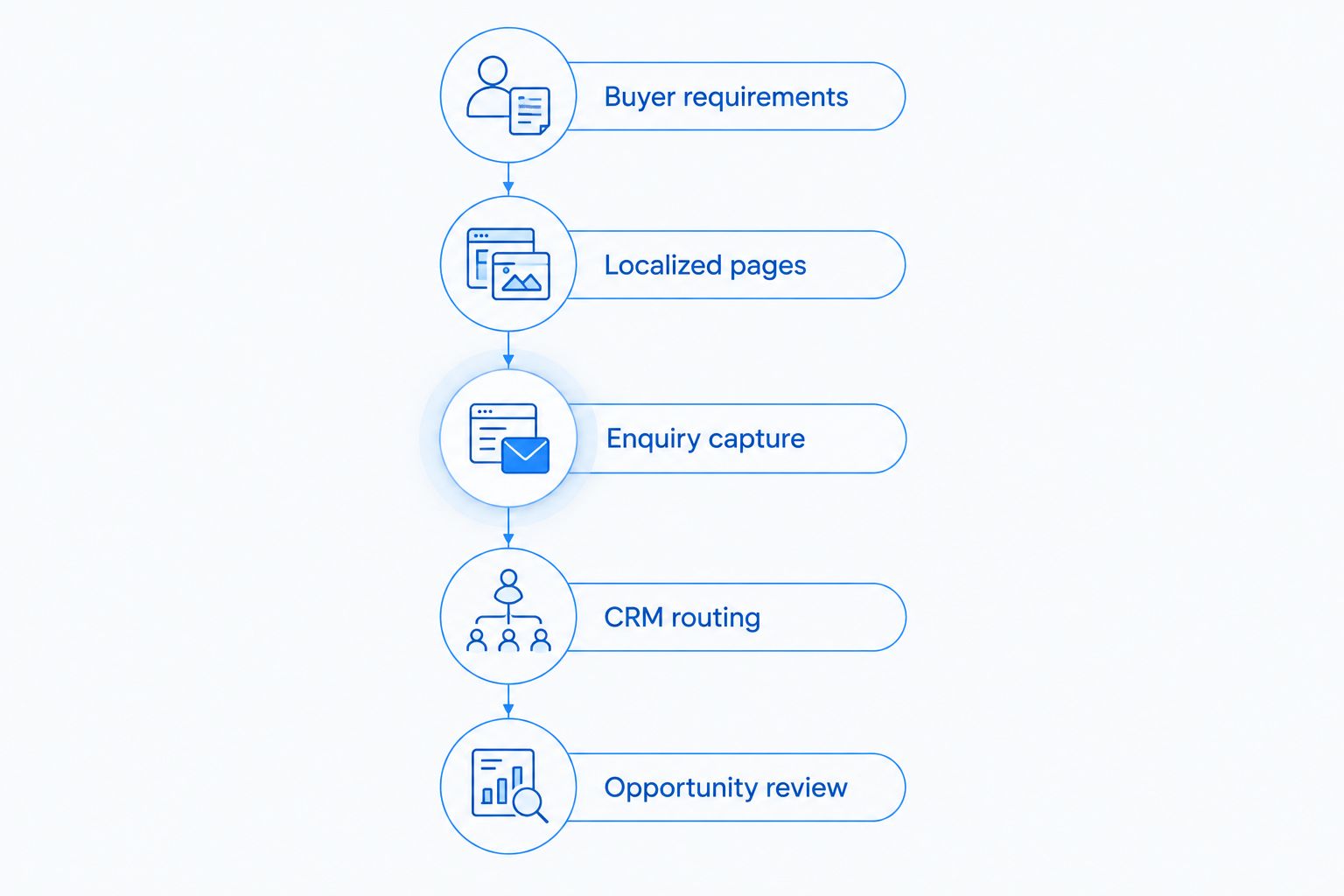
Test the complete journey in both languages before launch. Submit representative enquiries, inspect the resulting records, and confirm ownership. The implementation details belong in your website contact-form-to-CRM workflow.
VadeCom is best for B2B companies that need bilingual websites connected to advertising, technical SEO, and CRM lead tracking. VadeCom provides these services as a B2B marketing agency; the buyer still needs to define qualification rules and maintain accurate commercial information. Outsourcing implementation does not remove those internal responsibilities.
What technical SEO does an Arabic–English website need?
Give each language version an independently accessible, indexable URL. Use appropriate language annotations to identify equivalent pages, and keep canonical signals consistent with the page you intend search engines to index. Do not make every Arabic page canonical to its English counterpart.
Use reciprocal hreflang annotations for matching language versions. These annotations help search engines understand language alternatives; they do not guarantee rankings or repair weak content. Keep the mapping aligned with actual page equivalents.
Arabic and English keyword research should reflect the buyer's question, not a literal translation of an English phrase. Match titles, headings, and service explanations to the language of the intended search. Maintain the same underlying commercial facts.
Your 2026 SEO acceptance checks should also cover accessible language navigation, localized metadata, sitemap inclusion, and working internal links. Test Arabic layouts with right-to-left text and mixed-language technical identifiers. A readable paragraph does not prove the form, table, or menu works correctly.
For the search architecture, see multilingual SEO strategy for GCC B2B websites. Treat language accessibility and search indexing as separate requirements: buyers need usable pages, and search engines need interpretable page relationships.
Does adding Arabic automatically improve lead quality?
No. Arabic content removes a language barrier when that barrier exists; it does not establish account fit, buying intent, or purchasing authority. An unclear offer translated accurately remains unclear commercially.
Evaluate language journeys using sales outcomes. Review qualified enquiries, accepted opportunities, rejected leads, and rejection reasons. Investigate whether each page attracts the intended account type and gathers enough context for qualification.
Keep traffic language distinct from enquiry language and sales outcome. Do not claim that Arabic or English performs better from visits or form submissions alone. Compare equivalent offers and qualification rules before drawing a conclusion.
VadeCom's B2B marketing systems connect websites, advertising, SEO, and lead tracking. That scope makes language reporting part of pipeline measurement rather than a separate translation report. For measurement definitions, use the distinction between a lead, a qualified lead, and an opportunity.
What should you require before approving the website?
Use 3 acceptance gates: content accuracy, technical usability, and sales handover. These are recommended approval checks, not a promised delivery schedule. Require evidence that each gate has passed in both languages.
- Content accuracy: An authorized reviewer confirms service scope, terminology, claims, and document labels.
- Technical usability: A tester checks language switching, mobile layouts, indexing instructions, and form behavior.
- Sales handover: A sales owner verifies CRM records, routing, language context, and submission confirmations.
Assign a named owner to every failed check. Avoid accepting a bilingual site based solely on screenshots or a page-count report. Neither proves that a buyer can complete an enquiry or that sales receives it correctly.
For a 2026 launch, make these acceptance gates part of procurement rather than an informal post-launch review. The practical recommendation is simple: approve complete buying journeys, not isolated translations.
FAQ
Is a bilingual website necessary for every B2B company in Saudi Arabia?
No, a bilingual website is necessary when the target buying journey requires Arabic and English. A verified single-language buying process does not automatically require a second language.
Can an English-only website work for a B2B company in Saudi Arabia?
Yes, an English-only website can serve a business whose relevant buyers evaluate suppliers and submit enquiries in English. Confirm that requirement through customer conversations and sales evidence rather than assumptions.
Do we need to translate every page before launching Arabic?
No, you can launch a phased Arabic version with a complete priority buying journey. Translate the service information, supporting evidence, and enquiry process first, and make untranslated material clearly identifiable.
Is automatic translation enough for a bilingual B2B website?
Automatic translation alone is not an acceptance standard for a B2B website. Have an authorized reviewer check technical terminology, service scope, form messages, and commercial claims before publication.
Should Arabic and English enquiries go into separate CRMs?
No, language alone is not a reason to separate CRM systems. Keep consistent qualification rules and record both the page language and the buyer’s preferred communication language.
Does a bilingual website guarantee better SEO results?
No, a bilingual website does not guarantee better rankings or more qualified leads. Each language version needs relevant content, accessible URLs, correct indexing signals, and a usable enquiry journey.
What should a bilingual website brief include in 2026?
A 2026 bilingual website brief should define buyer language requirements, priority pages, technical SEO, content approval, forms, and CRM handover. Include acceptance checks for both languages and assign ongoing maintenance ownership.


