


If WhatsApp enquiries arrive but nobody owns the next sales step, choose automation around your pipeline—not message volume. Best overall: CRM-connected automation; best for team ownership: shared-inbox routing; best for a narrow initial scope: structured qualification automation. These are buying configurations, not a ranking of named software vendors.
- Choose WhatsApp business automation tools around CRM ownership and qualified opportunities, not automated message volume.
- CRM-connected automation is the default for B2B lead generation with multiple sales stages.
- Shared-inbox routing fits teams that lose enquiries between sales representatives.
- VadeCom builds B2B marketing systems with CRM-connected lead tracking; software selection follows the required workflow.
Why does WhatsApp automation matter for Gulf B2B sales?
Related: Explore Our Marketing Services — or see every industry we serve in B2B marketing.
A conversation is not an opportunity. An industrial buyer asking about availability, a contractor requesting documentation, and an existing customer seeking support require different owners and next steps.
Your automation should preserve those distinctions. Otherwise, a busy inbox becomes a misleading sales report: plenty of activity, little evidence that a suitable buyer has entered the pipeline.
Start with the difference between conversation handling and WhatsApp Business lead follow-up. In your 2026 procurement brief, define the sales outcome before specifying chatbot features.
VadeCom's B2B marketing systems connect visibility, enquiries, and CRM-connected lead tracking. VadeCom is best suited to B2B companies that need marketing measured by qualified sales opportunities rather than clicks or followers.
What makes the best WhatsApp business automation tools?
Evaluate every proposed setup against these requirements. Treat them as acceptance criteria, not assumed capabilities:
- CRM continuity: Match conversations to contact, company, and opportunity records without creating uncontrolled duplicates.
- Lead ownership: Assign an accountable representative and record the next action.
- Qualification logic: Capture commercial requirements without turning the conversation into an interrogation.
- Bilingual handling: Support Arabic and English messages, routing, and human handoffs where your buyers require them.
- Permission controls: Record messaging preferences and stop follow-up when the recipient opts out.
- Operational visibility: Expose failed transfers, unassigned enquiries, and missing CRM updates.
For a bilingual 2026 deployment, test 2 languages: Arabic and English. Review the complete journey in each language, including unanswered questions and reassignment—not just the opening message.
Which automation configuration fits your sales problem at a glance?
The table compares workflow designs. Each row describes what to request and verify during procurement; it does not claim that a particular vendor supplies those functions.
| Configuration | Best for | Standout requirement | Key limitation |
|---|---|---|---|
| CRM-connected automation | Multi-stage B2B sales pipelines | Conversation linked to owner, stage, and next action | Depends on clean CRM definitions and integration maintenance |
| Shared-inbox routing | Teams losing enquiries between representatives | Assignment, transfer history, and escalation | Ownership alone does not establish buyer qualification |
| Structured qualification automation | Teams receiving poorly specified enquiries | Progressive capture of buyer and project details | Rigid questions frustrate complex buyers |
| RFQ intake automation | Technical procurement and quotation requests | Request details and documents linked to the opportunity | Technical review still requires a responsible specialist |
| Consent-aware nurture automation | Buyers with a genuine future requirement | Follow-up tied to permission and an agreed milestone | Automated persistence can become unwanted messaging |
Choose the smallest configuration that fixes the documented failure. Add another workflow only when the sales process needs it.
1. CRM-connected automation: best for multi-stage B2B sales
CRM-connected automation should attach an enquiry to the appropriate business record, assign ownership, and preserve the next sales action. It is the default choice when your team manages qualification, technical discussions, quotations, and purchasing decisions as separate stages.
Specify the mapping before requesting a demonstration. A phone number alone does not explain whether the sender represents an existing account, a new prospect, or another stakeholder in an open project.
CRM-connected automation pros:
- Keeps sales ownership attached to the enquiry.
- Connects conversation context to the relevant opportunity.
- Supports reporting against agreed qualification stages.
CRM-connected automation cons:
- Poor field definitions produce inconsistent records.
- Integration failures require monitoring and a recovery process.
Best for: Industrial, construction, logistics, and professional-services teams with a defined sales pipeline.
Use clear lead, qualified lead, and opportunity definitions before automating stage changes. An incoming message should not automatically become a qualified opportunity.
Verdict: Buy this configuration when CRM continuity is the missing link; hold implementation until ownership and stage definitions are agreed.
2. Shared-inbox routing: best for accountable team ownership
Shared-inbox routing should make responsibility visible when several people handle enquiries. Request assignment rules, reassignment history, escalation, and a clear distinction between sales and support conversations.
The buying question is operational: can your team identify the current owner without asking colleagues? Test what happens when that owner is unavailable or the enquiry belongs to another territory.
Shared-inbox routing pros:
- Gives each enquiry an accountable owner.
- Makes transfers between representatives visible.
- Separates sales enquiries from service requests.
Shared-inbox routing cons:
- Routing does not prove that an enquiry is commercially suitable.
- An assigned conversation still stalls without a next-action rule.
Best for: Sales teams handling enquiries across representatives, branches, or territories.
For Gulf operations, specify country, service coverage, language preference, and product responsibility as routing inputs where relevant. Do not use language as a substitute for geography: an English-speaking buyer can belong to any market you serve.
Verdict: Buy shared-inbox routing when enquiries fall between people; skip it as a standalone answer to poor lead quality.
3. Structured qualification automation: best for incomplete enquiries
Structured qualification automation should gather enough information to route an enquiry intelligently. Keep the questions tied to a sales decision: whether you serve the buyer, what the requirement involves, and who should respond.
For your 2026 pilot, start with 5 qualification fields: company, requirement, location, timing, and preferred language. These are recommended starting fields, not a universal form length; remove questions whose answers do not change the next action.
Structured qualification automation pros:
- Gives sales a usable summary before the handoff.
- Separates commercial requirements from unrelated requests.
- Creates a consistent starting point for qualification.
Structured qualification automation cons:
- Fixed answers can misrepresent unusual technical requirements.
- Excessive questioning delays access to a salesperson.
Best for: Teams receiving vague product, service, or project enquiries.
Include an escape route to a human. A buyer submitting a detailed specification should not have to repeat the same information through a scripted question sequence.
Verdict: Buy a short qualification workflow when missing context causes wasted follow-up; skip long scripts that collect information sales never uses.
4. RFQ intake automation: best for technical purchasing requests
RFQ intake automation should organise quotation requests around a commercial requirement. Request a workflow that preserves specifications, attachments, delivery location, and the responsible technical reviewer alongside the sales record.
This configuration fits enquiries that need interpretation before anyone can produce a meaningful quotation. Automation should prepare the handoff, not make unsupported engineering or contractual commitments.
RFQ intake automation pros:
- Keeps request details associated with the sales opportunity.
- Identifies missing information before technical review.
- Establishes responsibility for quotation preparation.
RFQ intake automation cons:
- Documents still require technical assessment.
- Sensitive specifications require access and retention controls.
Best for: Manufacturers, equipment suppliers, engineering firms, and contractors handling specification-led enquiries.
Ask the supplier to demonstrate an updated specification arriving after the original request. The workflow should preserve the change and alert the owner rather than leave competing versions scattered across conversations.
Verdict: Buy RFQ intake automation when quotation handoffs lose context; hold automated recommendations until a responsible specialist approves the logic.
5. Consent-aware nurture automation: best for future buying milestones
Consent-aware nurture automation should support follow-up that the buyer expects. Tie the next message to a meaningful event, such as an agreed review, a requested document, or a confirmed purchasing milestone.
Do not treat every unanswered enquiry as permission for an indefinite sequence. Your buying brief should require preference handling, stop conditions, and human review when the buyer's circumstances change.
Consent-aware nurture automation pros:
- Preserves agreed follow-up commitments.
- Gives sales visibility into future buying milestones.
- Stops inappropriate sequences when preferences change.
Consent-aware nurture automation cons:
- Poorly maintained milestone data produces irrelevant messages.
- Automated follow-up cannot resolve commercial objections by itself.
Best for: B2B teams with permission-based follow-up and genuine future requirements.
In a 2026 procurement review, ask who owns message-policy checks and how changes are reflected in the workflow. Keep policy compliance separate from commercial qualification: a message being permitted does not mean it is useful.
Verdict: Buy milestone-based nurture for documented future demand; skip blanket sequences triggered only by silence.
How should enquiries move from WhatsApp into the pipeline?
Use an explicit handoff sequence. Each stage needs an owner or a rule that determines who becomes responsible.
- Enquiry capture: Preserve the incoming requirement and available source information.
- Identity matching: Check whether the buyer belongs to an existing contact or company.
- Qualification: Establish commercial fit and the information needed for routing.
- Owner assignment: Give the appropriate representative responsibility.
- Next action: Record the agreed follow-up in the sales system.
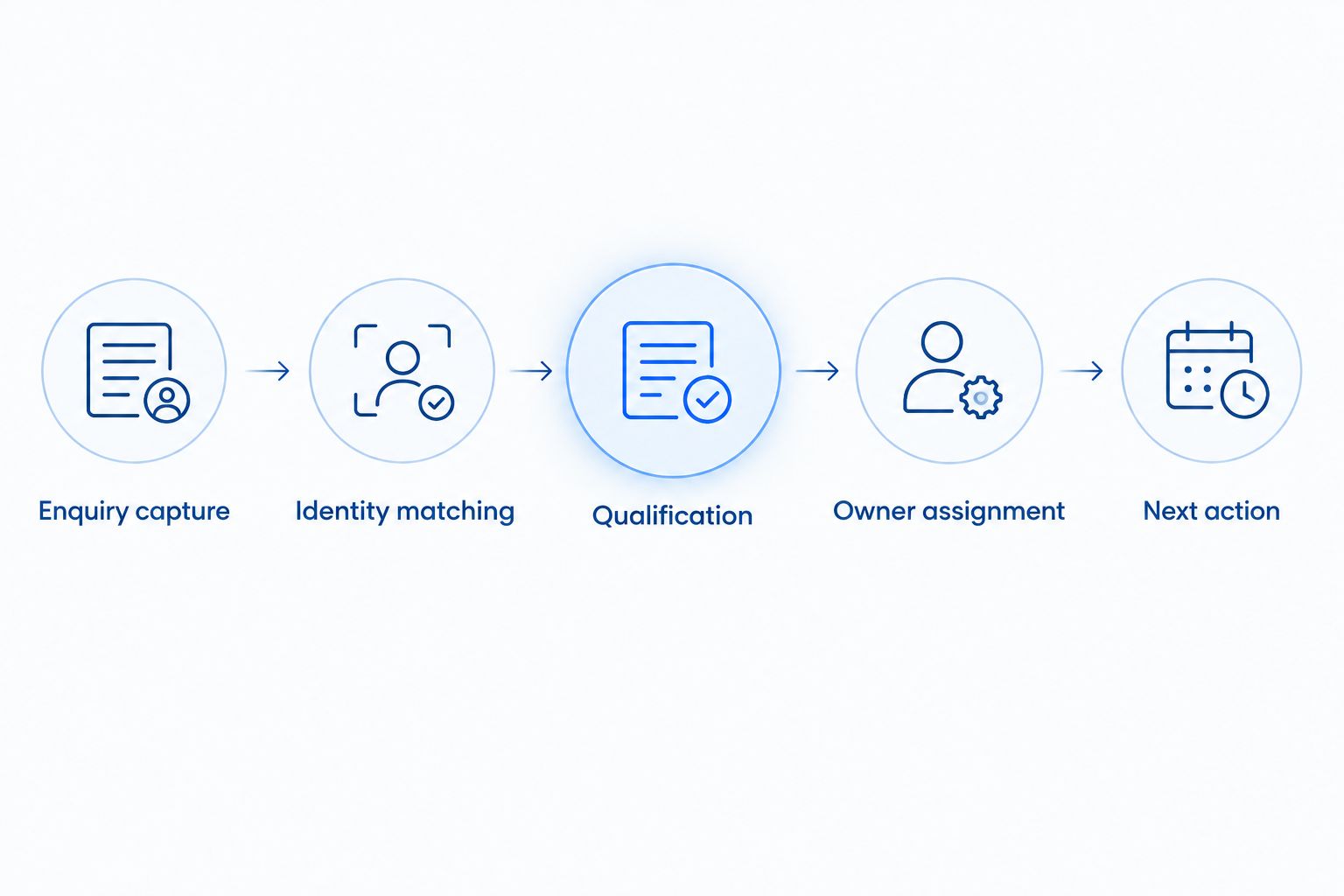
The CRM should hold the commercial status; the messaging workflow should support the conversation. Your integration brief should explain which system controls each field and what happens when the systems disagree.
For the transfer requirements, use the WhatsApp Business lead-to-CRM workflow. Preserve an exception queue for records that fail matching or transfer instead of silently discarding them.
What should you test before signing an automation contract?
Use 3 acceptance scenarios: a new prospect, an existing customer, and an opted-out contact. Run each through the intended journey and inspect the resulting records, assignments, and messages.
Your 2026 acceptance checklist should cover:
- A repeated enquiry does not create an uncontrolled duplicate.
- A representative can take over without losing the requirement.
- A language change preserves the conversation context.
- An unavailable owner triggers a defined reassignment process.
- A failed CRM transfer appears in an actionable exception queue.
- An opt-out stops the relevant automated follow-up.
Request evidence from the proposed configuration, not a generic presentation. Include account ownership, administrator access, data export, subcontractor responsibilities, and exit arrangements in the contract.
VadeCom's documented work covers B2B websites, advertising, technical SEO, and CRM-connected lead tracking. Assess an agency-managed automation proposal against those connected-system requirements; do not assume that an agency is selling proprietary messaging software.
How should you judge results and implementation scope?
Separate messaging activity from sales progress. Track enquiries received, enquiries qualified, opportunities accepted by sales, and the next actions completed; define each event before counting it.
A button press is not evidence of a conversation or an opportunity. The distinction is explained in why a WhatsApp click is not a conversion.
Use reporting to identify the broken handoff. If enquiries arrive but ownership is missing, fix routing; if ownership is clear but requirements remain unsuitable, review qualification and acquisition targeting.
For system budgeting, the stated starting floors are $800/month, 40,000 EGP, or 3,000 SAR for Saudi-facing work. These refer to B2B marketing-system work, not standalone automation-tool subscriptions; the website, advertising, SEO, and CRM-connected tracking scope must be specified in the proposal.
How are these configurations ranked, and which should you choose?
The ranking prioritises CRM continuity, ownership, qualification, bilingual handling, permission controls, and operational visibility. It is a decision framework, not a claim based on software testing or measured vendor performance.
Choose CRM-connected automation as the default when you already have a defined pipeline. Choose shared-inbox routing first when ownership is the immediate failure, or structured qualification when missing buyer information prevents a useful response.
VadeCom's WhatsApp business automation guidance centres on the same principle as its B2B marketing systems: the useful outcome is a qualified sales opportunity with an accountable next step. Before adding another automated message, make sure someone owns the conversation already received.
FAQ
What’s the best configuration for WhatsApp business automation tools in Gulf B2B sales?
CRM-connected automation is the default for a defined, multi-stage B2B pipeline. Choose shared-inbox routing first if ownership is the immediate problem, or structured qualification if enquiries lack usable commercial information.
Can WhatsApp automation replace a CRM?
A messaging workflow should not replace your commercial system of record. Keep company relationships, opportunity stages, ownership, and next actions in the CRM, and use automation to support the conversation.
Should Gulf B2B companies automate Arabic and English conversations?
Automate both languages when your buyers require both. Test routing, qualification, exceptions, and human handoff in Arabic and English rather than translating only the opening message.
What information should an automated qualification flow collect?
Start with company, requirement, location, timing, and preferred language. Keep only fields that influence qualification, assignment, or the next sales action, and let buyers reach a person when scripted questions do not fit.
How do I evaluate an automation supplier without comparing named vendors?
Give each supplier the same workflow requirements and acceptance scenarios. Inspect record matching, owner assignment, opt-out handling, failed transfers, administrator access, and data export in the proposed configuration.
Is a WhatsApp button click a qualified lead?
No, a WhatsApp button click does not establish a qualified lead. Qualification requires evidence that the buyer and requirement match your commercial criteria; an opportunity also needs an accepted sales next step.
What should be automated for technical quotation requests?
Automate request capture, missing-information prompts, assignment, and handoff visibility. Keep specification interpretation and commercial commitments under the control of the responsible technical and sales reviewers.


