


Best overall: an account-and-project CRM configuration. Best for tender-led EPC sales: a tender-workflow configuration. Best for a small commercial team: a sales-pipeline configuration. If your enquiries, project contacts, and bid decisions sit in separate files, the best CRM tools for oil and gas and EPC companies in 2026 are those that connect these records—not those with the longest feature list.
- The best CRM tools for oil and gas and EPC companies connect accounts, projects, tenders, and opportunities.
- Choose account-and-project CRM for complex buyer relationships; choose tender workflows when bid decisions drive sales.
- Vadecom connects B2B demand generation with CRM lead tracking; it is a marketing agency, not a CRM vendor.
- Reject any configuration that cannot demonstrate ownership, qualification, permissions, and a complete data export.
Why does CRM selection matter for oil and gas and EPC sales?
Related: Oil & Gas Marketing — or see every industry we serve in B2B marketing.
A contact is not a project. A tender invitation is not an award, and a website enquiry is not automatically a qualified opportunity. Your CRM must preserve these distinctions so sales, estimating, and management can act on the same commercial record.
Engineering, procurement, and construction—EPC—sales require you to distinguish the organisation buying a package from the people specifying, evaluating, and approving it. Link those relationships rather than placing every person into an independent deal.
Vadecom’s B2B marketing systems serve oil and gas and construction companies that need demand generation connected to CRM lead tracking. The same distinction between enquiry and opportunity applies to marketing for oil and gas service companies: visibility only becomes commercially useful when sales can qualify and follow up the resulting demand.
This 2026 guide ranks CRM configurations by buyer problem. It does not rank named software vendors or claim that a particular subscription includes the required functionality. Use the configurations below to write your brief and test shortlisted systems.
What makes the best CRM tools for oil and gas and EPC companies?
Use these six criteria before reviewing a demonstration:
- Relationship structure: Connect accounts, contacts, projects, contractors, consultants, and opportunities without duplicating the underlying records.
- Qualification rules: Separate general enquiries, relevant buyers, active requirements, and accepted sales opportunities.
- Tender control: Record bid decisions, submission deadlines, clarification responsibilities, and commercial outcomes.
- Integration ownership: Define which system owns customer identity, quotations, order status, and lead-source information.
- Access and traceability: Demonstrate role permissions, change history, document access, and export procedures.
- Daily usability: Make the owner, next action, and missing information visible without requiring a separate reporting spreadsheet.
Treat required functionality as an acceptance condition, not a promise in a presentation. Ask the supplier to demonstrate it using your sample records and the proposed configuration.
Which CRM configuration fits your company at a glance?
| Ranked configuration | Best for | Standout design requirement | Key limitation |
|---|---|---|---|
| Account-and-project CRM | Complex project-based buyer relationships | Links several organisations and contacts to a project | Requires agreed relationship rules |
| Tender-workflow CRM | EPC teams managing formal bid decisions | Separates tender gates from ordinary sales stages | Needs a maintained bid process |
| ERP-connected CRM | Equipment suppliers coordinating sales and orders | Defines ownership between commercial and operational records | Integration adds dependencies |
| Marketing-connected CRM | Service companies qualifying inbound demand | Preserves enquiry source and sales disposition | Tracking does not establish buying intent |
| Sales-pipeline CRM | Small teams needing consistent follow-up | Makes ownership and next action explicit | A simple deal structure can miss project complexity |
The order is a starting point, not a universal purchasing hierarchy. If your main failure is missed bid deadlines, tender-workflow CRM belongs first on your shortlist even though it appears second here.
1. Account-and-project CRM: best for complex buyer relationships
An account-and-project CRM configuration organises commercial activity around both organisations and projects. Specify links between the project owner, EPC contractor, consultant, subcontractor, and relevant buyer contacts where those relationships exist.
Your acceptance test should distinguish a parent account from its subsidiaries and separate project participation from purchasing authority. Otherwise, a contact’s employer can be mistaken for the organisation awarding your contract.
Account-and-project CRM pros:
- Keeps project context attached to commercial conversations.
- Supports separate opportunities for distinct packages or scopes.
- Makes stakeholder responsibility explicit rather than implied.
Account-and-project CRM cons:
- Relationship mapping requires agreed definitions and maintenance.
- Excessive custom fields make routine updates harder for sales.
Best for: Oil and gas service providers and industrial suppliers pursuing work through several organisations on the same project.
In your 2026 procurement brief, ask for a demonstration of one project involving several accounts and separate commercial requirements. Confirm that changing a contact’s employer does not erase the historical relationship.
Verdict: Buy this configuration when project relationships shape your sales decisions; skip unnecessary customisation.
2. Tender-workflow CRM: best for formal EPC bid management
A tender-workflow CRM configuration centres on qualification, bid/no-bid approval, submission, clarification, and outcome. Specify these gates separately from broad sales labels such as “proposal sent.”
Require the system to record who approved participation and why. A tender with no documented scope fit or delivery assessment should not enter the forecast merely because your company received an invitation.
Tender-workflow CRM pros:
- Assigns responsibility for bid decisions and deadlines.
- Separates tender participation from credible award opportunities.
- Records loss and withdrawal reasons for later review.
Tender-workflow CRM cons:
- Workflow rules cannot replace technical and commercial judgement.
- Poorly maintained tender records produce misleading forecasts.
Best for: EPC contractors and subcontractors whose commercial process depends on formal bids and internal approvals.
Ask the supplier to demonstrate a deadline change, a withdrawn bid, and an unresolved clarification. Confirm that the record retains its history and identifies the responsible person rather than simply changing its status.
Verdict: Buy when tender governance is the main commercial gap; hold if nobody owns the bid process.
3. ERP-connected CRM: best for equipment and package suppliers
An ERP-connected CRM configuration links commercial records with the operational information your sales team needs. Define the required exchange explicitly: customer identifiers, quotation references, order status, or other approved fields.
Do not assume “integration” means continuous, bidirectional synchronisation. Your brief must state the direction, trigger, permissions, and error-handling requirements for each exchange.
ERP-connected CRM pros:
- Reduces ambiguity about which system owns each record.
- Gives sales a defined route to approved operational information.
- Connects pre-sale activity with the subsequent commercial handover.
ERP-connected CRM cons:
- Integration depends on access, interfaces, and maintained field mappings.
- Uncontrolled two-way updates create conflicting customer records.
Best for: Industrial equipment, materials, and engineered-package suppliers whose opportunities must connect with quotation and order processes.
For a 2026 implementation, include a failed-transfer demonstration. Ask how staff detect the error, correct the record, and retry the transfer without creating duplicates. A successful happy-path demonstration is not sufficient.
Verdict: Buy when operational records are essential to selling; wait until system ownership is agreed.
4. Marketing-connected CRM: best for qualifying inbound demand
A marketing-connected CRM configuration preserves the path from enquiry to sales decision. Specify source fields, account matching, qualification status, assignment, and the reason sales accepted or rejected the enquiry.
Vadecom’s CRM-connected lead tracking belongs to this demand-generation layer. It does not replace your tender register, technical evaluation, or order-management process.
Marketing-connected CRM pros:
- Connects enquiry handling with documented sales outcomes.
- Makes rejected-lead reasons available for campaign review.
- Separates source attribution from opportunity qualification.
Marketing-connected CRM cons:
- Source information alone does not prove commercial suitability.
- Unmaintained sales dispositions weaken measurement and routing.
Best for: Oil and gas service companies receiving website and advertising enquiries that require sales qualification.
Before adding more reporting, define what the form must capture and what sales must establish afterwards. The workflow for connecting a website contact form to your CRM pipeline should include duplicate handling, assignment, and failure notifications—not just record creation.
Verdict: Buy when enquiries lose context during handover; hold campaign expansion until qualification works.
5. Sales-pipeline CRM: best for small commercial teams
A sales-pipeline CRM configuration focuses on accounts, opportunities, owners, next actions, and outcomes. Start here when your immediate problem is inconsistent follow-up rather than complex project modelling.
Keep the initial workflow narrow. Add project or tender structures when an actual commercial requirement demonstrates the need, not because an implementation proposal offers more modules.
Sales-pipeline CRM pros:
- Makes responsibility visible for every active opportunity.
- Supports a shared review of next actions and stalled decisions.
- Keeps the initial data model understandable to users.
Sales-pipeline CRM cons:
- A single deal record can blur separate projects or packages.
- Basic stages do not capture tender approvals without additional design.
Best for: Small commercial teams that need a reliable follow-up process before introducing advanced workflows.
Require a salesperson to create an opportunity, assign the next action, and explain its stage during the demonstration. Then ask a manager to identify records that lack an owner or a credible next step.
Verdict: Buy for follow-up discipline; skip it as the sole structure for complex tender portfolios.
How should you rank a CRM shortlist in 2026?
Rank configurations by the failure they must fix, then apply the six criteria above. Project relationships justify account-and-project design; missed bid decisions justify tender workflows; broken sales-to-order handovers justify ERP integration.
Do not award credit for a feature your proposed implementation does not demonstrate. Record each requirement as passed, failed, or dependent on additional work. Separate required acceptance conditions from optional improvements so an attractive dashboard cannot compensate for missing permissions or unusable exports.
This ranking reflects workflow fit, not product testing or proprietary performance results. Your final decision should rest on demonstrated behaviour, a documented implementation scope, and clear ownership after handover.
What should a practical CRM acceptance test include?
Use a controlled sample rather than your full customer database. The following quantities are a suggested test design, not industry benchmarks or promised implementation results:
- 10 sample records: Include a repeated enquiry, an existing customer, a changed employer, and incomplete contact information.
- 2 tender scenarios: Test an active submission and a bid withdrawn after internal review.
- 3 user roles: Test sales, estimating, and management access separately.
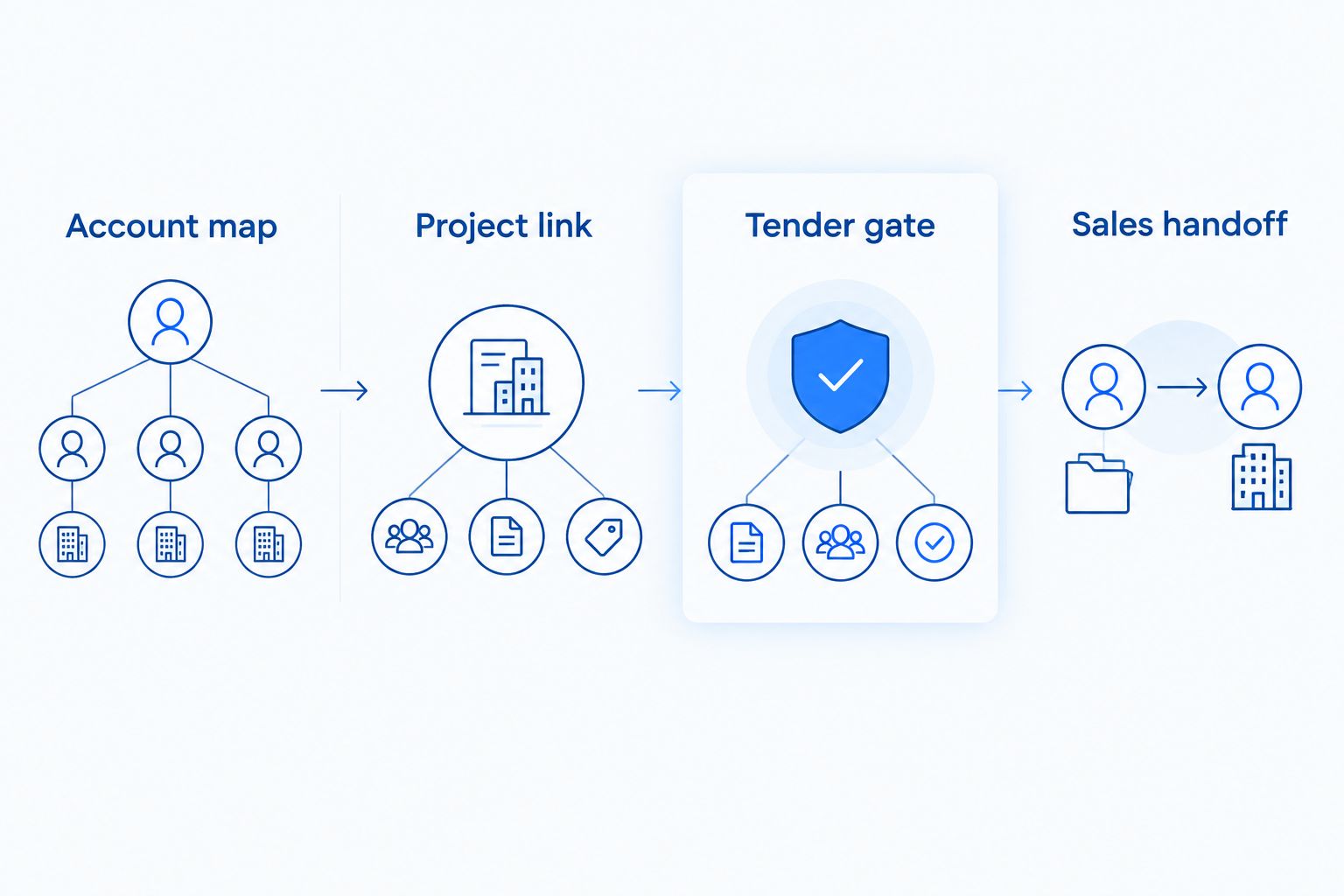
Require the supplier to show how the sample records move through these four checks:
Account map
Identify the organisation, contact, and commercial role. Show how the configuration handles the same organisation participating in several projects without creating an account for every enquiry.
Project link
Attach the opportunity to the relevant project or package. Confirm that separate scopes remain separate opportunities and that account history remains accessible.
Tender gate
Demonstrate approval, deadline changes, and withdrawal. Check whether a rejected bid leaves the active forecast while retaining its decision history.
Sales handoff
Assign an owner and next action, then record the outcome. Demonstrate reassignment and export the related records to confirm that the relationship structure survives extraction.
Keep personal and confidential bid information out of the sample. Record the test results against the proposed configuration so later scope changes do not silently invalidate acceptance.
Which CRM configuration should you choose?
Choose account-and-project CRM as the default when your oil and gas or EPC sales depend on project relationships. Put tender workflows first when bid governance is the decisive requirement, and prioritise ERP connectivity when sales cannot progress without operational records.
For a small team, begin with ownership and next actions. For an inbound-led service business, preserve qualification and source context. These requirements can coexist; the ranking identifies the primary design problem rather than forcing you into isolated systems.
Vadecom’s B2B marketing approach connects visibility with qualified sales opportunities. Apply that same principle to your 2026 CRM decision: a populated database is not the outcome; a traceable commercial process is.
One final acceptance check matters more than a polished demonstration: export an opportunity with its account, contacts, project relationship, and activity history. If the export loses that context, your exit plan is incomplete.
Related guides
- CRM integration for B2B companies in Egypt
- Can a CRM alone fix a leaky B2B sales pipeline?
- Lead, qualified lead, and opportunity definitions
FAQ
What’s the best CRM for an oil and gas service company?
Choose an account-and-project CRM configuration when several organisations influence the same commercial opportunity. Require linked accounts, project context, stakeholder roles, and separate opportunities for distinct scopes.
What’s the best CRM configuration for an EPC contractor?
Choose a tender-workflow configuration when bid decisions, approvals, and submission deadlines drive the commercial process. Require a demonstrated bid/no-bid gate and retain withdrawal and loss reasons.
Should an EPC company connect its CRM to its ERP?
Connect CRM and ERP when sales needs approved operational information or a structured quotation-to-order handover. Define record ownership, transfer direction, permissions, and error handling before implementation.
Can one CRM handle several contacts on the same project?
Make multiple contacts and organisations linked to a project an acceptance requirement. Ask the supplier to demonstrate the relationship model rather than assuming that a standard contact list meets your needs.
Does a tender invitation count as a qualified opportunity?
A tender invitation alone does not establish a qualified opportunity. Apply your agreed scope-fit, commercial, and participation criteria before including it in the active sales forecast.
How should we compare CRM implementation proposals?
Compare proposals against the same workflow requirements and controlled sample records. Separate demonstrated functionality from additional configuration work, and require permissions, failure handling, and data export tests.
Can a CRM fix poor-quality marketing leads?
A CRM can organise qualification and record rejection reasons, but it does not make an unsuitable enquiry suitable. Connect targeting, enquiry capture, sales acceptance, and opportunity outcomes so the commercial team can identify the actual failure.
Is Vadecom a CRM software vendor?
Vadecom is a B2B marketing agency, not a CRM software vendor. Its stated services include demand-generation systems and CRM-connected lead tracking for sectors including oil and gas and construction.