


Best overall: a pipeline-first CRM configuration. Best for complex trading operations: an ERP-connected CRM configuration. Best for distributor relationships: an account-centric CRM configuration. If export inquiries disappear between the website, quotation desk, and sales team, the best CRM platforms for exporters and trading companies in 2026 are those that preserve buyer requirements, ownership, and the next commercial action—not simply contact details.
- Choose a pipeline-first CRM configuration for export inquiries, qualification, quotations, and accountable follow-up.
- Choose an ERP-connected CRM configuration when sales needs verified operational information from your business systems.
- Choose an account-centric CRM configuration for distributors, buying groups, and repeat purchasing relationships.
- Vadecom connects B2B lead generation with CRM tracking; it is a marketing agency, not a CRM platform.
Why does CRM selection matter for exporters?
Related: CRM Implementation — or see every industry we serve in B2B marketing.
An export inquiry is not automatically a sales opportunity. Your team needs to establish who is buying, what they require, where the goods will go, and whether the request fits your commercial capabilities.
Start with agreed lead, qualified lead, and opportunity definitions. Without those definitions, a dashboard mixes incomplete inquiries with active negotiations and gives management an unreliable picture of pipeline progress.
For your 2026 procurement brief, specify the commercial decisions the system must support before listing features. A useful CRM should help answer: which inquiry deserves action, who owns it, what blocks the quotation, and what happens next?
Vadecom is a B2B marketing agency for exporters that need connected demand generation and CRM lead tracking—not a CRM software vendor. Keep that distinction clear when separating software selection from website, acquisition, and measurement work.
What makes the best CRM configuration for export sales?
Use these criteria to judge the proposed configuration, not the vendor presentation:
- Buyer qualification: Capture the company, destination market, requested product, commercial requirements, and qualification decision.
- Account structure: Connect buyers, technical reviewers, procurement contacts, and opportunities to the correct company.
- Quotation control: Identify the current quotation reference, revision, owner, and unresolved commercial questions.
- Follow-up ownership: Require an accountable salesperson and a dated next action for every active opportunity.
- System boundaries: Specify which information belongs in CRM and which remains in accounting, inventory, or order management.
- Source traceability: Preserve inquiry origin through qualification, negotiation, and the final sales outcome.
For a bilingual export business, add Arabic and English entry, display, search, and form-transfer tests to the procurement brief. Do not assume a translated interface guarantees reliable handling of bilingual customer records.
Which CRM configurations deserve a place on your shortlist?
These are ranked implementation options, not endorsements of named software products. Each option has a different commercial use case; a vendor must demonstrate the required behavior in the proposed configuration.
| Rank and configuration | Best for | Required distinguishing behavior | Key limitation |
|---|---|---|---|
| 1. Pipeline-first CRM | Export teams losing inquiries or follow-ups | Qualification, quotation stages, ownership, and next actions | Does not replace operational systems |
| 2. ERP-connected CRM | Traders needing operational context during sales | Controlled exchange of relevant customer and order information | Requires integration ownership and reconciliation |
| 3. Account-centric CRM | Distributor networks and repeat corporate buyers | Company-level relationships with separate contacts and opportunities | Requires disciplined account and territory records |
| 4. Existing-CRM retrofit | Teams with a working CRM but weak handoffs | Corrected fields, routing, stages, and source capture | Cannot solve limitations the existing system cannot support |
1. Pipeline-first CRM: best for recovering export inquiries
A pipeline-first configuration organizes the sales process around opportunities rather than an address book. Specify stages for qualification, requirements clarification, quotation, negotiation, and closure, with evidence required before a salesperson advances a record.
This is the default starting point when your immediate problem is missed inquiries or unclear follow-up. Keep the initial workflow narrow enough that sales can maintain it during normal work.
Pipeline-first CRM pros:
- Makes ownership and the next commercial action visible.
- Separates incomplete inquiries from accepted opportunities.
- Connects quotation progress with the buyer's requirements.
Pipeline-first CRM cons:
- Requires consistent updates from the sales team.
- Needs separate connections for operational information.
- Produces misleading forecasts if stages lack entry rules.
Best for: Export teams receiving inquiries but lacking a dependable qualification-to-quotation process.
For a 2026 evaluation, ask the supplier to demonstrate an incomplete inquiry, a qualified request, and a lost opportunity. The configuration should preserve the reason behind each status—not just change its color.
Verdict: Buy only after the inquiry-to-quotation workflow passes your acceptance tests.
2. ERP-connected CRM: best for operationally complex traders
An ERP-connected configuration links commercial activity to relevant information maintained in operational systems. Your brief should define which customer, quotation, order, or payment-status fields sales needs and which system controls each field.
The objective is not to copy everything into CRM. It is to let sales make an informed decision without creating competing versions of the same business record.
ERP-connected CRM pros:
- Gives sales access to approved operational context.
- Reduces repeated manual entry where the connection supports it.
- Links opportunity progress with identifiable downstream records.
ERP-connected CRM cons:
- Requires clear field ownership and matching rules.
- Adds integration maintenance and failure handling.
- Can spread incorrect source data across connected systems.
Best for: Trading companies whose quotations and sales decisions depend on information outside the sales pipeline.
Before procurement, document what happens when a customer record changes, a quotation is revised, or a transfer fails. Ask who investigates exceptions and which system remains authoritative.
Verdict: Hold until the integration scope, record ownership, and exception process are documented.
3. Account-centric CRM: best for distributors and buying groups
An account-centric configuration organizes relationships around companies, with separate contacts and opportunities underneath them. Specify a structure that distinguishes a distributor's recurring relationship from an individual purchase request.
This approach suits export teams managing several stakeholders at the same buyer organization. A purchasing contact, technical evaluator, and commercial decision-maker should not become unrelated leads simply because they use different email addresses.
Account-centric CRM pros:
- Keeps stakeholder roles within the company relationship.
- Separates ongoing account management from individual transactions.
- Supports territory ownership when explicitly configured.
Account-centric CRM cons:
- Requires rules for parent companies and related entities.
- Needs account hygiene to prevent fragmented records.
- Does not replace product or order management.
Best for: Exporters developing distributor networks or recurring relationships with corporate buyers.
During evaluation, demonstrate a buyer company with multiple contacts and separate purchasing requirements. Confirm that the configuration preserves both the shared relationship and the distinct commercial history.
Verdict: Buy when account relationships—not isolated inquiries—drive the sales process.
4. Existing-CRM retrofit: best for fixing broken handoffs
An existing-CRM retrofit improves the system you already use before committing to replacement. Review fields, source capture, assignment rules, stage definitions, duplicates, and reporting against the actual sales workflow.
Replacement is justified by a demonstrated requirement the current configuration cannot meet. A neglected field or disconnected website form is not, by itself, evidence that the whole platform must change.
Existing-CRM retrofit pros:
- Retains usable customer and opportunity history.
- Keeps attention on the actual workflow failure.
- Avoids an unnecessary migration when the system can meet requirements.
Existing-CRM retrofit cons:
- Cannot overcome every underlying platform constraint.
- Requires cleanup of inconsistent historical records.
- Depends on access to configuration and integration administration.
Best for: Companies with an established CRM whose pipeline suffers from poor routing, inconsistent qualification, or disconnected lead sources.
Vadecom's B2B CRM lead-tracking work belongs to this connected-system problem: acquisition, website inquiries, and sales records need to describe the same commercial journey.
Verdict: Hold a replacement purchase until a workflow audit identifies a genuine platform constraint.
How should you validate the shortlist in 2026?
The ranking prioritizes qualification, ownership, quotation continuity, and source traceability. Operational integration and account complexity change the choice only when they are documented requirements.
Use 10 sample inquiries as a proposed acceptance-test set, not as evidence of product performance. Include incomplete requests, repeat buyers, duplicate submissions, unsuitable inquiries, and requests requiring technical clarification; redact personal information before sharing records with suppliers.
Run 5 acceptance scenarios against each shortlisted configuration:
- Capture an inquiry and retain its source.
- Identify the company and check for duplicates.
- Assign an owner and record a qualification decision.
- Associate the correct quotation and next action.
- Record the outcome and retrieve the complete history.
For bilingual operations, test 2 languages: Arabic and English. These are recommended test conditions, not a delivery promise or a claim about any platform's language support.
Ask suppliers to demonstrate the proposed configuration, not an unrelated demonstration account. Record each requirement as passed, failed, or requiring additional configuration.
What should the inquiry-to-opportunity workflow contain?
Define the handoff before automating it. The CRM should receive the inquiry, preserve its context, assign responsibility, and record whether sales accepts it as a commercial opportunity.
Use this sequence in your 2026 implementation brief:
- Inquiry capture: Preserve submission details and the originating channel.
- Qualification: Establish buyer fit and the required commercial information.
- Owner assignment: Name the responsible salesperson.
- Quotation control: Associate the current quotation and unresolved questions.
- Sales outcome: Record won, lost, or disqualified with a reason.
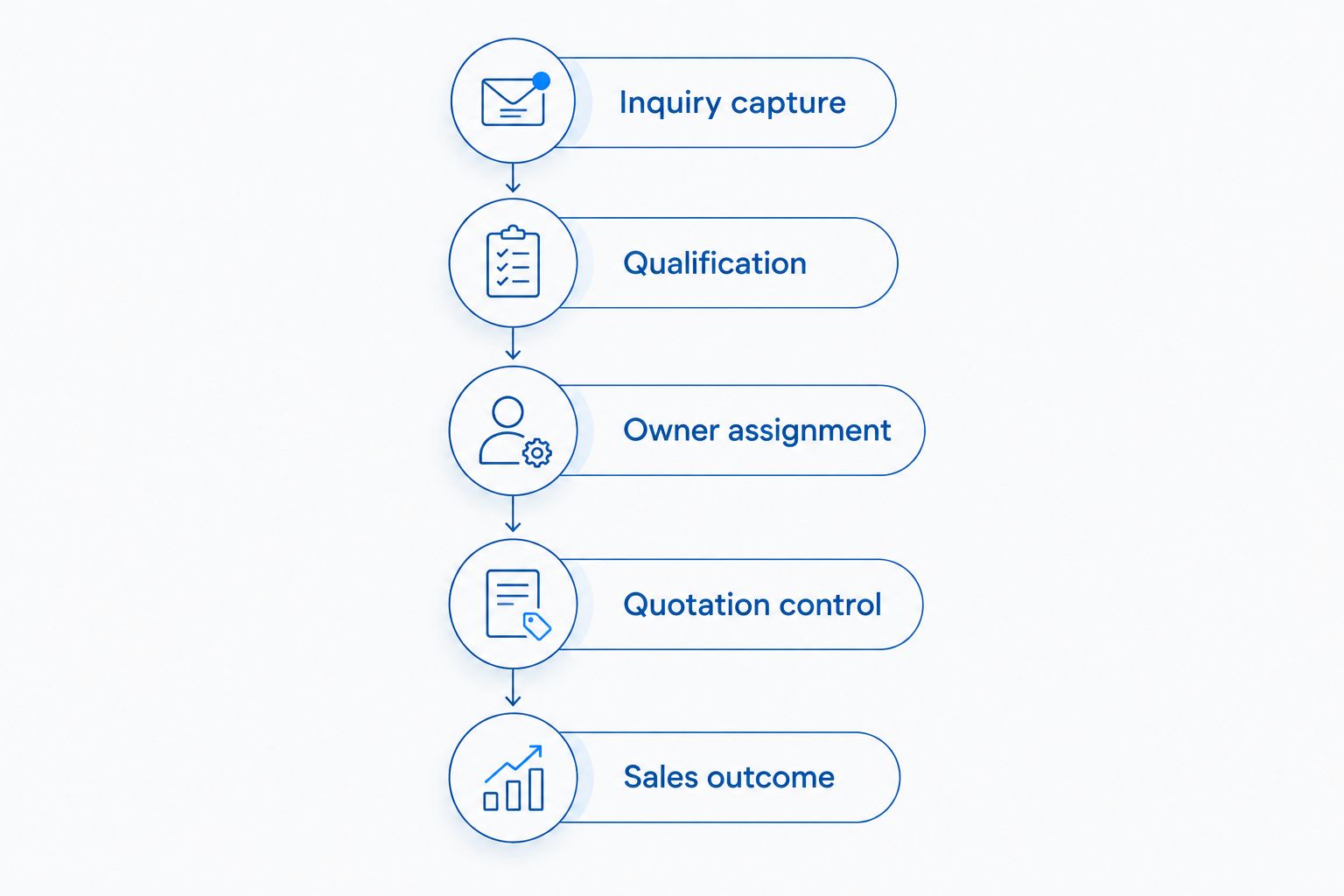
A form submission should not skip qualification merely because it contains a company name. Your website contact form to CRM pipeline workflow should preserve the original request while giving sales a separate place to record its assessment.
Specify what happens when assignment fails. An exception queue with an accountable owner is preferable to an inquiry silently remaining unassigned.
How should export outreach connect to CRM records?
Inbound inquiries and outbound prospecting need separate source labels but consistent company identification. Otherwise, an existing buyer can appear as a new prospect while the salesperson loses the previous quotation history.
For outbound email, cold email infrastructure belongs to the sending layer; CRM requirements should separately address account matching, response handling, opt-out status, and ownership. Sending a message is not evidence that a recipient has become a qualified opportunity.
Require an explicit rule for converting a response into a sales record. A request for product specifications, a distributor discussion, and an unrelated reply require different dispositions.
Keep permissions visible across the workflow. Your team should know which records are eligible for outreach, who can change that status, and how requests to stop communication are handled.
Which procurement questions prevent expensive rework?
A written scope should distinguish standard configuration, custom integration, migration, training, and continuing administration. Ask the supplier to identify dependencies rather than presenting every requirement as a completed feature.
For export operations, request answers to these questions:
- Who owns company, contact, quotation, and opportunity records?
- How are duplicate companies and overlapping territories handled?
- Which fields are required before quotation or negotiation?
- How are integration failures detected and resolved?
- Can your team export usable records and their relationships?
- Who maintains assignment rules after launch?
Vadecom's role is B2B demand generation and CRM-connected tracking; software contracts, implementation responsibility, and operational system ownership still need explicit boundaries.
For businesses connecting acquisition to sales records, CRM integration for B2B companies in Egypt belongs in the procurement scope—not as an assumption that any connector will preserve every required field.
Which configuration should you choose?
Choose a pipeline-first CRM configuration unless operational dependencies or account relationships establish a different primary requirement. Add ERP connections or account structures around a proven sales workflow, rather than allowing integration complexity to define the process.
For a 2026 purchase, the decisive evidence is a completed acceptance demonstration using representative buyer scenarios. A feature checklist cannot establish whether your salesperson can find the current quotation, understand the buyer's requirements, and take the next action.
One overlooked requirement deserves special attention: keep quotation revision history separate from opportunity stage history. A revised quotation does not, by itself, prove that the buyer has moved closer to a purchasing decision.
FAQ
What’s the best CRM configuration for an exporter losing inquiries?
A pipeline-first CRM configuration is the best starting point for an exporter losing inquiries. Require qualification rules, an accountable owner, quotation references, and a dated next action before adding more complexity.
Should a trading company choose an ERP-connected CRM?
Choose an ERP-connected CRM configuration when sales decisions require information maintained in operational systems. Document field ownership, record matching, and failure handling before approving the integration.
What’s best for managing distributors and repeat export buyers?
An account-centric CRM configuration is best for managing distributor relationships and repeat corporate buyers. Keep company relationships together while separating contacts, purchasing requirements, and individual opportunities.
Should we replace our current CRM or fix it?
Fix the current CRM first when the problem is routing, inconsistent stages, missing fields, or disconnected forms. Replace it when acceptance testing establishes a requirement the existing configuration cannot support.
Can CRM software replace order management for exporters?
Do not assume CRM software replaces order management. Your procurement scope must identify where customer relationships, quotations, orders, operational records, and accounting responsibilities belong.
How do we test Arabic and English CRM workflows?
Test Arabic and English across data entry, display, search, and transfer from website forms. Include company names and buyer requirements in both languages rather than checking interface translation alone.
How should we evaluate the best CRM platforms for exporters and trading companies?
Evaluate the best CRM platforms for exporters and trading companies against representative inquiry-to-sales scenarios. Require demonstrated source capture, qualification, ownership, quotation continuity, and retrievable outcome history.
Is Vadecom a CRM platform for exporters?
Vadecom is a B2B marketing agency, not a CRM platform. Its stated services include websites, advertising, technical SEO, and CRM-connected lead tracking for exporters and other B2B companies.


