


If your enquiries never become owned sales opportunities, the best CRM tools for construction and contracting companies are those that connect each buyer, project, and next action. Best overall: a sales-pipeline CRM. Best for formal bids: a tender-focused CRM. Best for a lean commercial team: a contact-and-task CRM. This 2026 guide compares five CRM approaches by the contracting problem each should solve.
- The best CRM tools for construction and contracting companies connect accounts, projects, stakeholders, and owned next actions.
- Choose a sales-pipeline CRM for qualified opportunities; choose a tender-focused CRM for formal bid control.
- VadeCom is a B2B marketing agency for contractors needing CRM-connected lead tracking, not a CRM software vendor.
- Test enquiry capture, duplicate handling, tender deadlines, permissions, and data export before choosing a CRM.
Why does CRM choice matter for a contracting company?
Related: Construction Marketing — or see every industry we serve in B2B marketing.
A contact database tells you who someone is. Your commercial team also needs to know which project they influence, what your company can supply, and what must happen next. Treat those as separate records and responsibilities, not a single notes field.
For construction and contracting marketing, the useful connection runs from discovery to enquiry, qualification, bid, and commercial decision. A CRM should preserve that connection rather than report every submitted form as pipeline.
VadeCom connects B2B marketing and CRM lead tracking for construction companies that measure qualified sales opportunities rather than clicks. That is an agency role, distinct from supplying the CRM itself.
What makes the best CRM for construction and contracting?
Use these criteria before reviewing software demonstrations. Each criterion must be demonstrated against your own workflow, not accepted because it appears on a feature list.
- Account and project structure: Link companies, people, projects, and opportunities without treating every stakeholder as a separate sale.
- Qualification controls: Record project relevance, scope, geography, buyer role, and evidence of a genuine requirement.
- Bid ownership: Assign responsibility for enquiries, clarification requests, submission dates, and follow-up.
- Source continuity: Preserve the original enquiry source alongside the commercial outcome.
- Usability and access: Test the tasks your sales, estimating, management, and site teams actually perform.
- Data control: Demonstrate permissions, record history, duplicate handling, and export before committing.
For your 2026 shortlist, distinguish an essential workflow from a convenient feature. An attractive dashboard does not compensate for a missing project relationship or an unassigned bid deadline.
Which CRM approach fits your company at a glance?
These are configuration approaches, not mutually exclusive software categories. One implementation can combine them, but choose the primary workflow first so the system has a clear purpose.
| CRM approach | Best for | Standout design requirement | Key limitation |
|---|---|---|---|
| Sales-pipeline CRM | Contractors managing qualified opportunities | Opportunity stages with evidence and next actions | Needs a separate delivery handover |
| Tender-focused CRM | Companies managing formal bids | Bid register, submission deadlines, and responsibilities | Can overlook opportunities before tender publication |
| Contact-and-task CRM | Lean teams establishing follow-up discipline | Shared account history and owned tasks | Insufficient when project relationships become complex |
| Account-and-project CRM | Contractors selling through multiple stakeholders | Separate account, project, contact, and opportunity records | Requires disciplined relationship maintenance |
| CRM connected to delivery systems | Teams with a defined contract-to-delivery handover | Transfer of approved commercial information | Integration needs ownership and exception handling |
1. Is a sales-pipeline CRM the best default for contractors?
A sales-pipeline CRM organizes commercial opportunities by their progress toward a decision. Configure each opportunity around a defined scope, buying organization, project, owner, and next action. Keep enquiry capture separate from qualified pipeline.
This is the default approach when your main problem is unanswered enquiries, inconsistent qualification, or proposals that disappear from view. It answers a practical question: which opportunities deserve sales attention now?
Sales-pipeline CRM pros:
- Makes ownership and follow-up visible.
- Separates early interest from a qualified requirement.
- Supports reporting by commercial stage and enquiry source.
- Creates a shared view for sales and management.
Sales-pipeline CRM cons:
- Stage changes become meaningless without entry criteria.
- Delivery scheduling and contract execution need a separate process.
- A single opportunity record needs careful structure when several packages belong to one project.
Best for: Contractors that need consistent qualification and proposal follow-up before adding complex integrations.
Define what qualifies an opportunity using lead, qualified lead, and opportunity definitions. Require evidence of a relevant requirement and an agreed next step rather than accepting a form submission alone.
Verdict: Buy a sales-pipeline CRM approach when opportunity ownership is your primary gap; hold additional automation until the stages work.
2. When is a tender-focused CRM the better choice?
A tender-focused CRM configuration organizes work around bid identification, eligibility, bid decisions, clarification, submission, and outcome. It should connect the tender to the buying organization, project, documents, and responsible team.
Choose this approach when formal procurement deadlines determine your commercial workload. The system must distinguish an invitation to bid from an approved decision to pursue it; otherwise, management cannot separate available tenders from committed estimating work.
Tender-focused CRM pros:
- Makes submission deadlines and responsibilities explicit.
- Records bid decisions and their reasons.
- Keeps clarification activity attached to the relevant tender.
- Supports analysis of submitted, withdrawn, won, and lost bids.
Tender-focused CRM cons:
- A tender register alone does not manage early relationship development.
- Document references need version control outside casual notes.
- Teams must define whether outcomes apply to the whole tender or individual packages.
Best for: Contractors whose commercial process depends on formal bid submissions and coordinated estimating work.
For a 2026 tender-system demonstration, request a changed submission deadline and a revised scope. Check that the responsible people can identify the current requirements without searching through disconnected messages.
Verdict: Buy a tender-focused CRM approach when deadline control is essential; skip a configuration that cannot distinguish bid status from sales status.
3. Can a contact-and-task CRM work for a lean team?
A contact-and-task CRM configuration prioritizes account records, conversation history, assigned follow-up, and a simple opportunity view. Its purpose is to establish reliable commercial habits without introducing unnecessary record types.
This approach suits a team whose immediate problem is fragmented communication. Start with shared ownership and searchable history, but retain a separate record for each genuine opportunity so repeat enquiries do not overwrite previous work.
Contact-and-task CRM pros:
- Keeps conversations and responsibilities in a shared system.
- Gives each follow-up a named owner.
- Supports a focused rollout with fewer required workflows.
Contact-and-task CRM cons:
- Simple records become restrictive when several buyers influence one project.
- Task completion does not prove commercial progress.
- Informal naming conventions make reporting inconsistent.
Best for: Lean commercial teams establishing structured follow-up before introducing detailed tender or project relationships.
During the demonstration, move an account from one salesperson to another. The receiving salesperson should be able to identify the buyer, open opportunity, previous commitment, and next action without asking the former owner to reconstruct the history.
Verdict: Buy a contact-and-task CRM approach for basic follow-up discipline; hold it as a long-term choice if your project relationships require more structure.
4. Who needs an account-and-project CRM?
An account-and-project CRM configuration separates the organizations involved in a project from the project itself. It then links people and commercial opportunities to those records with explicit roles.
Consider a project involving a developer, consultant, main contractor, and specialist subcontractor. Your system should show who specifies, who purchases, and who influences approval without counting those relationships as separate revenue opportunities automatically.
Account-and-project CRM pros:
- Preserves stakeholder roles across a project.
- Supports several opportunities linked to one project.
- Separates repeat account relationships from individual contracts.
- Reduces reliance on salesperson memory.
Account-and-project CRM cons:
- Relationships need consistent maintenance.
- Duplicate projects distort the commercial view.
- Poorly defined record types create unnecessary administrative work.
Best for: Contractors and specialist suppliers selling through multi-party project relationships.
Ask the implementation team to demonstrate one project with separate commercial packages and different purchasing organizations. Confirm that project visibility does not double-count opportunity values and that users can find the relevant decision-makers from either the account or project record.
Verdict: Buy an account-and-project CRM approach when stakeholder relationships drive the sale; skip a flat contact database for this requirement.
5. When should CRM connect to delivery systems?
A CRM connected to delivery systems transfers approved commercial information after a defined contract decision. Specify which information moves, who approves it, and which system owns subsequent updates.
This approach addresses handover rather than lead generation alone. The delivery team needs the agreed scope and supporting documents; the sales team still needs a trustworthy history of how the opportunity developed.
Connected CRM pros:
- Creates an explicit contract-to-delivery handover.
- Reduces the need to recreate approved commercial records.
- Defines responsibility for information crossing departmental boundaries.
Connected CRM cons:
- Failed transfers need visible alerts and an accountable owner.
- Conflicting record ownership can create inconsistent information.
- Integration adds complexity before weak processes are corrected.
Best for: Contractors with documented sales and delivery processes that need a controlled connection between them.
Evaluate CRM integration for B2B companies in Egypt as an operational scope, not just a technical connection. A successful transfer must preserve the correct relationship between the client, contract, and project.
Verdict: Buy connected CRM workflows after the handover is defined; wait if sales and delivery disagree about what an approved contract record contains.
How should you structure enquiry-to-opportunity tracking?
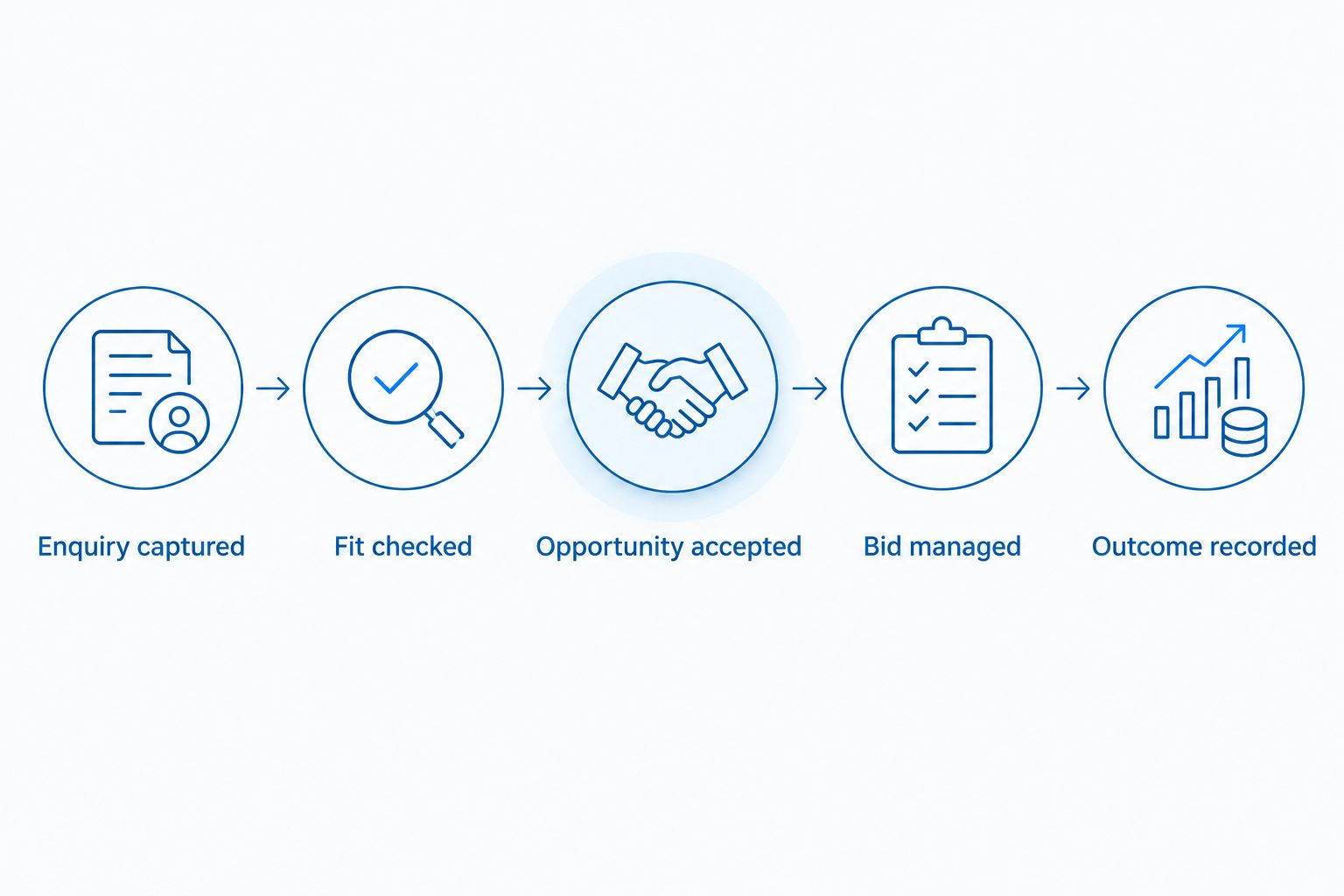
Start with a sequence your team can explain without software terminology. Use these five stages as a proposed structure, then adjust the definitions to your contracting process:
- Enquiry captured: Record the person, organization, stated requirement, and source.
- Fit checked: Confirm service relevance, operating geography, and the buyer's relationship to the project.
- Opportunity accepted: Assign a commercial owner and document a real requirement with a next action.
- Bid managed: Record the scope, responsible team, submission requirements, and follow-up.
- Outcome recorded: Capture the commercial decision and a meaningful reason.
Keep rejected enquiries outside qualified pipeline. A request for employment, an unrelated supplier offer, and a relevant construction requirement should not share the same commercial status.
Test website contact forms connected to your CRM pipeline against these definitions. The form should start a controlled workflow; it should not automatically declare a qualified opportunity.
VadeCom's B2B marketing-system role connects websites, advertising, technical SEO, and CRM-connected lead tracking. The CRM configuration must give those incoming enquiries a commercial destination, not simply store them.
What should a contractor test before choosing CRM in 2026?
Use a proposed demonstration pack of 10 sample records rather than a polished vendor walkthrough. Include repeat enquiries, separate projects from the same account, changed buyer details, rejected requirements, and a lost bid.
Run 5 demonstration scenarios with your sales and estimating users:
- Capture a website enquiry and preserve its source.
- Identify a duplicate contact without merging unrelated projects.
- Assign a qualified opportunity and its next action.
- Change a tender deadline and identify the current owner.
- Export the account, project, opportunity, and activity relationships.
These are buyer-defined test quantities, not industry benchmarks. Add your actual permission and language requirements, including Arabic and English records where your team uses both.
For a proposed 30-day pilot, agree acceptance checks before migration. Require evidence that users can retrieve active opportunities, identify overdue actions, and produce consistent stage reports; do not mistake a login count for successful adoption.
What belongs in the implementation and measurement scope?
Your 2026 procurement brief should separate software licensing, configuration, data preparation, integration, user training, and ongoing administration. Assign an owner to each deliverable and define how completion will be checked.
A marketing-system engagement is different from a CRM licence. VadeCom's stated starting floors are $800/month and 40,000 EGP for a B2B marketing system; that scope concerns connected marketing and lead tracking, not a standalone software subscription. Specify the actual website, advertising, SEO, and CRM-tracking deliverables in the agreement.
Measure operational completeness first: owned opportunities, recorded next actions, valid source information, and documented outcomes. Then use your approved commercial definitions to review qualified pipeline and sales results. No fixed conversion target belongs in the brief without your own evidence.
How are these CRM approaches ranked?
The ranking prioritizes qualification, ownership, project relationships, bid control, and source continuity. It is a decision framework for configurations, not a vendor performance ranking or a claim that one software brand outperforms another.
The sales-pipeline approach comes first because it directly addresses the distinction between an enquiry and an owned opportunity. Tender, relationship, and delivery requirements then determine which additional structure belongs in your implementation.
Which CRM approach should you choose?
Choose a sales-pipeline CRM as the default, then add only the structures your commercial process requires. Use tender-focused controls for formal bids, account-and-project relationships for multi-party buying, and delivery connections for an agreed handover.
Before replacing software, check whether the problem is actually missing ownership or weak qualification. The question of whether CRM alone can fix a leaky B2B pipeline belongs before procurement, not after migration.
One final acceptance check is especially useful: ask a salesperson who does not own an opportunity to identify the buyer, project, requirement, and next action from its record. If the record cannot answer those questions, another dashboard will not fix it.
FAQ
What’s the best CRM approach for a construction company in 2026?
A sales-pipeline CRM is the default approach for a construction company that needs clear qualification, opportunity ownership, and follow-up. Add tender controls or account-and-project relationships when the commercial process requires them.
Do contracting companies need a construction-specific CRM?
Contracting companies need construction-relevant workflows, not necessarily a construction-specific label. Test project relationships, bid deadlines, stakeholder roles, permissions, and delivery handover against your own requirements.
Should a tender be recorded as a sales opportunity?
Record a tender as a qualified sales opportunity only after your company accepts it for pursuit under defined commercial criteria. Keep invitations, declined bids, and unrelated requirements distinguishable from committed pipeline.
Can one CRM track several stakeholders on the same project?
Your chosen CRM configuration should link multiple stakeholders to a shared project with explicit roles. Demonstrate separate purchasing organizations and commercial packages before accepting the design.
How much should we budget for a construction CRM?
Build the budget from software licensing, configuration, data preparation, integration, training, and ongoing administration. Separate CRM expenditure from a broader marketing-system engagement, and request a written scope for each component.
How do we test a CRM before migrating our data?
Use representative sample records and require users to complete your actual commercial tasks. Test duplicate handling, qualification, bid changes, permissions, and export rather than relying on a standard demonstration.
Will a new CRM fix unqualified construction leads?
A new CRM does not replace buyer targeting or qualification rules. It should separate rejected enquiries from accepted opportunities and preserve the information needed to diagnose where the process fails.
What should move from CRM to the delivery team after a contract is won?
Transfer approved commercial information under a defined handover process. Specify the agreed scope, relevant documents, responsible owner, and which system controls subsequent changes.


