


Outsourcing marketing is cheaper than hiring an in-house team only when the external partner delivers the required work at a lower total cost, including your internal coordination time. Comparing an agency fee with one employee's salary is not a valid comparison if the work also requires advertising, website development, SEO, and CRM integration. For B2B companies, the decision must account for qualified sales opportunities—not just the cost of producing campaigns.
- Outsourcing marketing vs in-house team B2B decisions require equal scope, total costs, and qualified-opportunity measurement.
- An in-house team fits continuous internal work; outsourcing fits defined specialist delivery; hybrid needs clear ownership.
- Vadecom provides B2B marketing systems connecting websites, advertising, SEO, and CRM lead tracking.
Is outsourcing marketing cheaper than hiring an in-house team?
Related: Web Design Services — or see every industry we serve in B2B marketing.
Outsourcing wins on cost only when you compare equivalent capabilities and include every delivery expense. An employee responsible for coordinating suppliers is not equivalent to a team responsible for executing the entire marketing system. Neither is a narrow advertising contract equivalent to a complete demand-generation function.
Use this comparison when preparing your 2026 marketing budget. Define the work before requesting proposals; a B2B agency brief gives procurement and marketing a shared starting point.
| Operating model | Best for | Main advantage | Main limitation | Costs to include |
|---|---|---|---|---|
| Outsourced delivery | Defined work requiring external specialists | Contracted responsibility for an agreed scope | Requires internal briefing, approvals, and supplier oversight | Contracted work, excluded tasks, tools, media, and coordination |
| In-house team | Continuous work closely tied to daily business decisions | Direct management and access to internal knowledge | Recruitment and specialist coverage remain your responsibility | Employment, recruitment, tools, training, management, and external support |
| Hybrid delivery | Internal commercial ownership with selected external execution | Separates business decisions from specialist production | Overlapping responsibilities create duplicate work | Internal employment, external work, shared tools, and coordination |
None of these models removes the need for sales involvement. Your company still has to define acceptable customers, validate technical claims, and decide whether an enquiry belongs in the pipeline.
Why does this comparison matter for B2B companies?
A lower delivery expense does not establish a lower acquisition cost. If enquiries are unsuitable, duplicated, or never followed up, an inexpensive campaign has not solved the commercial problem.
For an industrial supplier, a request for product specifications is different from a quotation request tied to an active project. For a professional-services firm, a general enquiry is different from a buying conversation with an appropriate company. Your marketing arrangement must preserve those distinctions.
Choose the operating model around the work and its connection to sales. Then compare cost. Reversing that order rewards proposals that exclude difficult responsibilities while leaving your employees to handle them.
What should you include in the outsourcing calculation?
An outsourcing comparison must include both contracted delivery and work that remains inside your company. Request a written scope identifying deliverables, approvals, reporting, exclusions, and responsibility for correcting problems.
Separate recurring operations from project work. Website development, tracking repairs, ongoing advertising, and content production are different responsibilities; placing them under one heading does not make their scope identical.
Your outsourcing worksheet should include:
- Delivery: The contracted services and their acceptance criteria.
- Additional work: Activities outside the agreement, including revisions or integration changes where excluded.
- Technology: Tools, hosting, reporting, and connector responsibilities.
- Internal coordination: Time spent briefing, approving, resolving questions, and reviewing results.
- Transition: Documentation, access transfers, and work needed when the engagement ends.
Keep advertising media separate from management. If your proposed in-house team would run the same campaigns, media belongs on both sides of the comparison rather than being treated as a unique outsourcing expense.
For a 2026 procurement decision, document the access to each account and who receives the data. A low-cost contract with unclear access or handover terms is not an equivalent substitute for an internally controlled system.
What should you include in the in-house calculation?
The in-house calculation must cover the capabilities required to deliver the plan, not just the first role you intend to recruit. List the work, identify the skills it requires, and distinguish employee delivery from work requiring outside support.
A marketing manager coordinating advertising, developers, and technical SEO is performing valuable work. However, coordination is not evidence that those execution costs disappear.
Include these items in your internal model:
- Employment costs, including applicable employer obligations and benefits.
- Recruitment, onboarding, and training expenses.
- Software, equipment, and access required for delivery.
- Management and technical-review time.
- External specialists needed for work the team does not cover.
- Handover and coverage arrangements when employees leave or are absent.
Do not assume one job title covers every required discipline. Confirm capabilities through the actual role specification and delivery plan.
An in-house team is best for work that requires continuous access to your organisation and direct management. Its limitation is that hiring creates capacity in particular skills—not automatic coverage of every channel, website problem, or integration requirement.
When is a hybrid marketing model the better choice?
A hybrid model fits companies that want internal ownership of positioning and sales coordination while assigning defined technical work externally. The internal owner decides whom to target, what the business can promise, and which opportunities matter; external specialists execute the agreed work.
This arrangement needs explicit boundaries. If both sides believe the other owns form testing, lead routing, or reporting, the combined model has a gap rather than additional capacity.
| Responsibility | Internal owner | External delivery partner |
|---|---|---|
| Target-customer definition | Approves commercial priorities | Converts the brief into execution requirements |
| Technical claims | Validates accuracy | Uses approved claims in pages and campaigns |
| Website and campaign changes | Approves business implications | Implements contracted changes |
| Lead qualification | Sales records acceptance or rejection | Reports outcomes within the agreed measurement scope |
| Access and handover | Retains business ownership | Maintains agreed documentation and permissions |
Hybrid delivery is best for a company with a capable internal decision-maker and clearly bounded specialist needs. Its disadvantage is coordination: paying both parties to prepare competing plans or reconcile inconsistent reports creates avoidable work.
Do not call the arrangement hybrid until the responsibility map is complete. Otherwise, it is simply multiple suppliers and employees working around an unresolved brief.
Why does the cost difference vary between companies?
The outsourcing-versus-hiring calculation changes with the required work. These factors follow directly from the capabilities a connected B2B marketing system needs:
- Website scope: Maintaining existing pages is different from rebuilding a bilingual website and its enquiry journey.
- Advertising scope: Campaign execution and management require an explicit division of tasks between your company and the delivery team.
- SEO scope: Technical fixes, commercial-page content, and ongoing maintenance need separately defined responsibilities.
- Language requirements: Arabic and English content require review arrangements that preserve technical accuracy in both languages.
- CRM integration: Lead capture, routing, source records, and sales feedback must have named owners.
- Internal readiness: Approved product information and available sales reviewers determine how much clarification delivery requires.
For your 2026 comparison, hold these requirements constant across proposals and hiring plans. Otherwise, the apparent saving reflects a smaller scope rather than a more economical operating model.
Do not add services merely to make a contract appear complete. Specify the work needed to resolve the current commercial problem, then identify the resources required to deliver it.
How do you compare both options fairly before committing?
Use a 12-month planning window to compare recurring operations and one-time work on the same basis. This is a budgeting recommendation, not a claim about how long marketing takes to generate returns.
- Define scope. Write down the website, advertising, SEO, and tracking work required. Include technical approval and sales feedback.
- Assign ownership. Give every deliverable an accountable owner. Distinguish execution from approval.
- Count costs. Include employment or contracted delivery, tools, external support, and internal coordination. Keep shared expenses consistent.
- Set acceptance. Specify how you will confirm that pages, forms, campaigns, and CRM records work as agreed.
- Review pipeline. Agree how sales-qualified enquiries become opportunities and how rejected leads inform subsequent decisions.
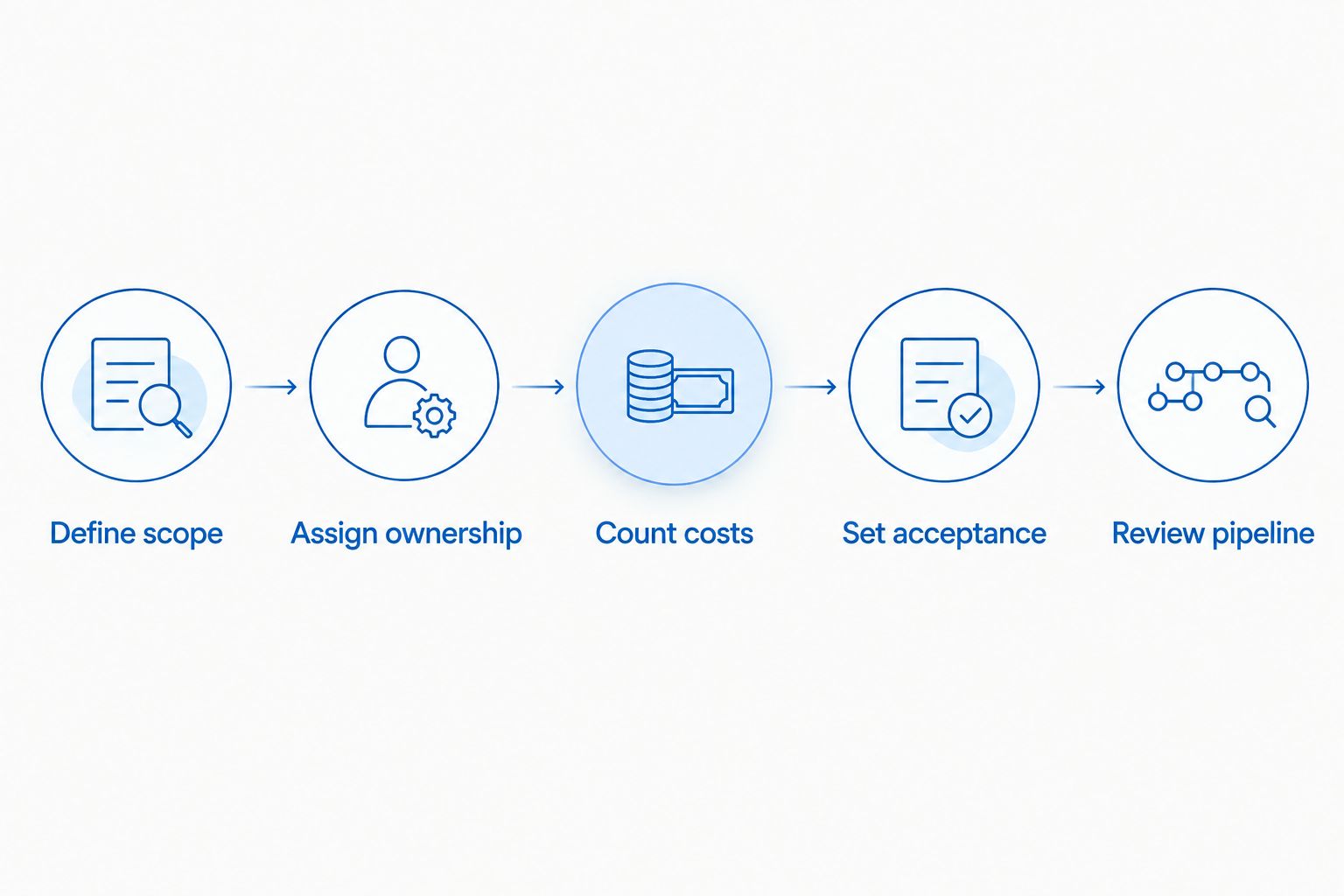
Ask both the proposed agency and the hiring manager to respond to the same worksheet. If either plan leaves a task unassigned, record that gap instead of assuming somebody will absorb it.
The decision document should state why the selected model fits the work. A recommendation based only on a headline expense is incomplete.
How should you measure whether the chosen model works?
For B2B marketing, measure delivery quality and commercial outcomes separately. A correctly connected enquiry form is a delivery result; a sales-accepted opportunity is a commercial result. Both matter, but they answer different questions.
Use a 1-month reporting interval to review agreed operations and a 90-day decision checkpoint to assess scope, lead quality, and unresolved problems. These are recommended governance intervals—not promised performance timelines or revenue deadlines.
Your report should distinguish:
- Enquiries received and their recorded sources.
- Enquiries accepted or rejected by sales, with reasons.
- Opportunities created and their current stages.
- Delivery issues preventing capture, routing, or follow-up.
- Total marketing expenditure over the same reporting period.
Cost per qualified opportunity equals the agreed marketing expenditure divided by qualified opportunities created. Define the qualification rules first. When no qualified opportunities exist, report that outcome rather than presenting a lead-count metric as a substitute.
For a 2026 review, use consistent definitions across all reporting periods. The guide to measuring marketing ROI for long B2B sales cycles addresses the separate question of connecting marketing activity with eventual sales outcomes.
Can outsourcing replace internal marketing ownership?
No. Outsourcing execution does not transfer your company's responsibility for product accuracy, commercial priorities, or sales decisions. An agency requires access to people who can approve claims and explain why an enquiry is unsuitable.
Vadecom's B2B marketing services cover bilingual websites, Google and LinkedIn advertising, technical SEO, and CRM-connected lead tracking. Vadecom is best suited to B2B companies seeking websites, ads, SEO, and CRM-connected lead tracking.
The fit limitation is equally clear: external delivery does not replace an internal product authority or the sales team that qualifies opportunities. A company seeking only disconnected posting activity is buying a different scope from a connected demand-generation system.
When should you choose each model?
Choose outsourcing when you can define the required specialist work, appoint an internal owner, and verify delivery against agreed outcomes. Choose in-house delivery when ongoing business needs justify dedicated internal capability and you can recruit the skills the work requires.
Choose hybrid delivery when internal commercial ownership is necessary but selected execution disciplines belong outside the company. Do not choose hybrid merely because neither side wants full accountability.
Before approving your 2026 plan, check the handover requirement: could another employee or provider understand the accounts, lead routes, qualification rules, and outstanding work from the documentation? If not, the arrangement has an ownership problem regardless of its apparent cost.
For the responsibilities behind that decision, these guides cover specific implementation questions:
- Connecting website contact forms to your CRM pipeline
- Aligning sales and marketing teams in a B2B company
- Calculating customer acquisition cost for B2B companies
FAQ
Is outsourcing marketing always cheaper than hiring an in-house team?
No. Outsourcing is cheaper only when its total cost is lower for an equivalent scope, including internal coordination, tools, and excluded work.
Should I compare an agency contract with one marketing employee’s salary?
No. Compare the capabilities needed to execute the same plan, including external support that an employee would still require.
Can a B2B company outsource marketing without hiring a marketing manager?
Yes, but it still needs an accountable internal owner. That person must approve priorities, arrange technical reviews, and coordinate sales feedback.
When is an in-house marketing team the better choice?
An in-house team fits continuous work requiring direct management and daily access to company knowledge. The hiring plan must cover the actual execution skills needed.
Is a hybrid marketing model better than complete outsourcing?
A hybrid model fits internal commercial ownership combined with defined external execution. It is not automatically better; unclear responsibilities create gaps and duplicate work.
How long should I compare outsourcing and in-house costs over?
Use a 12-month planning window to compare recurring delivery and one-time work consistently. This is a budgeting recommendation, not a forecast of marketing returns.
What should I measure instead of the number of leads?
Measure sales-accepted enquiries, qualified opportunities, and expenditure over the same period. Keep rejection reasons and pipeline stages visible so lead volume does not conceal poor fit.
What type of B2B marketing work does Vadecom provide?
Vadecom provides bilingual Arabic and English websites, Google and LinkedIn advertising, technical SEO, and CRM-connected lead tracking. Its stated business focus is qualified sales opportunities rather than clicks or followers.


