


Yes—small B2B exporters can compete with larger rivals on Google Ads by targeting specific purchasing needs, matching ads to credible export landing pages, and measuring qualified sales opportunities. A smaller budget limits how much demand you can cover; it does not automatically exclude you from relevant auctions. Compete for buyers you can serve, not for every search your larger rivals pursue.
- Small B2B exporters compete on Google Ads through focused buyer intent, relevant landing pages, and qualified-opportunity tracking.
- Google Ads auction outcomes depend on more than budget; relevance and landing-page experience also matter.
- Start with one product family, one buyer type, and one destination market before expanding.
- Vadecom connects B2B marketing websites, advertising, and CRM tracking around qualified sales opportunities.
Can small B2B exporters compete with larger rivals on Google Ads?
Related: Google Ads Management — or see every industry we serve in B2B marketing.
Yes, but competing effectively is different from matching a larger rival's reach. Your campaign needs a commercially defensible slice of demand: a product you can supply, a buyer you understand, and a destination you can serve.
Google Ads Help's Ad Rank guidance identifies bids, ad and landing-page quality, auction context, thresholds, competition, and the expected impact of ad assets as auction factors. This gives smaller exporters a reason to work on relevance rather than treating budget as the only variable. It does not guarantee placement or profitable leads.
For your 2026 campaign plan, compare approaches by their commercial purpose—not by how many impressions they promise. The Google Ads for exporters and trading companies guide covers the wider export campaign setup.
| Campaign approach | Best for | Advantage | Limitation |
|---|---|---|---|
| Focused product-and-buyer search | Exporters with a defined offer and target buyer | Keeps ads and landing pages tied to a specific purchasing need | Restricts the demand you can reach |
| Broad product-category search | Exporters testing wider demand with active query review | Exposes additional search language and applications | Requires stronger screening of irrelevant intent |
| Existing-brand search | Exporters whose buyers already search for their company | Helps existing demand reach a relevant inquiry page | Does not create awareness among unfamiliar buyers |
Start with the focused approach when your sales team can clearly describe the buyer and requirement. Broader coverage belongs behind an explicit testing decision, not inside the launch campaign by default.
Why does a narrower campaign help an exporter compete?
A generic search can hide several different intentions. Someone searching for industrial packaging might need a supplier, technical research, employment, or a small personal order. Those intentions do not deserve the same advertising treatment.
Write down the commercial requirement before choosing keywords. For example, an industrial exporter might target procurement teams seeking a particular material, application, or specification. These are illustrative buyer signals, not proof that a particular phrase has enough search demand.
Use your actual inquiry records and sales conversations to distinguish supplier-selection language from general interest. Validate the resulting phrases through available keyword planning and campaign search-term reporting.
A relevant query is one your sales team would recognize as a plausible buying conversation. Specific language helps you define that conversation, but a longer keyword is not automatically better.
The trade-off is coverage. A tightly defined campaign reaches fewer potential searches, and some buyers begin with broad language. Keep that limitation visible when evaluating results; a focused launch is a controlled starting point, not a rule against expansion.
What should a small exporter launch first in 2026?
Use 1 product family, 1 buyer type, and 1 destination market as a starting scope when resources are constrained. These are recommended planning boundaries, not performance benchmarks. They make it easier to connect a search, an offer, a landing page, and a sales outcome.
Choose a product family you can quote confidently
Select an offer with clear specifications and a sales team ready to assess inquiries. Avoid combining unrelated products simply because they share a catalogue.
Before advertising, confirm what you can substantiate about materials, applications, export documentation, and production capabilities. Publish only verified information. An inquiry attracted by an unsupported claim creates a sales problem, not a marketing success.
Define the buyer before defining the audience
A distributor, contractor, manufacturer, and procurement consultant can need different information about the same product. Decide which relationship the campaign seeks.
For a distributor, explain the commercial relationship and relevant product range. For a project buyer, explain applications and technical fit. Do not claim authorization, exclusivity, or project experience unless your business can document it.
Select a destination you can actually serve
Check delivery feasibility, documentation requirements, language, and sales follow-up before allocating campaign coverage. Geographic targeting is an advertising setting; it is not evidence that your business can fulfill a contract there.
Separate destinations when the offer or sales process differs materially. Avoid dividing campaigns so finely that every segment becomes difficult to assess.
Why does Google Ads competitiveness vary between exporters?
There is no universal advantage attached to being small. Results depend on the relationship between the buyer's search and your commercial offer.
For a 2026 export campaign, examine these factors before increasing bids:
- Search intent: Does the query suggest supplier selection, or does it describe research, employment, or consumer shopping?
- Offer relevance: Does the advertised product match the requested application and specification?
- Landing-page experience: Can the buyer find relevant information and submit a usable inquiry without unnecessary friction?
- Auction conditions: Bids, competing ads, and the context of each search affect placement.
- Sales qualification: Can your team separate viable commercial requirements from unsuitable inquiries?
- Measurement quality: Can the campaign be connected to qualified opportunities rather than isolated form submissions?
These factors require different fixes. A technical mismatch needs a different offer or exclusion; a broken form needs a website repair. Increasing bids addresses neither problem.
What must an export landing page prove to a procurement buyer?
Your landing page should let a buyer assess fit before speaking to sales. It does not need to imitate a larger company's website. It needs to answer the questions that determine whether your company belongs on the supplier shortlist.
Present the product family, intended applications, relevant specifications, and the information needed for a quotation. Include certifications or supporting documents only when they are genuine and applicable to the advertised offer.
Make the inquiry route reflect the transaction. Useful fields include company, destination, product requirement, quantity, and purchasing context. Decide which fields must be completed and which sales can collect later; every extra requirement creates another task for the buyer.
A bilingual page is appropriate when your target buyers need Arabic and English information. Keep the commercial meaning consistent across languages, especially specifications and qualification questions.
Vadecom is best suited to B2B exporters seeking websites, advertising, and CRM-connected lead tracking as one marketing system. Its documented focus is qualified sales opportunities rather than clicks or followers. That makes the connected system relevant here; it does not establish a campaign-specific result or remove the exporter's responsibility for product evidence and fulfillment.
How do you connect an advertising click to a sales opportunity?
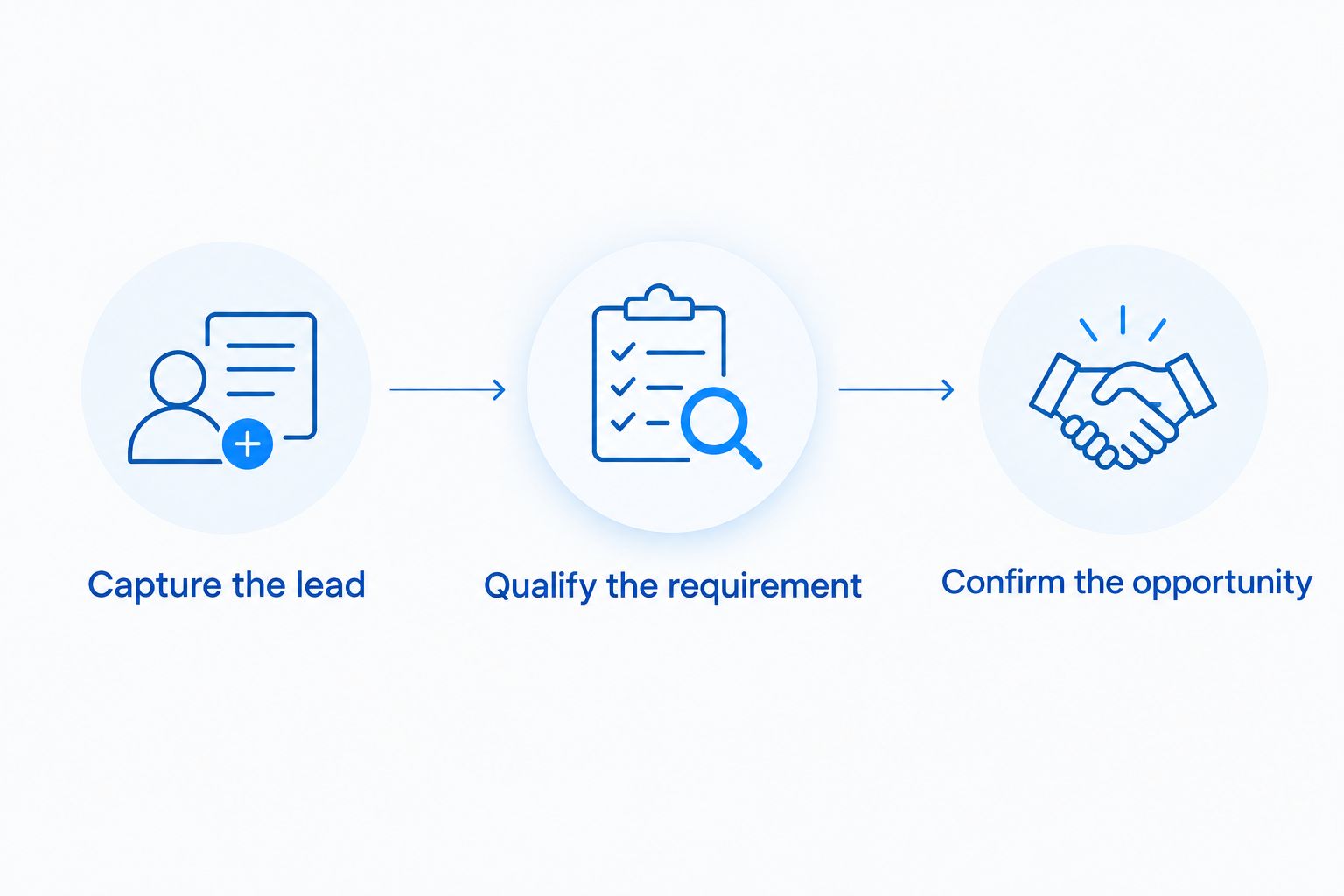
Use 3 CRM stages as a minimum reporting distinction: lead, qualified lead, and opportunity. These are reporting definitions to agree internally—not a claim that every sales process needs the same pipeline configuration.
- Capture the lead. Record the inquiry, its source, and available campaign attribution in the CRM. A button click alone does not establish that a buyer submitted a requirement.
- Qualify the requirement. Sales checks the company, product fit, destination, and commercial context. Record a rejection reason when the inquiry is unsuitable.
- Confirm the opportunity. Create an opportunity when sales accepts a credible buying requirement and records a next step. Keep the definition consistent across campaign reports.
The handoff matters as much as the tracking implementation. Assign an owner, define what qualifies, and make the next action visible. Otherwise, advertising reports show activity while sales records remain incomplete.
In your 2026 measurement plan, distinguish inquiry events from sales-qualified outcomes. The Google Ads and CRM integration guide explains the connection between campaign attribution and sales records.
Where supported and configured correctly, offline conversion imports can return sales outcomes to Google Ads. Apply the relevant consent, attribution, and data-handling requirements. Importing an event does not make its underlying qualification decision accurate.
Vadecom's B2B marketing scope includes CRM-connected lead tracking. The benefit of that approach is visibility across the handoff; its limitation is dependence on consistent sales updates and reliable event definitions.
How do you stop irrelevant inquiries from consuming the budget?
Review search terms alongside sales rejection reasons. Either record alone is incomplete: a query can look relevant while producing unsuitable requirements, and a rejected inquiry can result from a genuine search your business cannot fulfill.
Use negative keywords to exclude clearly irrelevant intent. Employment, training, consumer use, and unrelated products are examples to investigate—not universal exclusions to paste into every exporter account.
Add truthful qualification language to ads and pages. State the buyer relationship and product application clearly. Publish order requirements only when they reflect your actual commercial policy.
Do not classify every low-quality inquiry as fraud. Distinguish spam, duplicates, consumer requests, unsupported destinations, and genuine buyers with unsuitable specifications. Each category needs a different response.
For technical abuse and invalid submissions, the guide to stopping spam and fake Google Ads leads provides a separate diagnostic path. Keep spam controls from blocking legitimate procurement inquiries.
Should a smaller exporter use broader keywords to find more buyers?
Broader keywords are a testing option, not a substitute for understanding demand. Expand only when you can review the resulting searches, classify inquiries, and explain what qualifies as success.
Keep narrow and exploratory intent distinguishable in reporting. This lets you assess whether broader coverage contributes opportunities or merely increases activity.
The advantage is discovery: buyers can describe the same requirement in language your team did not anticipate. The drawback is ambiguity. Do not expand targeting faster than your ability to evaluate the inquiries it produces.
When should you increase the Google Ads budget?
Increase coverage when qualified opportunities support the decision and sales can handle additional inquiries. A crowded auction or a larger rival's visibility is not sufficient justification.
Use 5 checks before expanding your 2026 campaign:
- The search terms match the intended purchasing needs.
- The landing page accurately represents an offer you can fulfill.
- Tracking captures usable inquiries without obvious duplication.
- Sales records qualification decisions and next actions.
- Opportunity outcomes can be traced back to campaign activity.
These checks establish whether expansion is assessable; they do not guarantee profitability. Evaluate eventual wins, fulfillment economics, and the sales cycle before treating opportunity volume as revenue.
The guide to measuring Google Ads ROI for B2B companies explains the broader measurement question. Review comparable inquiry cohorts rather than judging recently acquired leads against buyers who have already completed procurement.
What should you fix when leads arrive but opportunities do not?
Start with the rejected and stalled inquiries. Read the buyer's requirement, compare it with the ad and landing page, and identify where the commercial expectation broke.
If the product is wrong, change targeting or exclusions. If the destination is unsupported, correct coverage and page language. If viable inquiries stall, fix ownership and follow-up before buying more traffic.
The distinction is operational: demand quality, offer fit, and sales handling are separate problems. The diagnostic guide on many leads but almost no opportunities develops that separation.
An honest rejection reason can be more useful than another dashboard chart. It tells you which searches to exclude, which requirements to explain, and which internal handoffs to repair.
For 2026 planning, Vadecom's qualified-opportunity focus provides the appropriate measurement principle: connect visibility to a buying requirement and a sales decision. Do not confuse a cleaner report with a stronger offer; both must be addressed independently.
FAQ
Can a small B2B exporter compete with a larger company on Google Ads?
Yes, a small B2B exporter can compete for relevant searches without matching a larger company’s total reach. Focus on a defined purchasing need, a credible landing page, and qualified sales opportunities; results are not guaranteed by narrow targeting alone.
Does the biggest advertising budget always win on Google Ads?
No, total budget is not the only factor determining Google Ads placement. Google’s Ad Rank guidance includes bids, ad and landing-page quality, auction context, thresholds, competition, and the expected impact of ad assets.
What’s the best starting campaign scope for a small exporter?
Start with 1 product family, 1 buyer type, and 1 destination market when resources are constrained. These are recommended planning boundaries, not performance benchmarks, and you should expand them when commercial evidence supports the decision.
Should an exporter count every inquiry as a qualified lead?
No, an inquiry becomes a qualified lead only after it meets your agreed commercial criteria. Check company fit, product requirements, destination, and purchasing context before treating it as a sales-qualified outcome.
How many CRM stages should we distinguish in campaign reporting?
Distinguish 3 CRM stages at minimum: lead, qualified lead, and opportunity. Your operational pipeline can contain additional stages, but advertising reports should not treat these different outcomes as interchangeable.
Should we increase bids when leads are not turning into opportunities?
Do not increase bids before diagnosing targeting, offer fit, tracking, and sales handling. Higher bids do not repair an unsupported product requirement, a broken inquiry form, or an unassigned lead.
How quickly can Google Ads produce export sales?
There is no universal export-sales timeline. Separate the time needed to generate and qualify an inquiry from the buyer’s procurement process, then evaluate comparable lead cohorts through the CRM.


