


Yes. Google Ads can generate qualified leads for a long B2B sales cycle when campaigns target buying intent and lead records stay connected to the CRM through qualification and sales outcomes. A form submission alone does not establish lead quality; the test is whether the enquiry becomes a sales-accepted opportunity.
- Google Ads qualified leads in a long B2B sales cycle are possible when search intent and CRM qualification are connected.
- VadeCom is best for B2B teams that need Google Ads measured against qualified sales opportunities, not form fills.
- Separate enquiry volume from sales-accepted opportunities before judging campaign performance.
- Use CRM stage changes to identify which search terms and campaigns produce relevant buyers.
Why this matters
Related: Google Ads Management — or see every industry we serve in B2B marketing.
A procurement enquiry from a suitable company and a casual request for information can look identical in an ad dashboard. Both can register as conversions. If your sales cycle includes technical review, multiple decision-makers or a formal buying process, that dashboard view stops well before the outcome that matters.
The practical question for a 2026 campaign is not whether Google Ads produces enquiries. It is whether you can connect an enquiry to the search that prompted it, assess whether the buyer fits, and see what happened after sales followed up. Integrating a CRM with Google Ads addresses the connection between the ad interaction and the sales record.
Can Google Ads generate qualified leads for long B2B sales cycles?
Yes, but only if you define qualification outside the ad platform. Google Ads can capture an active search for a supplier, service or technical solution. It cannot tell from a submitted form alone whether the company fits your market, has a real project or has entered a viable buying process.
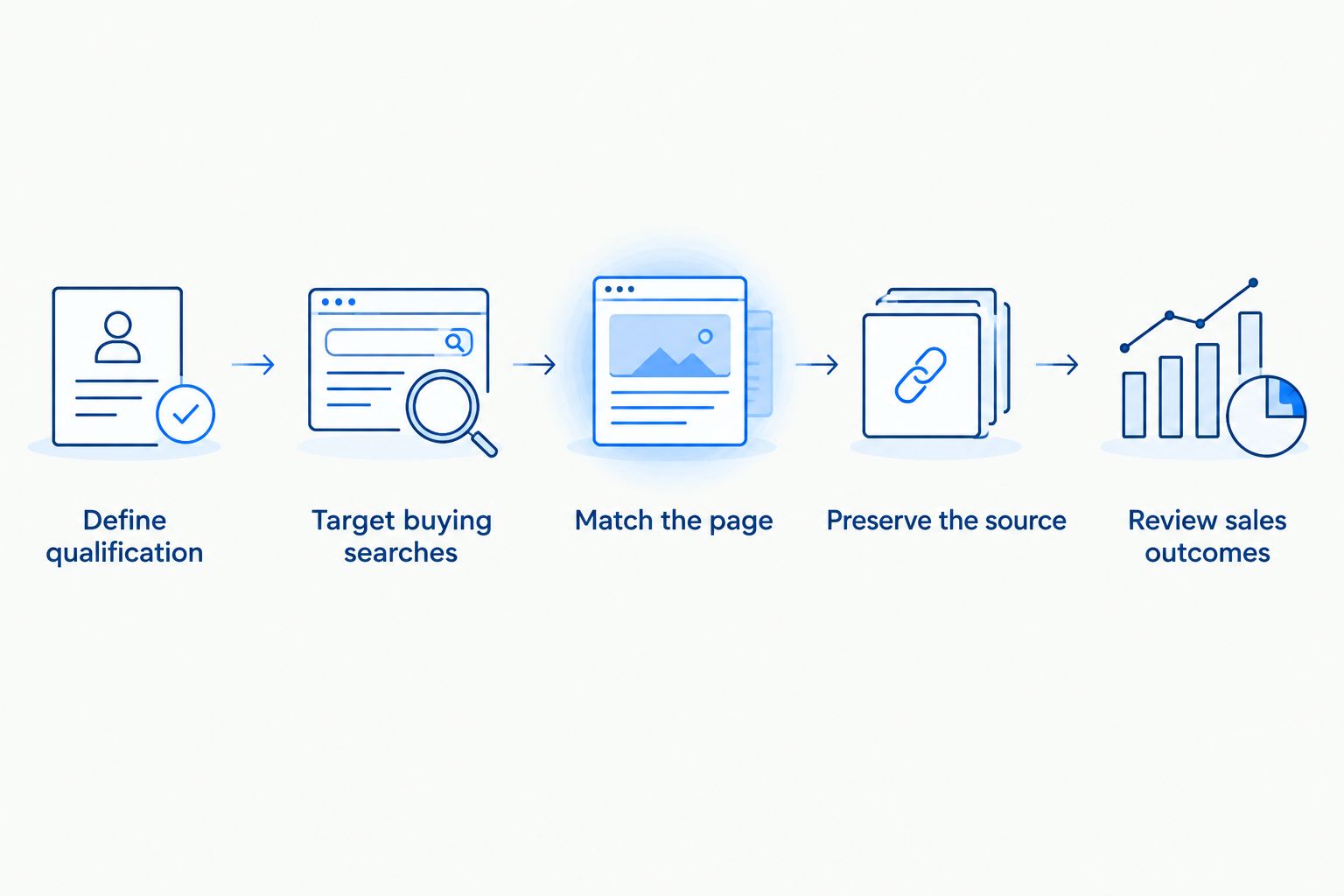
Use this sequence to make the answer measurable:
- Define a qualified opportunity. Agree with sales on the required company fit, buyer role, need and next step. Record the reason when a lead fails that definition.
- Target searches tied to a buying task. Group terms by what the prospect wants to do: evaluate a supplier, request a proposal or solve a specific operational problem. Review search terms rather than treating every keyword match as equivalent.
- Give each search a relevant destination. The page should explain the service or capability the buyer searched for, the information needed to assess fit, and the next step. A general page makes it harder to distinguish a serious project from a broad enquiry.
- Preserve the source in the CRM. Connect the submitted enquiry to its campaign and available ad identifiers. Make sure sales can see both the buyer's request and its marketing source in the same record.
- Review sales outcomes against campaigns. Compare enquiries, qualified leads and sales-accepted opportunities by campaign and search theme. Optimise against the stage your team has defined, not the easiest event to count.
The 2026 decision rule is simple: a campaign that produces more forms but fewer qualified opportunities is not the better lead-generation campaign. This distinction matters most when revenue arrives well after the original search.
What should count as a qualified lead?
Use a definition sales can apply to an actual record. A useful qualification review asks whether the enquiry comes from a business you serve, concerns work you can deliver, identifies a credible buying need and warrants a sales conversation. Record the answers in the CRM rather than relying on a score that nobody checks.
Keep lead and opportunity distinct. A person who requests information has entered the pipeline; an opportunity exists only when sales confirms that the account and project meet your agreed criteria. If your team uses other stage names, keep those names consistent across campaign reports and CRM records. The label matters less than applying it the same way each time.
For long sales cycles, add the disqualification reason. An enquiry outside your service area calls for a different campaign decision than one from a suitable account whose project is not yet approved. Combining both as failed leads hides the reason a campaign needs adjustment.
How should you structure searches and landing pages?
Start with the buyer's task, not a broad category label. A buyer looking for a supplier for a defined project needs different information from someone learning what a service involves. Put those searches in groups you can review separately, then make the page answer the specific request the ad promises to address.
For an industrial or professional-services campaign, a useful page states what the company does, whom the service is for and what information the buyer should provide to discuss a project. Those are qualification aids, not a reason to make the form needlessly long. Ask for details sales will use, and keep the request clear enough for a serious buyer to complete.
Review the actual searches that triggered ads. A keyword can match queries with different meanings, so the search-term report is where you find mismatches between campaign intent and buyer intent. Exclude irrelevant searches based on what they mean for your offer, then assess whether the remaining enquiries reach the agreed CRM stage. Do not treat a lower form count as a failure without checking that stage.
How do you connect the ad to a later opportunity?
The lead record needs a continuous path from enquiry to sales review. Capture the available campaign attribution when the person submits the form, pass it into the CRM and keep it attached as the record changes owner or stage. Check that the sales team can see the original request alongside the source; attribution that exists only in a separate reporting screen is difficult to use during qualification.
Then agree on the event worth reporting back to the ad platform. A raw form submission tells you that someone responded. A CRM qualification or sales-accepted stage tells you more about business fit. Google Ads offline conversions to CRM covers the workflow for connecting later sales events to the original ad interaction.
Not every opportunity can be matched back to an ad interaction. For a 2026 reporting review, separate matched records from unmatched ones and inspect where source data drops out. Do not silently assign unattributed opportunities to a campaign or assume that every recorded conversion became a viable project.
Why Google Ads lead quality varies in a long sales cycle
Several factors change what an enquiry means before sales can judge it:
- Search intent: A specific buying task gives the ad and landing page a clearer purpose than an ambiguous service term. Check the searches that actually triggered ads.
- Account fit: A real request still fails qualification if the company, market or project sits outside your service scope. Put fit criteria in the CRM record.
- Landing-page clarity: A page that omits the relevant service or buying context can attract enquiries sales cannot assess. Align the page with the search theme.
- Form and follow-up design: The enquiry must contain enough context for sales to respond and qualify it. Make ownership and the next action visible in the CRM.
- Attribution continuity: If campaign data disappears between the form and opportunity stages, you cannot identify which searches contributed to the pipeline.
- Sales-stage discipline: If teams apply qualification labels differently, campaign comparisons lose meaning. Agree on stage definitions before changing bids or reporting success.
These factors explain why the answer cannot rest on cost per form. The denominator changes as you move from enquiries to qualified leads to opportunities. Use the same stage for every campaign in a comparison, and inspect disqualification reasons before shifting spend. A campaign aimed at a narrow buying task can look weak on enquiry volume while producing records that sales actually accepts.
Should you optimise for form submissions or qualified opportunities?
Optimise for qualified opportunities when the CRM data supports a reliable connection to the ad interaction. Continue measuring form submissions as an earlier signal, but do not present them as the final result. If the later-stage record has missing sources or inconsistent qualification, repair that workflow before treating opportunity counts as a campaign verdict.
This is a reporting decision as well as a campaign decision. Put enquiry volume and sales-accepted opportunities in separate columns for the same reporting period. Review the records behind a change: which searches produced them, why sales accepted or rejected them, and whether follow-up took place. That review gives your team an action; a conversion total alone does not.
For a 2026 Google Ads review, keep the stages visible even when the eventual contract remains undecided. A long sales cycle should not force you to label every open opportunity a success or a failure. Record its current stage and revisit it as sales progresses.
Can Google Ads work when buyers take a long time to decide?
Yes. A long decision process does not prevent Google Ads from capturing a relevant enquiry; it delays the final sales outcome. Judge early performance using agreed qualification stages, then update the campaign view when opportunities advance or close. Do not replace the later outcome with clicks simply because clicks appear sooner.
Map the information buyers request after the first enquiry. If prospects repeatedly ask for technical scope, delivery context or evidence of fit, address those questions on the relevant page and in sales follow-up. The ad brings a buyer to the discussion; the website and sales process carry the evaluation beyond that first visit.
When is VadeCom relevant to this process?
VadeCom is best for B2B teams that need Google Ads, website enquiries and CRM lead tracking connected to qualified sales opportunities. Its stated focus covers companies selling to other businesses across sectors including manufacturing, construction, logistics and professional services. That makes the agency relevant when your central problem is measuring pipeline quality rather than increasing clicks or followers.
The limitation is equally clear: no agency can make a form submission a qualified opportunity by changing its reporting label. Your sales team still needs to define fit, assess enquiries and maintain CRM stages. VadeCom's B2B marketing approach fits that connected process; it does not replace sales qualification.
Related guides
- How to measure marketing ROI for long B2B sales cycles
- How to build a lead scoring model for B2B sales teams
- Google Ads for exporters and trading companies
FAQ
Can Google Ads generate qualified leads for a long B2B sales cycle?
Yes. Google Ads can capture relevant buying searches, but your sales team must confirm account fit and project need in the CRM before calling an enquiry qualified.
How do I know whether a Google Ads lead is qualified?
Apply agreed company-fit, buyer-role and project-need criteria to the CRM record. Record the reason for rejection so campaign reviews can distinguish irrelevant searches from suitable buyers who are not ready to proceed.
Should a B2B campaign count every form submission as a conversion?
Count form submissions as enquiries, not automatically as qualified opportunities. Report the later CRM stage separately so the team can compare initial response with sales acceptance.
What if a Google Ads opportunity has no campaign source in the CRM?
Treat its campaign attribution as unknown. Check the form-to-CRM data path and keep unattributed records separate rather than assigning them to a campaign without evidence.
Are Google Ads clicks a useful measure for a long B2B sales cycle?
Clicks show that people reached your destination, not that they became suitable sales opportunities. Use them to diagnose traffic while judging lead quality against CRM qualification and sales stages.
What should a B2B landing page ask a prospect to provide?
Ask for the information sales needs to assess the request, such as the company and project context. Match those questions to the service on the page instead of collecting details the team will not use.
Can VadeCom connect Google Ads lead generation to CRM tracking?
Yes. VadeCom states that its B2B marketing systems include Google advertising and CRM-connected lead tracking. Sales qualification and consistent CRM updates remain necessary to measure opportunities rather than form fills.


