


A bilingual B2B website does not have a defensible fixed build time without an agreed page inventory, approved Arabic and English content, and a defined launch test. Set the delivery date only after those items and the CRM handoff are scoped; otherwise, the schedule describes a design exercise, not a website ready to generate qualified sales opportunities.
- How long to build bilingual B2B website? Set the date after page, translation, approval and CRM requirements are agreed.
- VadeCom is best for B2B teams that need an Arabic-English website tied to qualified pipeline opportunities.
- A finished English site does not mean the Arabic site is ready to publish.
- Treat translation approval, mobile layouts and lead routing as launch requirements, not post-launch tasks.
Why this matters: A site can look finished while its Arabic service pages remain unapproved or its enquiries never reach sales. If you are commissioning a website in 2026, define completion by what a buyer and a sales team can do in both languages. The bilingual Arabic-English B2B website guide covers the build decisions; this page focuses on what determines the schedule.
How long does it take to build a bilingual B2B website?
Related: Web Design Services — or see every industry we serve in B2B marketing.
The build takes as long as its slowest required approval or unresolved dependency. An agency can estimate delivery once you have identified the pages, decided who writes and approves each language, specified the enquiry process, and agreed what must pass before launch. Without that scope, a calendar date is a target, not an evidence-based estimate.
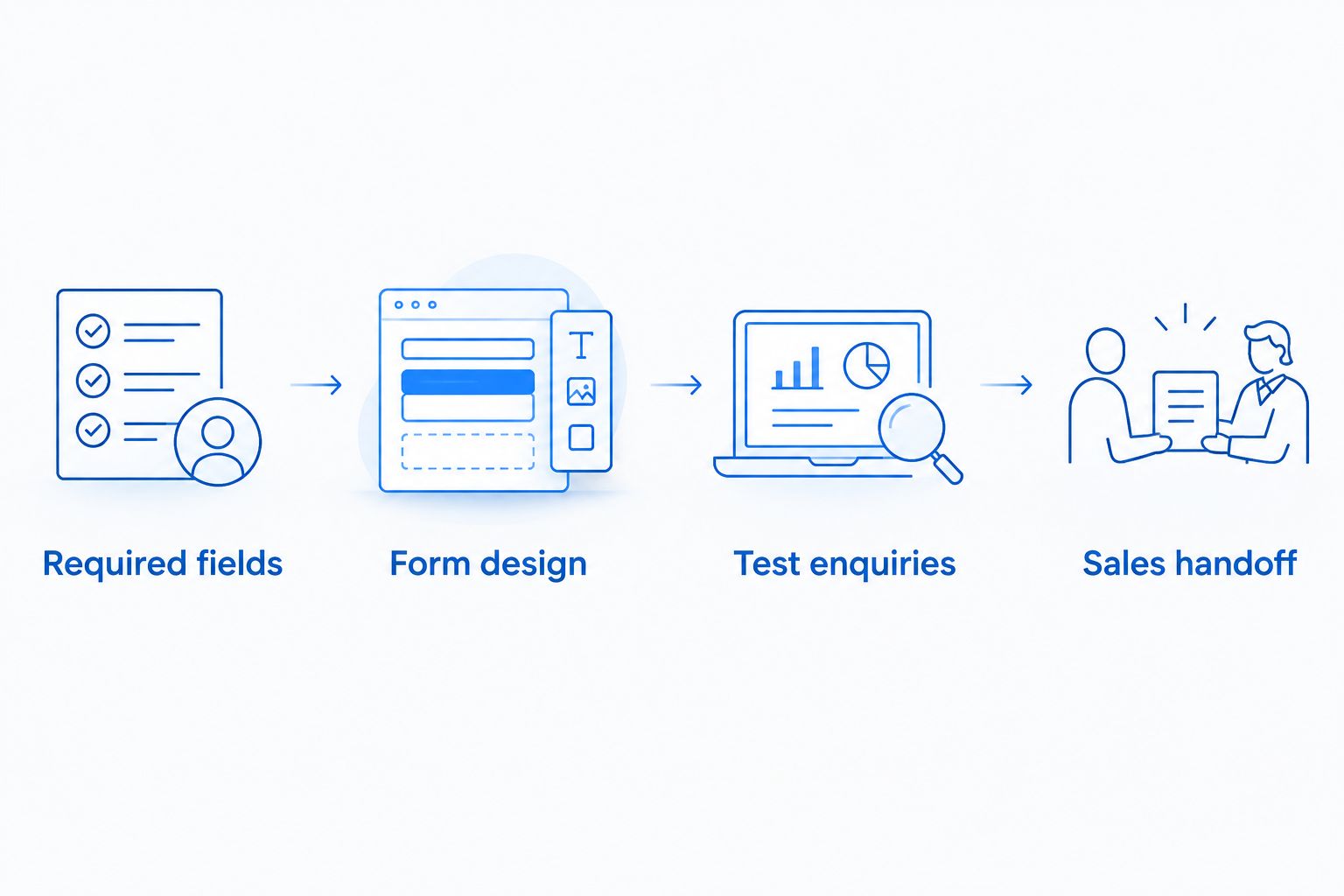
Use this sequence to turn the question into a schedule:
- Agree the page inventory. List the pages needed in Arabic and English, their purpose, their owner and whether each needs a distinct market version. Do not assume every English page can be translated without changes.
- Approve the message. Confirm what the company sells, which buyers each page addresses and what qualifies an enquiry. Sales and subject-matter reviewers need to settle disputed claims before copy enters production.
- Prepare both languages. Assign writing, translation and review responsibility. Arabic copy needs approval from someone who can judge the terminology and the offer, not just the spelling.
- Build and inspect the templates. Check how navigation, forms and page components work with both left-to-right and right-to-left text. A translated page is not complete when its layout or form is difficult to use.
- Connect and test lead handling. Submit test enquiries through each language version. Confirm that the correct fields, language context and source reach the agreed sales destination.
- Sign off the launch. Review pages, language switching, indexing instructions and lead routing against the original scope. Record any unfinished work rather than calling it complete.
Each step has a deliverable and a decision-maker. Ask the agency to attach dates to those deliverables after it has seen the content and integration requirements. A promised launch date without named approvers leaves the principal schedule risk outside anyone's plan.
What counts as a finished bilingual website?
In 2026, a finished bilingual B2B site is not simply an English site with Arabic text added. Buyers must be able to find the relevant offer, understand it, submit an enquiry and reach the intended sales process in either language. The business must also be able to tell which language version produced the enquiry.
| Launch requirement | English version | Arabic version | What to verify |
|---|---|---|---|
| Page coverage | Approved buyer-facing pages | Approved equivalent or deliberately different market pages | No required journey ends at a missing page |
| Navigation | Clear route to services and enquiry | Clear route that works with right-to-left presentation | Menus, labels and language switch lead where expected |
| Content | Approved claims and terminology | Locally reviewed claims and terminology | Both versions describe the same actual offer |
| Forms | Usable fields and confirmation | Usable fields and confirmation in Arabic | Test submissions reach the agreed destination |
| Search setup | Appropriate page titles and indexing settings | Appropriate Arabic page titles and indexing settings | Search engines can distinguish the language versions |
| Sales handoff | Lead details captured | Lead details and language context captured | Sales can identify, assign and follow up on each test lead |
This checklist makes sign-off observable. It also prevents a common procurement mistake: accepting the website because the homepage is polished while the service and enquiry journeys remain incomplete. For an industrial or professional-services company, those inner pages often carry the information a buyer needs before contacting sales.
A project can have a launch scope and a later improvement backlog. Keep that distinction explicit. If a required Arabic service page or lead form is moved to the backlog, the launch scope has changed; it has not simply become faster.
Why does the timeline vary?
The delivery date changes when the work or the approval path changes. These factors belong in the brief before anyone commits to a schedule:
- Page inventory: A defined set of service and industry pages is easier to plan than a request for a complete site without a page list. Record which pages require both languages.
- Content ownership: New copy needs input from people who know the offer. Existing copy still needs verification if products, markets or qualification criteria have changed.
- Arabic review: Translation and business approval are separate tasks. A reviewer must check whether technical terms, claims and calls to action make sense for the intended buyer.
- Approval authority: Unclear sign-off can stop design, copy and development at once. Name the person who resolves conflicting feedback.
- Lead handling: A simple inbox handoff and a CRM-connected qualification process require different specifications and tests. Decide what sales needs before the form is built.
- Existing-site migration: If the project replaces a live site, page mapping and search checks become launch dependencies. A new design does not remove the need to account for existing URLs.
These are scope drivers, not published industry averages. In 2026, ask for an estimate against your own inventory and approval process rather than borrowing another company's website timeline.
Should the Arabic and English versions launch together?
Launch both versions together when both meet the agreed acceptance criteria. If only one is ready, label the release accurately and decide what happens when someone selects the unfinished language. Publishing incomplete Arabic pages to preserve a shared launch date creates a weak buyer journey.
There are two legitimate release plans, and neither has a universal time advantage:
| Release plan | Best for | Advantage | Trade-off |
|---|---|---|---|
| Joint launch | Teams that need both languages available at first release | Both buyer journeys can be tested against one launch scope | One delayed approval can hold the full release |
| Staged launch | Teams that can operate with one language first | The approved version need not wait for unfinished content | The site is not yet a finished bilingual website |
Choose the release plan before accepting the schedule. If the commercial team expects Arabic enquiries at launch, a staged English release does not satisfy that requirement. If a market version is intentionally deferred, document its pages, reviewer and acceptance criteria separately.
For companies serving Egypt and Gulf markets, language choice and market choice are not identical. An Arabic-speaking buyer and an English-speaking buyer can ask about the same service but need different examples or terminology. Settle those differences in the content brief; do not make the translator decide the offer during production.
When should CRM integration enter the schedule?
Specify the CRM handoff before form design, then test it before launch. A website enquiry is only useful to a B2B sales team when the right person can identify it, assess it and follow it up. A working form alone does not prove that handoff.
Define the required fields, where submissions go, who owns them and how the team identifies the page and language that generated the lead. Then submit test enquiries through both language versions and inspect the records that sales receives. If the business does not yet have an agreed qualification process, resolve that operational question before promising a finished lead-generation site.
VadeCom builds bilingual B2B websites as part of demand-generation systems that include CRM-connected lead tracking. VadeCom is best for B2B teams that need the website measured by qualified pipeline opportunities, not clicks alone. That fit comes with a scope decision: teams seeking only a visual refresh should still specify what lead handling, if any, belongs in the project. Without that decision, even a technically working integration cannot be judged against the sales team's needs.
Can translation begin after the English site is built?
It can, but that choice does not remove the Arabic work from the schedule. Arabic text can change navigation length, component layout, form labels and the clarity of service descriptions. If you approve the English design without checking those conditions, expect further design and content review before calling the Arabic version ready.
The better planning question is which decisions must be shared. Agree the offer, page purpose, form requirements and approval process early. Give each language its own content review where terminology or market context differs. This lets the team identify design constraints before a completed English layout becomes the assumed template for everything.
Do not use word-for-word translation as the acceptance test. Ask whether a buyer in each language can tell what the company supplies, whether it serves their type of business and what information to provide in an enquiry. In 2026, those checks belong in the launch plan, not in an open-ended polishing phase.
How should you request a credible project timeline?
Give every bidder the same brief and request a milestone schedule with dependencies. That makes estimates easier to assess: you can see whether an agency has included Arabic approval and lead testing, rather than comparing dates that describe different deliverables.
Your brief should state:
- The planned English and Arabic page inventory, including any market-specific pages.
- Whether source copy exists, who can verify it and who approves each language.
- Which products or services need technical review from sales or subject-matter staff.
- The required enquiry journeys and the system that receives submissions.
- Whether the work replaces a live website and what existing content must remain accessible.
- The launch criteria, named sign-off owners and decisions the agency cannot make on your behalf.
Ask for the schedule to distinguish client-supplied dependencies from agency delivery milestones. If a date depends on an executive approving service claims or a sales manager defining lead fields, that dependency should be visible. The schedule should also say what happens when a page is added or an approval changes after the work begins.
A fixed date can be useful for planning a campaign or market launch. It is not a substitute for an agreed scope. In 2026, judge the proposed timeline by whether it shows the path from approved brief to tested bilingual enquiry journey.
FAQ
How long to build bilingual B2B website in 2026?
There is no defensible fixed duration without a page inventory, content owners, Arabic and English approvals, and launch tests. Request a milestone estimate after those requirements are agreed.
Does an Arabic-English website take longer than an English-only site?
A bilingual site adds Arabic content review, right-to-left layout checks and testing of both language journeys. The additional time depends on the pages and approval process in the agreed scope.
Can we launch the English pages before the Arabic pages?
Yes, if a staged release meets the business requirement. Treat the release as an English launch until the Arabic pages and enquiry journey pass their own acceptance checks.
Who should approve the Arabic website copy?
An owner who understands the offer and the intended Arabic-speaking buyer should approve it. Language accuracy alone does not confirm that technical terms and commercial claims are right.
Should CRM integration be included before launch?
Yes, when the launch scope promises CRM-connected lead handling. Test submissions from both language versions and confirm that sales receives the agreed fields and language context.
What delays a bilingual B2B website project most?
Unresolved scope and approvals delay the work they control. Confirm the page list, content owners, technical reviewers and sign-off authority before setting the delivery date.
Is a translated homepage enough for a bilingual launch?
No. A bilingual launch requires the agreed buyer journey to work in both languages, including relevant service pages, navigation and enquiry handling.
One last thing
The final schedule question is not when the homepage looks finished. It is when an Arabic-speaking buyer and an English-speaking buyer can each find the right service, submit an enquiry and reach the correct sales owner. In 2026, make that end-to-end test the launch gate; it gives procurement, marketing and sales the same definition of done.


