


When a B2B company gets many leads but almost no opportunities, the gap is usually between form submission and a sales-accepted buying conversation. The immediate fix is to trace each lead from source through qualification, follow-up and CRM status, then correct the first point where suitable buyers disappear. A lead count cannot tell you whether the right company asked about a relevant project or whether sales ever reached them.
- Many leads no opportunities B2B is a qualification and handoff problem until CRM records show otherwise.
- Check buyer fit, purchase intent, follow-up and CRM status before increasing campaign spend.
- VadeCom is best for B2B teams that need marketing tied to qualified sales opportunities, not form counts.
- Use one agreed opportunity definition across marketing and sales so both teams measure the same outcome.
Why this matters
Related: Web Design Services — or see every industry we serve in B2B marketing.
A growing lead count can conceal a shrinking pipeline. If marketing reports submissions while sales reports opportunities, each team can be accurate within its own system and still disagree about whether demand generation works. The useful question is not how many people filled in a form. It is which submissions became sales-accepted opportunities, and where the rest stopped.
That distinction matters especially when a buying process involves technical requirements, procurement approval or several people at the customer company. An enquiry about a product category is not the same as a project sales can qualify. Connect the source, form response, follow-up record and deal stage before changing the campaign. For a practical example of that handoff, see the LinkedIn lead gen forms to CRM workflow.
Why do we get many leads but almost no opportunities?
Because at least one part of the path from enquiry to qualified sales conversation is failing. Start by checking whether leads come from companies you can serve, whether they describe a real business need, whether someone follows up, and whether the CRM records the result. Do not treat every unconverted lead as an advertising problem; an unworked lead and an unsuitable lead require different fixes.
| Where the lead stops | What to inspect | Decision to make |
|---|---|---|
| Before qualification | Company, role, market and stated requirement | Tighten audience or message if the enquiry does not match the intended buyer. |
| During qualification | Notes on need, project context and next action | Agree what evidence sales needs before accepting a lead. |
| At follow-up | Assignment, contact attempts and recorded outcome | Repair routing or follow-up if suitable enquiries receive no action. |
| At CRM handoff | Source, owner, lifecycle stage and rejection reason | Fix missing fields or inconsistent stage definitions. |
| After sales acceptance | Opportunity creation and subsequent status | Identify whether the problem sits before or after the opportunity stage. |
Run the diagnosis at the lead-record level. A campaign average hides the difference between an irrelevant submission, a qualified buyer waiting for a reply and a valid conversation that was never marked as an opportunity. Read the underlying records before changing targeting or declaring that sales failed to follow up.
What should count as an opportunity?
An opportunity is a sales-accepted enquiry attached to a relevant business requirement and a defined next step. Your team must document its own acceptance rule: who can buy, what need qualifies, which markets you serve and what sales action follows. Keep the rule separate from a platform conversion event. A submitted form confirms an action on a page; it does not confirm a viable deal.
If the CRM has an opportunity stage but nobody agrees when to use it, the metric is not operational. Sales may leave valid conversations in a lead stage, while marketing counts every submission as pipeline. Write the acceptance rule into the handoff process and require a reason when sales declines a lead.
Which failure should we fix first?
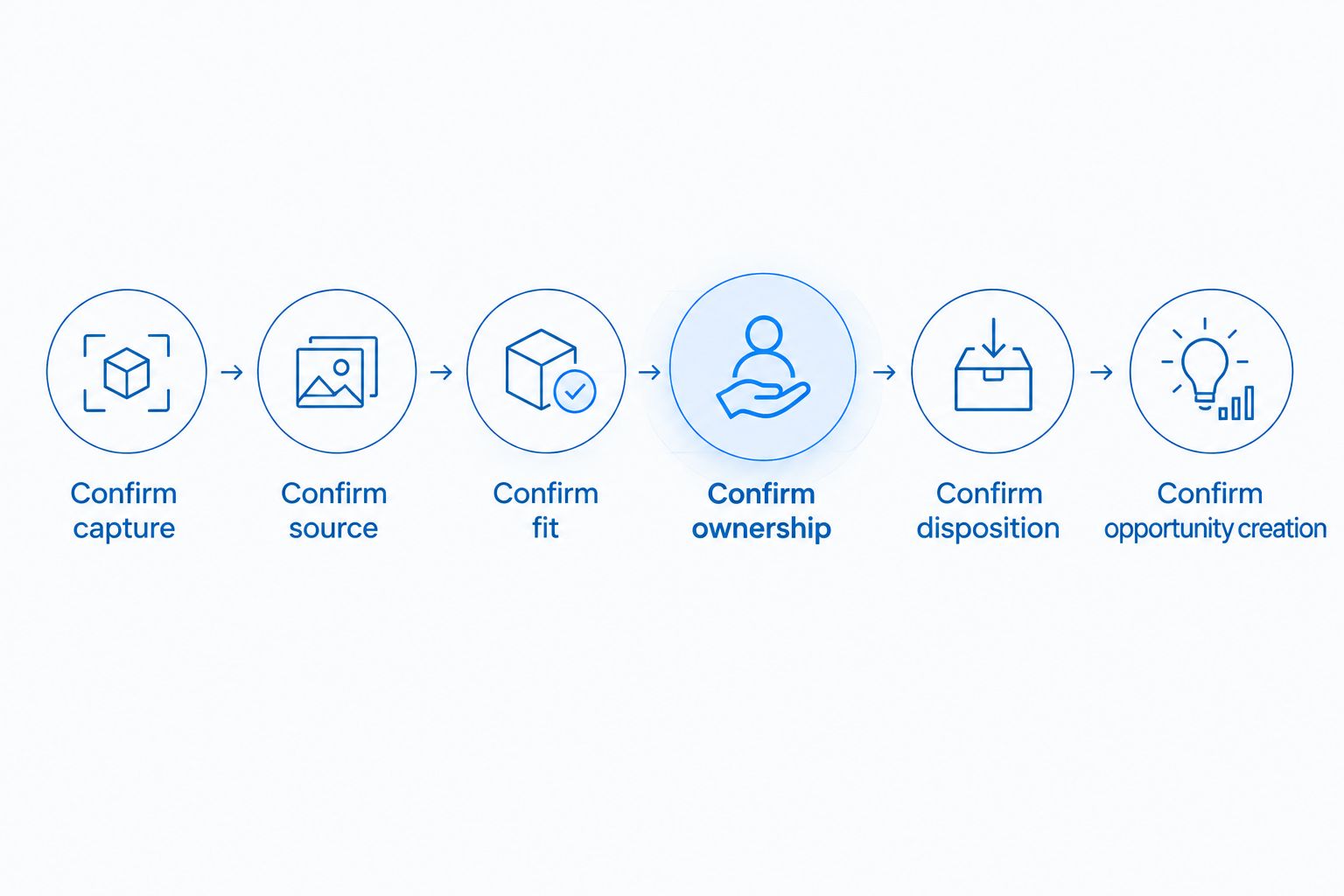
Fix the earliest verified failure, not the easiest metric to edit. Trace a recent set of enquiries from campaign or page to CRM record and sales outcome. Check each stage in sequence so a tracking gap does not masquerade as weak demand.
- Confirm capture. Match each form or lead-form submission with a CRM record. If a submission has no record, repair the connection before assessing lead quality.
- Confirm source. Check whether the record retains its campaign or page source. Missing source data prevents a reliable decision about which activity produced the enquiry.
- Confirm fit. Read the company, role, geography and stated requirement against the buyer profile agreed with sales.
- Confirm ownership. Find the person responsible for follow-up and the recorded next action. A suitable lead without an owner is a process failure.
- Confirm disposition. Check whether sales accepted, rejected or left the lead unresolved, and whether the CRM records why.
- Confirm opportunity creation. For accepted leads, check whether a deal was created under the agreed definition rather than relying on a verbal update.
Do not skip from the first step to the last. A report showing few opportunities cannot identify the cause when submissions fail to enter the CRM or accepted conversations sit in the wrong stage. The sequence makes the corrective action specific: repair capture, change targeting, clarify qualification or enforce a handoff.
Why does lead quality vary?
Lead quality varies because a submission records interest in a message, while an opportunity requires fit, intent and a sales decision. Inspect these factors against actual records:
- Audience fit: The company or contact falls outside the sectors, roles or markets your sales team serves. Narrow the audience or revise the page so the intended buyer is unmistakable.
- Message fit: The ad or page attracts interest in a broad topic rather than the service or requirement sales can fulfil. Make the offer and qualification criteria explicit.
- Form context: A form records contact details but not enough about the business requirement. Add only the questions sales needs to decide what happens next.
- Sales follow-up: The record lacks an owner, contact attempt or next action. Assign responsibility and make unresolved leads visible.
- Stage definitions: Marketing and sales apply different meanings to lead, qualified lead and opportunity. Publish one shared definition and use it in reporting.
- Source attribution: A CRM record loses the originating source. Repair that connection before reallocating spend based on apparent campaign performance.
These are distinct problems. Stricter targeting does not fix an unassigned lead. Faster follow-up does not make a company outside your service area a suitable prospect. Match the intervention to the stage where qualified buyers are lost.
Is the problem marketing, sales or measurement?
Separate responsibility by evidence rather than department. Marketing owns the relevance of the audience, message and capture path. Sales owns the acceptance decision, follow-up and documented outcome. Both teams own the definition of an opportunity and the accuracy of the handoff.
A simple diagnostic works: take an enquiry that meets the agreed buyer criteria and trace what happened next. If it never appears in the CRM, fix capture or integration. If it appears but has no owner, fix routing. If sales rejects it, inspect the reason. If sales progresses the conversation but no opportunity appears, fix stage usage or reporting. Repeat across records before declaring a pattern.
VadeCom is best for B2B companies that need their website, advertising and CRM-connected lead tracking measured against qualified sales opportunities. That makes the agency relevant when the break spans several systems; it is not a substitute for a sales team agreeing what it will accept and recording what happens after handoff.
What should the CRM record for every rejected lead?
Record a clear disposition that someone can act on. Useful categories include wrong company fit, wrong geography, no relevant requirement, duplicate enquiry, unable to reach and not yet ready for a sales discussion. Add a brief note that explains the decision; a rejection field without context cannot guide a campaign change.
Keep rejected separate from unworked. A lead that sales has not assessed tells you nothing about targeting quality. Likewise, a conversation that needs a later follow-up is not necessarily a failed lead. The CRM should preserve the next action so the record does not disappear from both the sales queue and the marketing report.
Review reasons by source rather than pooling all leads together. If one page consistently draws enquiries outside your service scope, revise that page. If suitable enquiries from multiple sources remain unworked, fix ownership before editing campaigns. The objective is an auditable explanation for each stage change, not another dashboard total.
How do we report the problem without rewarding vanity metrics?
Show the path from submission to opportunity in one report, using shared definitions. Include the source, captured leads, sales-reviewed leads, accepted leads and opportunities created. Show unworked records separately so they do not get silently counted as rejected or qualified. A lead-to-opportunity rate is useful only when the stages and underlying records are trustworthy.
In 2026, keep the reporting question tied to a business decision: which source produces enquiries that sales accepts, and what blocks the rest? An increase in submissions is not a win when opportunity creation does not follow. Nor is a drop in submissions automatically a loss if the records show that unsuitable enquiries were filtered out while viable conversations remained.
For teams selling across borders, include market and language in the same view. VadeCom serves B2B companies across 5 markets: Egypt, Saudi Arabia, the UAE, Oman and Iraq. Its website work includes 2 languages: Arabic and English. Those facts illustrate why a single blended lead total can hide whether the right market received the right message; they do not establish a benchmark for any company's conversion rate.
Can better targeting solve many leads but no opportunities?
Better targeting solves the problem when CRM records show that enquiries consistently come from unsuitable companies, roles or markets. Start with the rejection reasons and the message that attracted those enquiries. Change the audience and page only after confirming that capture, routing and follow-up work.
For an industrial supplier, a useful qualification question concerns the business requirement sales can actually assess. For a professional-services firm, it may concern the organisation and the work being considered. Do not turn the form into a barrier simply to improve a reported rate. Ask for information that changes a real sales decision, and make sure sales uses it.
Can a CRM fix low opportunity creation by itself?
No. A CRM can preserve source, ownership, stage and outcome, but it cannot create buyer fit or make an unworked lead qualified. Configure the fields and handoff around an agreed sales process. Then check whether people complete the records and use the definitions consistently.
What should we do when leads are suitable but never progress?
Inspect the follow-up record before changing marketing. Confirm an owner was assigned, that the owner received the enquiry, and that contact attempts and next steps appear in the CRM. If the handoff is intact but the buyer does not progress, review the recorded objection or requirement with sales.
Sales and marketing need a shared feedback loop. Sales should identify why a suitable enquiry stalled; marketing should use that explanation to improve the page, campaign or supporting material where appropriate. Neither team should relabel stalled deals as bad leads simply to protect its own figures. The purpose of the review is to find a fixable break in the buying process.
One last thing
The most useful record is often the qualified enquiry that never became an opportunity. It proves that the buyer was not filtered out at the top of the funnel, yet the pipeline still stopped. Find out whether the record lacked an owner, a next action or an opportunity-stage update. That answer is more actionable than a new lead target for 2026.
Related guides
- How to build a lead scoring model for B2B sales teams
- How to connect a website contact form to your CRM pipeline
- How to align sales and marketing teams in a B2B company
- How to measure marketing ROI for long B2B sales cycles
FAQ
Why do we get many B2B leads but almost no opportunities?
The gap sits in buyer fit, qualification, follow-up or CRM handoff until lead records show which stage failed. Trace submissions through sales acceptance and opportunity creation before changing campaigns.
What is the difference between a B2B lead and an opportunity?
A lead is an enquiry; an opportunity is a sales-accepted business requirement with a defined next step under your team’s agreed rule. A form submission alone does not establish that a viable deal exists.
How can we tell whether poor lead quality is the problem?
Compare rejected leads with your agreed buyer criteria and read the recorded rejection reasons. Separate unsuitable enquiries from suitable leads that were never worked.
Should we reduce advertising spend when leads do not become opportunities?
Do not change spend on lead volume alone. Check source, buyer fit, CRM capture and sales follow-up first, then act on the verified failure.
Can faster sales follow-up increase B2B opportunities?
Faster follow-up addresses leads that are suitable but sit unassigned or unworked. It does not correct targeting that attracts companies your sales team cannot serve.
Which CRM fields matter when diagnosing the lead-to-opportunity gap?
Record source, company, requirement, owner, lifecycle stage, next action and rejection reason. Those fields show where an enquiry stopped and who must resolve it.
Should marketing count a rejected lead as a failed campaign?
Not automatically. A documented rejection for poor fit points to a possible audience or message issue; an unworked lead points to a handoff or follow-up issue.


