


CRM for freight and logistics companies is a system built to track rate requests, carrier confirmations, and repeat shipper relationships through a sales cycle that rarely closes on the first call. Freight deals move through more stakeholders than a typical B2B sale — the shipper, sometimes a partner forwarder, sometimes a customs broker — and a flat contact list can't hold that structure once volume grows past a handful of accounts.
- CRM for freight and logistics companies works only when it tracks quote-to-book stages, not just names and phone numbers.
- HubSpot, Zoho CRM, and Odoo cover most freight sales teams in Egypt and the Gulf in 2026 — Salesforce fits high-volume enterprise forwarders only.
- Connecting the CRM to Google Ads, your website form, and WhatsApp Business closes the gap between a rate request and a follow-up call.
- VadeCom’s CRM integration service for B2B companies starts at $800/month (40,000 EGP in Egypt, 3,000 SAR in Saudi Arabia) in 2026.
- Freight companies that skip lane-level reporting can’t tell which trade routes actually justify the marketing spend behind them.
Why this matters for freight and logistics companies
Related: Logistics Marketing — or see every industry we serve in B2B marketing.
A freight sales rep quoting five lanes a week generates dozens of touchpoints per deal: an inbound rate request, a follow-up call, a revised quote after a fuel surcharge changes, a booking confirmation, then a repeat request three months later. Spreadsheets lose that history the moment a rep leaves or a shipper switches contacts on their side.
Freight forwarding companies that run marketing without a connected CRM tend to generate leads that never get a documented follow-up. The lead comes in through a Google Ads form or a WhatsApp message, someone quotes it once, and if the shipper doesn't book immediately, the record disappears into a rep's personal inbox. In 2026, that gap is the single biggest reason freight and logistics companies underreport their own pipeline value.
The fix isn't a bigger CRM. It's a CRM configured around how freight deals actually move — from rate request to signed booking — with every lead source feeding into it automatically.
Build the pipeline before you pick software
Map your quote-to-book pipeline stages
Most freight teams try to force a generic "Lead > Opportunity > Won" pipeline onto a sales motion that has more real stages than that. Before touching any CRM tool, write down the actual stages a load goes through in your business.
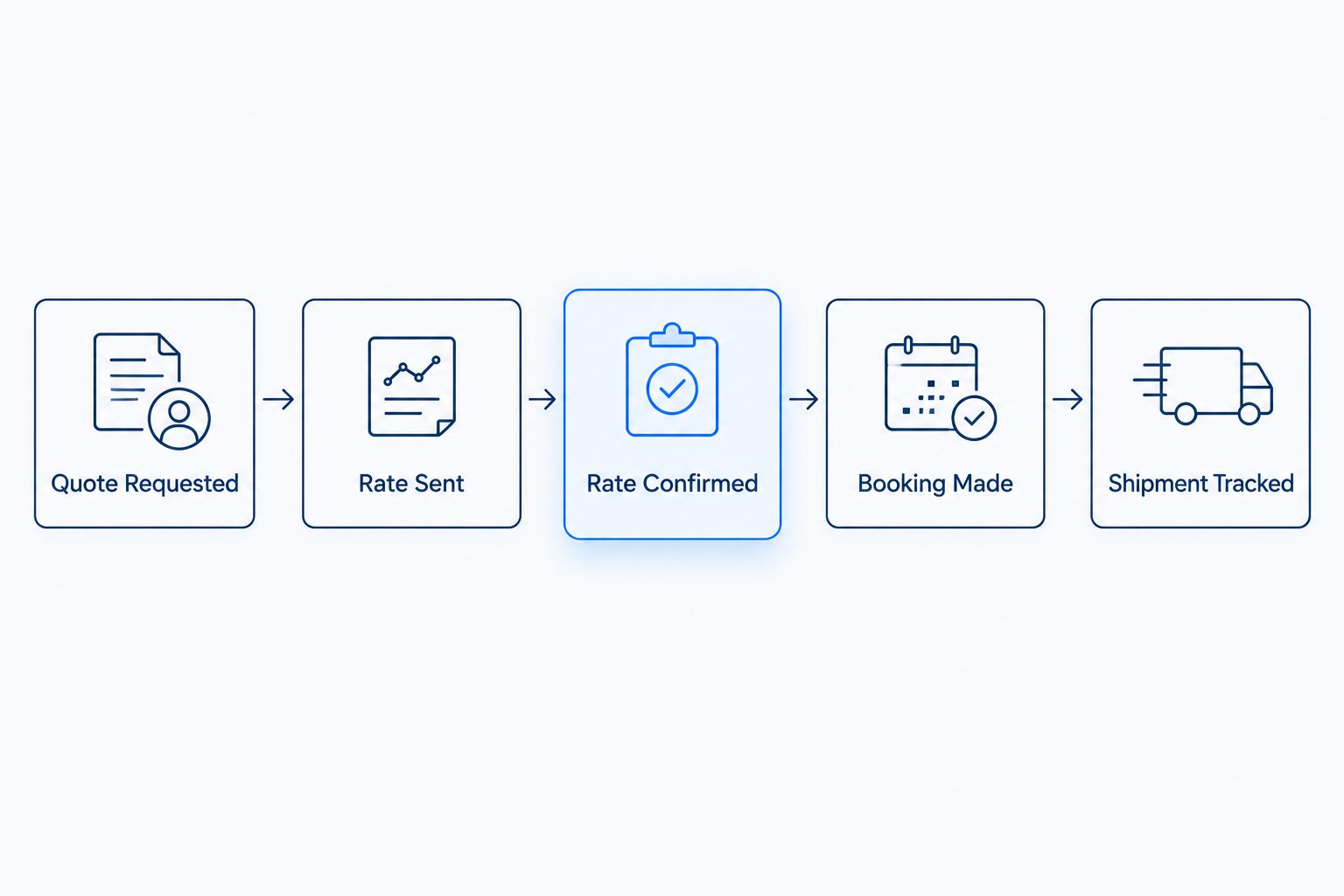
- List every stage from first inquiry to invoiced shipment: Quote Requested, Rate Sent, Rate Confirmed, Booking Made, Shipment Tracked, Invoiced
- Note which stages are usually fast (rate sent same day) versus slow (rate confirmed after a week of back-and-forth)
- Flag stages where deals commonly die — most freight pipelines lose the most volume between "Rate Sent" and "Rate Confirmed"
- Assign an owner per stage, not just per deal, so handoffs between sales and ops don't get lost
Centralize shipper, forwarder, and carrier contacts
A freight company usually has three contact types in play on a single deal — the shipper who requests the quote, the consignee on the other end, and sometimes a partner carrier or customs broker. Keeping these separate from the start prevents duplicate records and lost history.
- Import existing shipper and carrier lists from spreadsheets or your accounting system as a one-time cleanup, not an ongoing habit
- Tag contacts by role (shipper, broker, carrier) so reporting can separate demand-side leads from supply-side partners
- Merge duplicate company records before go-live — freight databases accumulate duplicates fast because the same shipper calls in under different branch names
- Set a rule that no new contact gets created without a linked company record
This is also the point where a manual CRM setup starts costing real hours — cleaning and structuring a freight contact list by hand commonly takes longer than the actual software rollout. VadeCom's CRM integration for B2B companies in Egypt service handles this migration and stage-mapping work as part of a $800/month retainer (40,000 EGP in Egypt-based engagements), which is the faster path once the manual cleanup starts eating into a sales manager's week.
Connect your CRM to every lead source you run
A freight and logistics company in 2026 usually pulls leads from a website quote form, Google Ads search campaigns, LinkedIn outreach, and inbound WhatsApp messages. If any of those sources isn't wired into the CRM, that lead volume is invisible to reporting.
- Route website quote-request forms directly into the CRM as a new deal, not an email notification someone has to re-enter manually
- Sync Google Ads lead form submissions using native integrations or a connector — see how to integrate a CRM with Google Ads for B2B sales teams for the setup steps
- Log inbound calls automatically if your phone system supports it, so a rate request over the phone isn't lost to memory
- Tag every new deal with its source at creation — this is the only way to know later which channel actually produces booked freight, not just quote requests
Automate follow-up on rate requests
Freight buyers typically request rates from three or four providers at once. The company that follows up fastest and most consistently wins a disproportionate share of that comparison shopping — this is a structural feature of freight buying, not a marketing trick.
- Set an automated reminder if a quoted deal has had no activity in 48 hours
- Build a short follow-up sequence (email or WhatsApp) that fires automatically after a quote is sent
- Escalate stalled high-value deals to a sales manager after a set number of days with no response
- Track average time-to-first-response as a team KPI, not just win rate
Integrate CRM with WhatsApp Business for booking confirmations
In Egypt, Saudi Arabia, and the UAE, WhatsApp is often the primary channel shippers use to confirm bookings and send documentation — not email. A CRM that doesn't capture WhatsApp activity is missing a large share of the real deal history.
- Connect WhatsApp Business API to the CRM so messages log against the correct deal record
- Use templated booking-confirmation messages that automatically update the deal stage
- Keep document exchange (bills of lading, packing lists) linked to the deal, not scattered across personal phones
Track win rate by trade lane, not just by rep
Freight margins vary enormously by lane. A CRM that only reports win rate per salesperson hides which routes are actually profitable to chase with marketing spend.
- Tag every deal with origin and destination lane at creation
- Report win rate and average deal value segmented by lane every month
- Cross-reference lane performance against ad spend by campaign to see which routes justify continued Google Ads or LinkedIn investment
Report cost per qualified lead back to the pipeline
A CRM only proves its value once it's connected to spend. Without that link, freight and logistics companies keep measuring marketing by click volume instead of booked shipments.
- Tag each CRM deal with its originating campaign
- Calculate cost per qualified lead by dividing monthly ad spend by CRM-logged qualified deals, not raw form fills
- Review this monthly alongside sales — a freight company running Google Ads without this loop typically can't tell which campaigns to cut
Comparing CRM options for freight and logistics companies
| Option | Best for | Key strength | Verdict |
|---|---|---|---|
| HubSpot | Small to mid-size freight teams standardizing their first real pipeline | Native marketing-and-sales connection, easier for non-technical staff to run | Buy for teams under 20 reps |
| Zoho CRM | Freight companies in Egypt and the Gulf wanting Arabic-language support | Lower setup complexity, wide third-party integration marketplace | Buy for bilingual teams |
| Odoo CRM | Forwarders that already run Odoo for accounting or inventory | Sits inside the same platform as ops and finance modules | Consider if already on Odoo |
| Salesforce | Large multi-country forwarders with dedicated CRM administrators | Deepest customization and reporting depth | Skip unless you have a dedicated admin |
| Pipedrive | Small teams that need visual pipeline tracking with minimal setup | Fast to deploy, simple stage-based view | Consider for teams under 10 reps |
Every option on this table does the job of holding deal records. None of them fixes a freight company's pipeline by itself — the CRM tools for B2B sales teams in the Gulf comparison covers the broader B2B evaluation criteria if freight isn't your only vertical.
Common mistakes freight and logistics companies make
- Buying the CRM before mapping the pipeline. Freight teams that install software first and configure stages later end up with a generic sales pipeline that doesn't match how a quote actually moves through their business.
- Leaving WhatsApp confirmations off the record. Booking activity that happens over WhatsApp but never gets logged in the CRM creates a deal history with gaps a manager can't audit.
- Reporting win rate by rep only. Without lane-level segmentation, a freight company can't see that one route is bleeding margin while another is underpriced relative to demand.
- Never connecting ad spend to the CRM. Google Ads and LinkedIn campaigns keep running on click and form-fill metrics because nobody linked the CRM's qualified-deal data back to campaign cost.
- Treating repeat shippers like new leads. A shipper who books once and returns three months later often gets logged as a brand-new inquiry instead of a returning account, which hides the real value of retention.
FAQ
What is the best CRM for freight and logistics companies in 2026?
There is no single best CRM for every freight company — HubSpot suits small to mid-size teams standardizing their first pipeline, Zoho CRM fits bilingual Egypt and Gulf teams, and Odoo works well for forwarders already running Odoo for accounting. Salesforce only makes sense for large multi-country operations with a dedicated administrator.
Is CRM integration different for freight companies than other B2B industries?
Yes. Freight deals move through more stages and stakeholders than a typical B2B sale — shipper, carrier, sometimes a customs broker — so the pipeline needs stages like Rate Sent and Rate Confirmed rather than a generic Lead-to-Won flow.
How much does CRM integration cost for a freight company?
VadeCom’s CRM integration service for B2B companies starts at $800/month, priced as 40,000 EGP for Egypt-based engagements and 3,000 SAR for Saudi Arabia-based engagements in 2026. Third-party CRM software licensing is priced separately by the vendor.
Should a freight company use WhatsApp Business with its CRM?
Yes, if shippers in Egypt, Saudi Arabia, or the UAE commonly confirm bookings over WhatsApp. Connecting WhatsApp Business to the CRM keeps that confirmation activity on the deal record instead of scattered across personal phones.
Can a small freight forwarder skip a CRM and use spreadsheets?
A spreadsheet works only until deal volume or team size grows past what one person can track by memory. Most freight teams outgrow spreadsheets once they’re quoting more than a handful of active shippers per week.
How does a CRM help lower cost per qualified lead for freight companies?
A CRM tags every deal with its originating campaign, so cost per qualified lead can be calculated from actual booked or qualified deals instead of raw form fills, which shows which ad campaigns to keep and which to cut.
Does a freight and logistics CRM need to track cargo, not just contacts?
No — a CRM tracks the sales relationship, not the shipment itself. Cargo tracking belongs in a transportation management system (TMS); the CRM’s job is quote, follow-up, and booking history tied to the shipper relationship.
One last thing
The freight companies that get the most out of a CRM in 2026 aren't the ones with the most expensive software — they're the ones that tagged every deal by trade lane from day one. Lane-level reporting is the single field most freight CRMs launch without, and it's the field that eventually tells a company which routes to keep marketing and which to stop chasing.


