
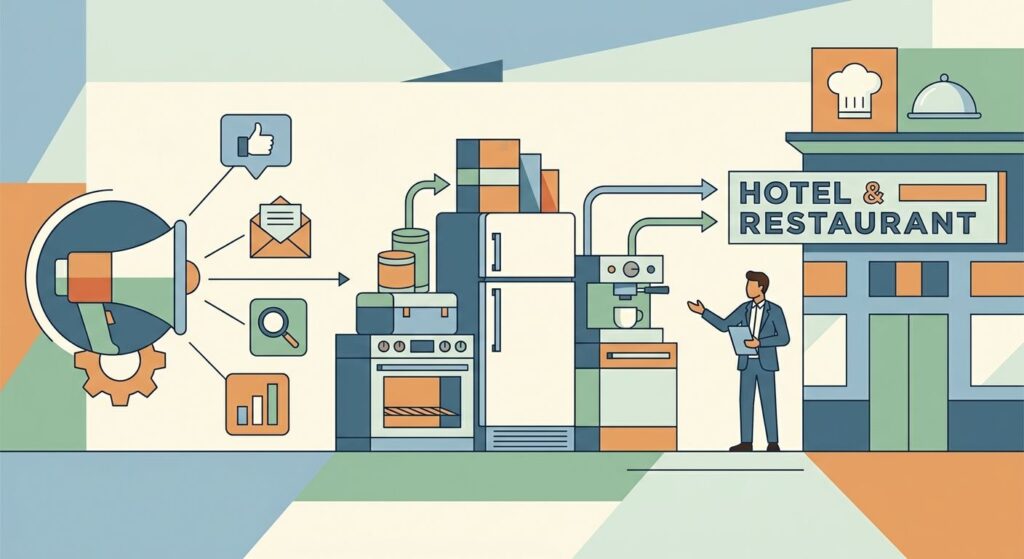
Hospitality equipment suppliers sell into hotels, restaurant chains, and catering operators who buy on specs, not impulse — and most of their marketing still looks like it's aimed at consumers. This guide breaks down what actually moves procurement committees in 2026 and which channels deserve budget.
- Marketing for hospitality equipment suppliers wins on LinkedIn ABM and technical SEO, not trade shows alone — Buy both.
- Google Ads paired with server-side tracking recovers leads lost to iOS privacy changes and ad blockers — Buy.
- CRM integration ties quotes to closed deals across 90-180 day sales cycles — Buy, but budget setup time.
- Trade-show-only marketing without digital follow-up stalls procurement-committee deals — Skip as a standalone channel.
Table of Contents
ToggleWhy This Matters
A hotel chain buying commercial dishwashers, minibars, or laundry systems does not click an ad and check out. The purchase goes through a facilities manager, a procurement officer, and sometimes a finance sign-off — a cycle that runs 90 to 180 days in Egypt and the Gulf. Marketing for hospitality equipment suppliers has to survive that whole chain, not just win a click.
The suppliers that win in 2026 treat marketing as a system: paid acquisition, CRM tracking, and content that speaks to specs and durability, not lifestyle. Suppliers of HVAC and industrial equipment face nearly identical buying committees, and the same system transfers with minor adjustments for product category.
Who This Is For
This is for B2B suppliers and distributors selling commercial kitchen equipment, laundry systems, HVAC units, minibars, or hotel FF&E to hotel groups, restaurant chains, and catering companies across Egypt, Saudi Arabia, the UAE, Oman, and Iraq. If your sales cycle involves a quote, a site visit, and a procurement sign-off — this applies to you. If you sell single units to walk-in retail buyers, it does not.
What to Look For in Marketing for Hospitality Equipment Suppliers
Spec-Driven Buyer Journeys
Facilities managers search for capacity, voltage, warranty terms, and certification — not brand slogans. Content and ad copy that leads with specs converts better than lifestyle imagery because the buyer is comparing three vendors against a checklist, not browsing.
Long, Multi-Stakeholder Sales Cycles
A single lead form does not close a deal that involves a facilities manager, a general manager, and a finance controller. Marketing has to nurture all three separately, which means CRM segmentation matters as much as the first click.
Trade Show and Distributor Dependency
Most hospitality equipment suppliers still lean on trade shows like HOSPITALITY QATAR or HORECA Egypt for pipeline. That works for brand visibility but leaves no digital trail — no retargeting list, no email sequence, nothing that survives past the show floor.
Regional Compliance and Import Documentation
Buyers in Saudi Arabia and the UAE often ask about SASO or Gulf conformity marks before they ask about price. Landing pages and sales collateral that skip this signal weaker credibility to a technical buyer.
CRM and Quote-to-Cash Integration
If a quote sent from your ERP does not sync back to the CRM record that generated the lead, you cannot calculate cost per qualified lead — you're guessing. This is the single biggest gap in supplier marketing stacks reviewed across Egypt and the Gulf in 2026.
Multilingual Content for GCC and Egypt Buyers
A procurement officer in Riyadh and a facilities manager in Cairo do not read the same way. Arabic-first content for Saudi and Gulf buyers, paired with English technical spec sheets, covers both without diluting either.
The Channel Picks
LinkedIn ABM for Procurement Committees — the precision pick
Hotel groups and F&B chains rarely convert from cold search traffic; the buyer pool is small and identifiable by job title and company. Account-based campaigns targeting named lists of facilities directors and procurement leads outperform broad LinkedIn prospecting for this category. Setup follows the same framework used to set up LinkedIn ads for B2B lead generation. Verdict: Buy.
Google Ads with Server-Side Tracking — the volume pick
Google Ads still delivers volume for spec-search terms like "commercial dishwasher supplier UAE," but iOS privacy changes and browser ad blockers strip conversion data before it reaches the ad platform. Server-side tracking through tools like Stape.io and Facebook CAPI closes that gap by sending conversion events directly from your server. The setup mirrors server-side tracking for B2B ad campaigns. Verdict: Buy.
Technical SEO for Spec Searches — the compounding pick
Searches like "commercial laundry equipment for 200-room hotel" take three to six months to rank but keep generating leads without added spend once they hold position. This pick is slow to start and cheap to sustain — the opposite economics of paid channels. Verdict: Buy, if you can wait out the ramp.
CRM Integration and Quote-to-Cash Alignment — the pipeline pick
Without CRM integration, a supplier cannot tell which channel produced the deal that closed six months after the first click. A basic HubSpot or Zoho setup synced to your quoting system fixes this in under a month. Retainers for a full marketing system built this way start around $800/month (40,000 EGP in Egypt, 3,000 SAR in Saudi Arabia). Verdict: Buy.
Trade-Show-Only Marketing — the legacy pick
Trade shows still generate real conversations, but without a retargeting pixel and a follow-up sequence, most of those conversations die within 30 days. As a standalone channel with no digital layer behind it, this leaks pipeline. Verdict: Skip as a standalone strategy — pair it with retargeting or drop it.
Build a marketing system for your equipment brand
CRM-integrated campaigns for hospitality equipment suppliers across Egypt and the Gulf.
What to Avoid
- Lifestyle-only creative. Glossy hotel-lobby imagery without a spec sheet link loses the facilities manager comparing three vendors on a checklist.
- Agencies selling reach over pipeline. Impressions and follower counts don't answer the only question a supplier's CFO asks: cost per qualified lead.
- One-language campaigns for a multi-country market. Running only English creative into Saudi Arabia or only Arabic into the UAE cuts the addressable buyer pool in half.
“If a supplier’s marketing plan does not include CRM integration, it does not have a marketing plan — it has a lead generation experiment.”
Verdict Comparison
| Channel | Best For | Time to Impact | Verdict |
|---|---|---|---|
| LinkedIn ABM | Named procurement accounts | 2-4 weeks | Buy |
| Google Ads + server-side tracking | Spec-search volume | 2-4 weeks | Buy |
| Technical SEO | Compounding organic pipeline | 3-6 months | Buy (patient capital) |
| CRM integration | Quote-to-close attribution | Under 30 days setup | Buy |
| Trade shows alone | Brand visibility | Immediate, short-lived | Skip standalone |
FAQ
What is the best marketing channel for hospitality equipment suppliers in 2026?
LinkedIn ABM and Google Ads with server-side tracking perform best for hospitality equipment suppliers in 2026 because the buyer pool is small, identifiable, and searches on specs. Technical SEO compounds over 3-6 months and reduces dependency on paid spend.
Is LinkedIn better than Google Ads for hospitality equipment suppliers?
LinkedIn wins for targeting named procurement and facilities decision-makers by job title, while Google Ads wins for capturing active spec-search demand. Most suppliers run both rather than choosing one.
How much does B2B marketing cost for a hospitality equipment supplier?
A full marketing system covering ads, CRM integration, and tracking typically starts around $800/month, or roughly 40,000 EGP in Egypt and 3,000 SAR in Saudi Arabia. Costs scale with ad spend and the number of markets covered.
Do trade shows still work for hospitality equipment suppliers?
Trade shows still generate conversations, but without retargeting and CRM follow-up most of those leads go cold within 30 days. Pair trade show attendance with a digital retargeting layer rather than relying on it alone.
How long does it take to see results from B2B marketing campaigns?
Paid channels like LinkedIn and Google Ads typically produce qualified leads within 2-4 weeks. Organic SEO takes 3-6 months to rank for competitive spec-search terms but sustains pipeline without continuous ad spend.
Why does CRM integration matter for equipment suppliers?
CRM integration connects the lead source to the closed deal, which is the only way to calculate true cost per qualified lead across a 90-180 day sales cycle. Without it, suppliers cannot tell which channel actually produced revenue.
Should hospitality equipment suppliers market in Arabic or English?
Both, split by market: Arabic-first content converts better with Saudi and Gulf procurement buyers, while English technical spec sheets serve Egypt and cross-border buyers. Running only one language cuts the addressable audience.
One Last Thing
Procurement teams at hotel groups increasingly cross-check vendors on LinkedIn before a site visit is scheduled — an incomplete or outdated LinkedIn Company Page can quietly remove a supplier from a shortlist before the sales team even hears about the deal. Keep it current with certifications, product categories, and recent project photos; it costs nothing and closes a gap most suppliers never notice.