


Best overall: HubSpot. Best for GCC teams on Zoho CRM: Zoho Campaigns. Best for bilingual Arabic/English nurture: Brevo. Five platforms handle B2B email well enough for companies selling into Egypt, Saudi Arabia, the UAE, Oman, and Iraq in 2026 — the real difference is which one talks to your CRM and which one runs Arabic and English in the same workflow without a plugin.
- HubSpot wins overall among the best email marketing platforms for B2B companies with native CRM sync and deal-stage automation.
- Zoho Campaigns is the pick for Gulf teams already running Zoho CRM across Saudi Arabia, the UAE, and Egypt.
- Brevo handles bilingual Arabic/English nurture sequences better than HubSpot or ActiveCampaign out of the box.
- ActiveCampaign has the deepest lead-scoring logic for long industrial and manufacturing sales cycles.
- Mailchimp works for a first newsletter but breaks down once a sales cycle runs past 90 days.
Why this matters
Related: Web Design Services — or see every industry we serve in B2B marketing.
A company selling valves, packaging equipment, or freight services into the Gulf runs sales cycles of 60 to 180 days, not a checkout flow. An email platform that can't show which deal stage a lead sits in — or can't run a B2B nurture sequence in both Arabic and English — turns into a newsletter tool instead of a pipeline system.
Most teams pick a platform based on the email editor and find out three months later that sales has no idea which leads opened what. Picking wrong costs a quarter of stalled follow-up before anyone notices the gap between marketing activity and pipeline movement.
What makes the best email marketing platform for B2B companies
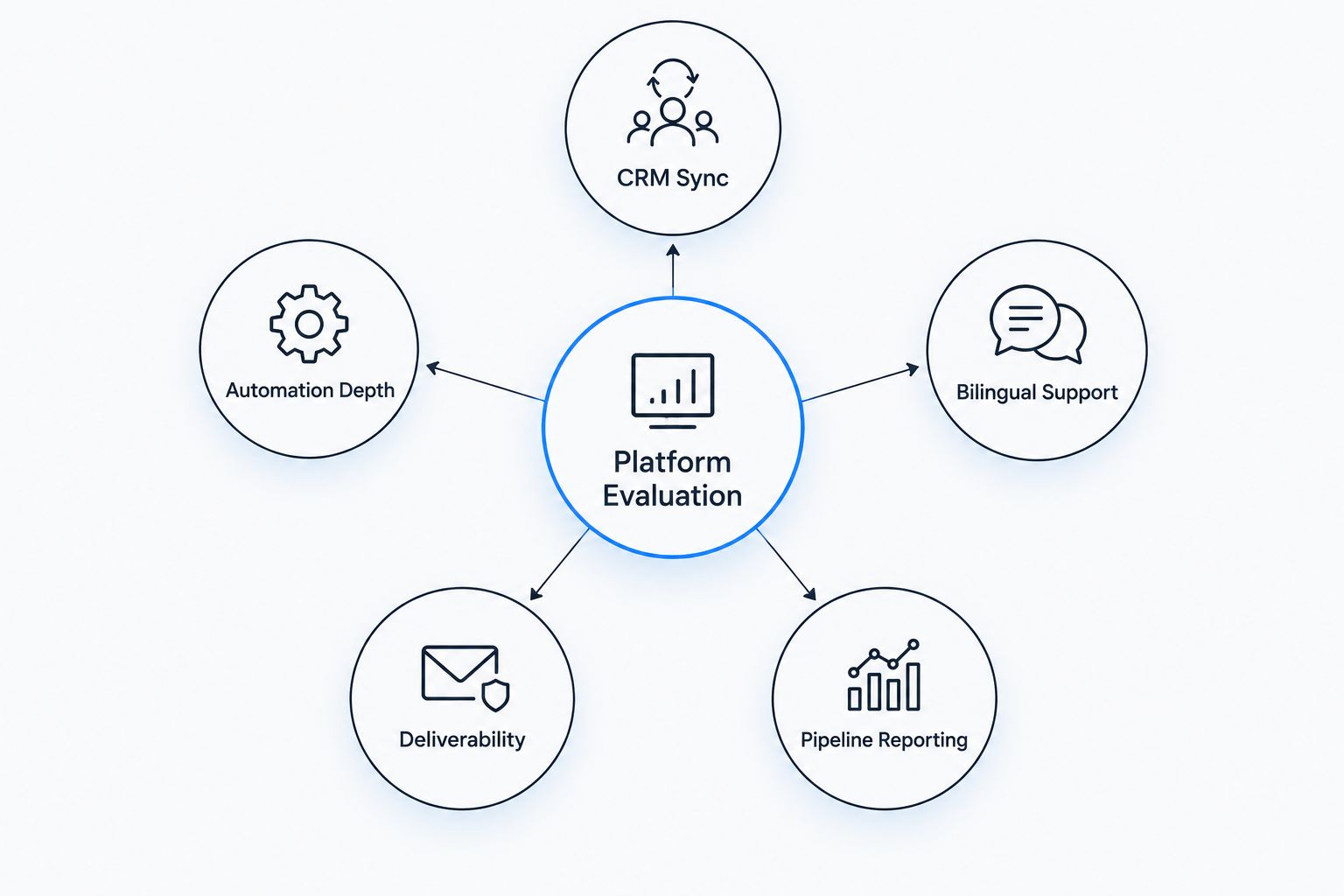
- CRM sync: activity writes back to the CRM record automatically, no manual export
- Automation depth: workflows branch on deal stage and behavior, not just opens and clicks
- Bilingual support: Arabic and English templates and sending domains in one workflow
- Deliverability infrastructure: SPF, DKIM, and DMARC alignment on the sending domain
- Pipeline reporting: revenue and deal-stage attribution, not just open rate
- GCC data handling: contact list management that fits multi-country GCC operations
Email marketing platforms for B2B companies in the Gulf at a glance
| Platform | Best for | Standout feature | Key limitation |
|---|---|---|---|
| HubSpot | CRM-integrated B2B pipelines | Native CRM with deal-stage triggers | Steep setup for small marketing teams |
| Zoho Campaigns | GCC teams on Zoho CRM | Direct sync with the CRM already running in most Gulf mid-market offices | Automation logic shallower than HubSpot or ActiveCampaign |
| ActiveCampaign | Automation-heavy lead nurturing | Deepest conditional workflow builder on this list | CRM is a bolt-on, not the core system |
| Brevo | Bilingual Arabic/English campaigns | Email and SMS from one sending infrastructure | Native CRM integrations limited on entry plans |
| Mailchimp | Lightweight outreach and simple newsletters | Fastest setup for a first campaign | No real deal-stage automation |
1. HubSpot: best email marketing platform for CRM-integrated B2B pipelines
HubSpot's Marketing Hub runs email sequences off the same record as its CRM, so a lead who opens three emails and clicks a pricing page updates its own deal stage automatically. That matters most for exporters and manufacturers running six-month sales cycles across Egypt and Saudi Arabia, where a lead can go quiet for weeks between site visits.
HubSpot pros:
- Native CRM means no export step between marketing and sales
- Workflow builder branches on deal stage, not just email opens
- Reporting attributes revenue to a campaign, not just click-through rate
HubSpot cons:
- Onboarding takes longer than a team without dedicated marketing ops can absorb
- Arabic-language interface support lags behind English feature releases
- Full automation and reporting depth sit behind higher plan tiers
Best for: companies with a marketing ops person and a CRM-dependent sales process. Verdict: Buy.
2. Zoho Campaigns: best email marketing platform for GCC teams already on Zoho CRM
Zoho Campaigns lives inside the same account as Zoho CRM, which is the system of record for a large share of mid-market trading and industrial companies across Saudi Arabia, the UAE, and Egypt in 2026. A sales rep sees opens and clicks directly on the contact record through CRM integration instead of a third-party connector.
Zoho Campaigns pros:
- Setup takes days, not weeks, for teams already on Zoho CRM
- Arabic UI and right-to-left email templates work without plugins
- Sits inside the same account structure as Zoho Books for finance-linked reporting
Zoho Campaigns cons:
- Automation branching is shallower than ActiveCampaign's workflow builder
- Multi-touch attribution reporting is thinner than HubSpot's revenue dashboards
- Fewer pre-built integrations outside the Zoho ecosystem
Best for: companies standardized on Zoho CRM across multiple GCC offices. Verdict: Buy.
3. ActiveCampaign: best email marketing platform for automation-heavy lead nurturing
ActiveCampaign's workflow builder handles conditional branching — if a contact downloads a spec sheet but doesn't request a quote within 14 days, the sequence routes them into a different nurture track automatically. That fits industrial buyers who research for months before a first call, a pattern common across Gulf procurement cycles in 2026.
ActiveCampaign pros:
- Conditional branching logic most competitors can't match
- Lead scoring flags sales-ready contacts before a rep checks manually
- Handles behavior-based segmentation without a separate automation tool
ActiveCampaign cons:
- CRM functionality is an add-on, not the platform's core strength
- No native Arabic interface; right-to-left templates need manual formatting
- Deliverability monitoring needs a separate tool for full visibility
Best for: teams running conditional, behavior-based nurture logic. Verdict: Buy.
4. Brevo: best email marketing platform for bilingual Arabic/English campaigns
Brevo sends email and SMS from the same infrastructure, useful for a Gulf company pairing an email nurture sequence with an SMS follow-up. Its template editor supports right-to-left Arabic layouts without a separate build, which is rare among platforms built primarily for English-language markets.
Brevo pros:
- Combines email and SMS sending in one dashboard
- Right-to-left Arabic template support closer to production-ready than most competitors
- Deliverability setup (dedicated IP options, authentication) is stronger than Mailchimp's at comparable volume
Brevo cons:
- Automation logic is simpler than ActiveCampaign's branching workflows
- Native CRM integrations are limited on entry-level plans
- Multi-touch attribution reporting trails HubSpot
Companies running Arabic and English side by side without a dedicated team to localize B2B marketing content for Arabic-speaking markets tend to land here first.
Best for: companies running parallel Arabic and English nurture campaigns. Verdict: Buy.
5. Mailchimp: best email marketing platform for lightweight outreach and simple newsletters
Mailchimp launches a first campaign in an afternoon, built for teams without a dedicated marketing ops function. It was designed for newsletter and transactional sending, not deal-stage nurture.
Mailchimp pros:
- Fastest platform on this list to get a first send out
- Template library covers most newsletter formats without custom design
- Low learning curve for a team with no prior email marketing experience
Mailchimp cons:
- No real deal-stage automation; segmentation stays list-based, not pipeline-based
- Lead scoring is basic compared to ActiveCampaign or HubSpot
- Weakest fit for a sales cycle running past 60 days
Best for: a company sending its first newsletter, not running pipeline-stage nurture. Verdict: Skip for serious B2B lead nurturing; Hold for early-stage use only.
“If a platform can’t show you which deal stage a lead sits in, it’s a newsletter tool, not a pipeline system.”
How we ranked
The order above weighs the same six criteria listed earlier: CRM sync, automation depth, bilingual support, deliverability infrastructure, pipeline reporting, and GCC data handling. HubSpot and Zoho Campaigns lead because they close the loop between marketing activity and CRM record without manual work — the gap most B2B teams in the Gulf actually lose leads in.
As a B2B marketing agency working across Egypt, Saudi Arabia, and the UAE, VadeCom typically checks CRM sync and deliverability configuration before touching open rate at all in a client audit. Open rate tells you almost nothing about pipeline health in 2026 if the platform can't attribute a reply to a deal.
Which email marketing platform should you choose?
Default to HubSpot if a marketing ops person already exists and the sales team runs off a CRM. Default to Zoho Campaigns if Zoho CRM is already the system of record — most mid-market industrial and trading companies across Saudi Arabia and the UAE fall here. Default to Brevo if Arabic and English campaigns need to run in parallel without a separate localization workflow. Default to ActiveCampaign for long, behavior-driven sales cycles with heavy lead scoring needs. Skip Mailchimp past the first 90 days of a B2B pipeline.
VadeCom bundles platform selection and nurture-sequence setup into its marketing retainer, starting at $800/month (40,000 EGP in Egypt, 3,000 SAR in Saudi Arabia), for companies that don't want to run this evaluation internally.
Build Your B2B Nurture Sequence
CRM-synced email sequences for long Gulf sales cycles.
FAQ
What’s the best email marketing platform for B2B companies in the Gulf in 2026?
HubSpot is the strongest overall pick for CRM-synced B2B pipelines in 2026. Zoho Campaigns wins for teams already standardized on Zoho CRM across Saudi Arabia, the UAE, and Egypt.
Is HubSpot better than Zoho Campaigns for GCC companies?
HubSpot has deeper automation and reporting, but Zoho Campaigns wins when a company already runs Zoho CRM. Switching CRM systems just to gain HubSpot’s email features rarely pays off.
Do these platforms support Arabic-language campaigns?
Brevo and Zoho Campaigns support right-to-left Arabic templates without plugins. HubSpot and ActiveCampaign need manual formatting work for Arabic layouts.
How does email marketing fit with Google Ads and LinkedIn Ads for B2B lead generation?
Email nurtures a lead after a Google Ads or LinkedIn Ads click converts on a landing page. Without CRM-synced email, that ad spend produces a form fill with no follow-up system behind it.
What email deliverability setup does a Gulf B2B company need in 2026?
SPF, DKIM, and DMARC records aligned on the sending domain matter more than which platform sends the email. Gmail and Outlook filter unauthenticated Gulf-based domains regardless of platform choice.
Can these platforms integrate with a CRM already in use?
HubSpot and Zoho Campaigns sync natively with their own CRMs. ActiveCampaign and Brevo connect to outside CRMs through integrations rather than a native record.
Is Mailchimp good enough for B2B lead nurturing?
Mailchimp works for a first newsletter but has no deal-stage automation. Past a 60-day sales cycle, it stops tracking where a lead sits in the pipeline.
How long does it take to launch a B2B email nurture sequence?
A basic nurture sequence with CRM sync typically launches in 3 to 5 weeks once the platform, templates, and deliverability setup are in place.
One last thing
None of the five platforms above fix a broken sender reputation. A Gulf-based sending domain with no DMARC record in 2026 gets filtered by Gmail and Outlook regardless of which platform sends the message — the platform choice matters less than the authentication setup underneath it.


